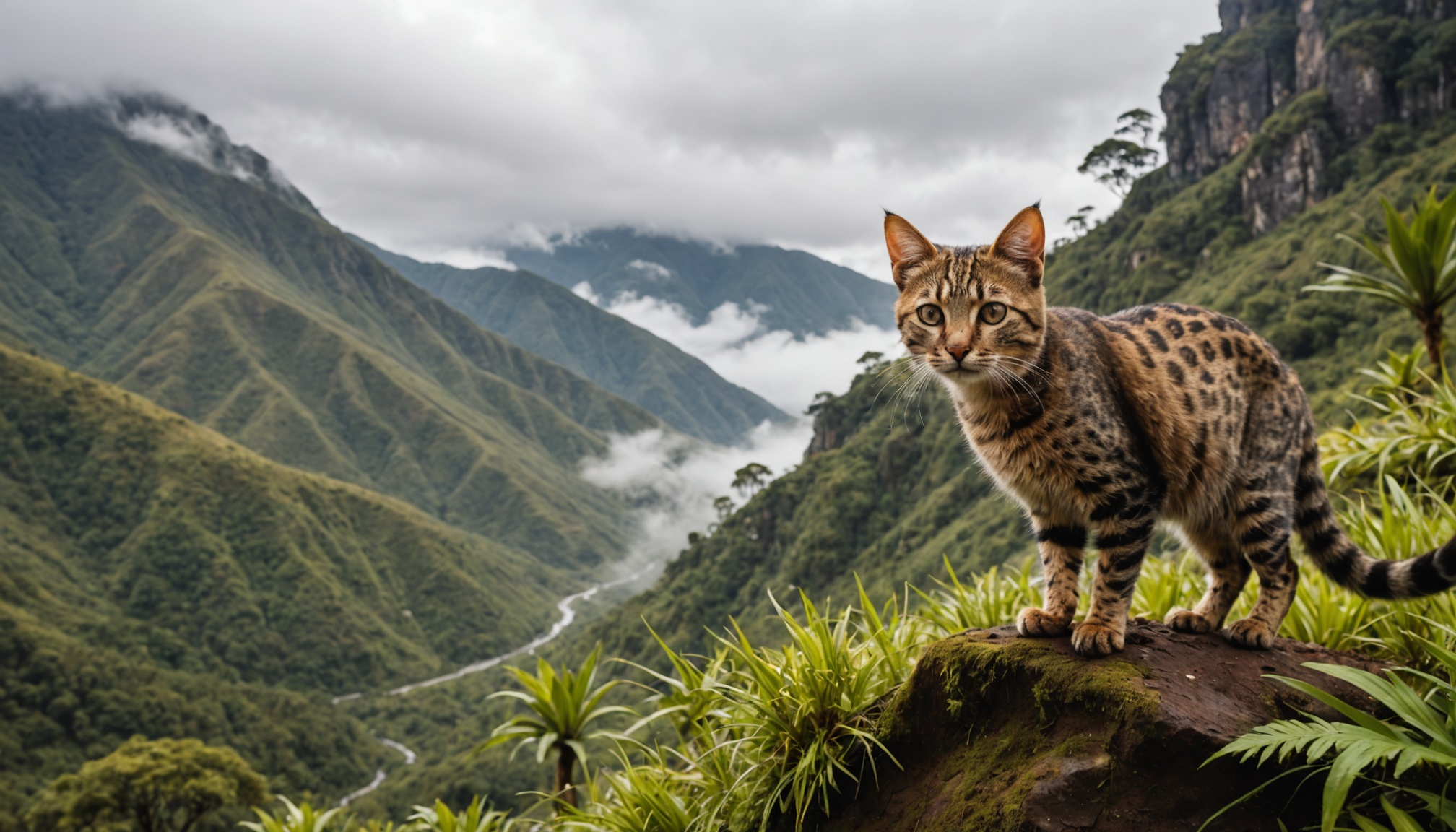
It took over a century for science to describe a completely unknown wild cat species once again. That's exactly what has happened with the tilcayo, a small spotted cat spotted in the Bolivian mountains, whose description has just been published in the journal Current Biology.
A species discovered in the Bolivian Yungas
Contents
It was in the mountainous Yungas region, in northeastern Bolivia, that a team of researchers identified this small spotted-coat feline. The animal measures about 45 centimeters in length, roughly the size of a domestic cat. Its name, tilcayo, comes directly from local residents, who had already been using the term to refer to the animal long before science took an interest in it. Researchers drew on this local name to officially christen the species Leopardus tilcayo.
After several years of field observations and genetic analysis, scientists confirmed that this cat is indeed a species in its own right, distinct from other small wild cats of South America such as the ocelot or Geoffroy's cat, with which it nonetheless shares certain physical traits.
Why this discovery is exceptional
No new wild cat species had been formally described anywhere in the world in nearly a century. The last one dated back to the early 20th century. In other words, the description of the tilcayo is a rare event for zoology, in a field where most major groups of terrestrial animals are considered already thoroughly cataloged.
This rarity is partly explained by the tilcayo's way of life: discreet, nocturnal, and confined to hard-to-reach terrain, it had until now slipped through the cracks of classification, partly because it could easily be mistaken for already known species in the absence of in-depth genetic studies.
A species already under threat
For now, the tilcayo has only been observed in Bolivia, making it an endemic species. Researchers already consider it threatened, due to the fragmentation of its mountain habitat and the pressure that human activity places on the areas where it lives. This situation is reminiscent of other cases of species weakened by the loss of their natural habitat, as illustrated, for example, by the fate of the western capercaillie in France, now protected in an effort to curb its decline.
More broadly, the discovery of the tilcayo comes at a time when South American ecosystems are facing growing climate pressures, a phenomenon that can be put into perspective alongside events such as the particularly intense El Niño episode observed recently, or the periods of drought affecting waterways, which illustrate just how much natural environments are under strain today around the world.
What this discovery actually changes
- It confirms that still poorly explored areas remain, even among large mammals, a group nonetheless considered the best-documented in the animal kingdom.
- It renews efforts toward targeted conservation in the Bolivian Yungas, a region of exceptional biodiversity that remains little protected.
- It highlights the decisive contribution of genetic analysis in distinguishing species that had previously been confused based on appearance alone.
Frequently Asked Questions
What is the tilcayo?
The tilcayo is a small wild cat with a spotted coat, recently described under the scientific name Leopardus tilcayo. It measures about 45 centimeters and lives in the mountainous areas of the Yungas, in Bolivia.
Why is this discovery so rare?
Because no new wild cat species had been formally described anywhere in the world in nearly a century. Most large terrestrial mammals are now considered to have already been cataloged by science.
Is the tilcayo endangered?
Yes. Researchers already consider it a threatened species, due to the fragmentation of its natural habitat and growing human pressure on the mountainous areas where it lives.
Sources
Author Profile
Latest entries
 Finance20 November 2026Consumer Credit: Mini-Loans, Split Payments, and Overdrafts Face Tighter Rules
 Planet15 November 2026CO2 Emissions: Why Transportation Remains France's Climate Blind Spot
 Artificial Intelligence12 November 2026Imagine Enterprise: IBM and Microsoft Team Up on AI Agents for Large Businesses
 Economy11 November 2026Livret A Rate: Understanding How It's Calculated and Its Limits
This article was written with the help of artificial intelligence. Editorial policy