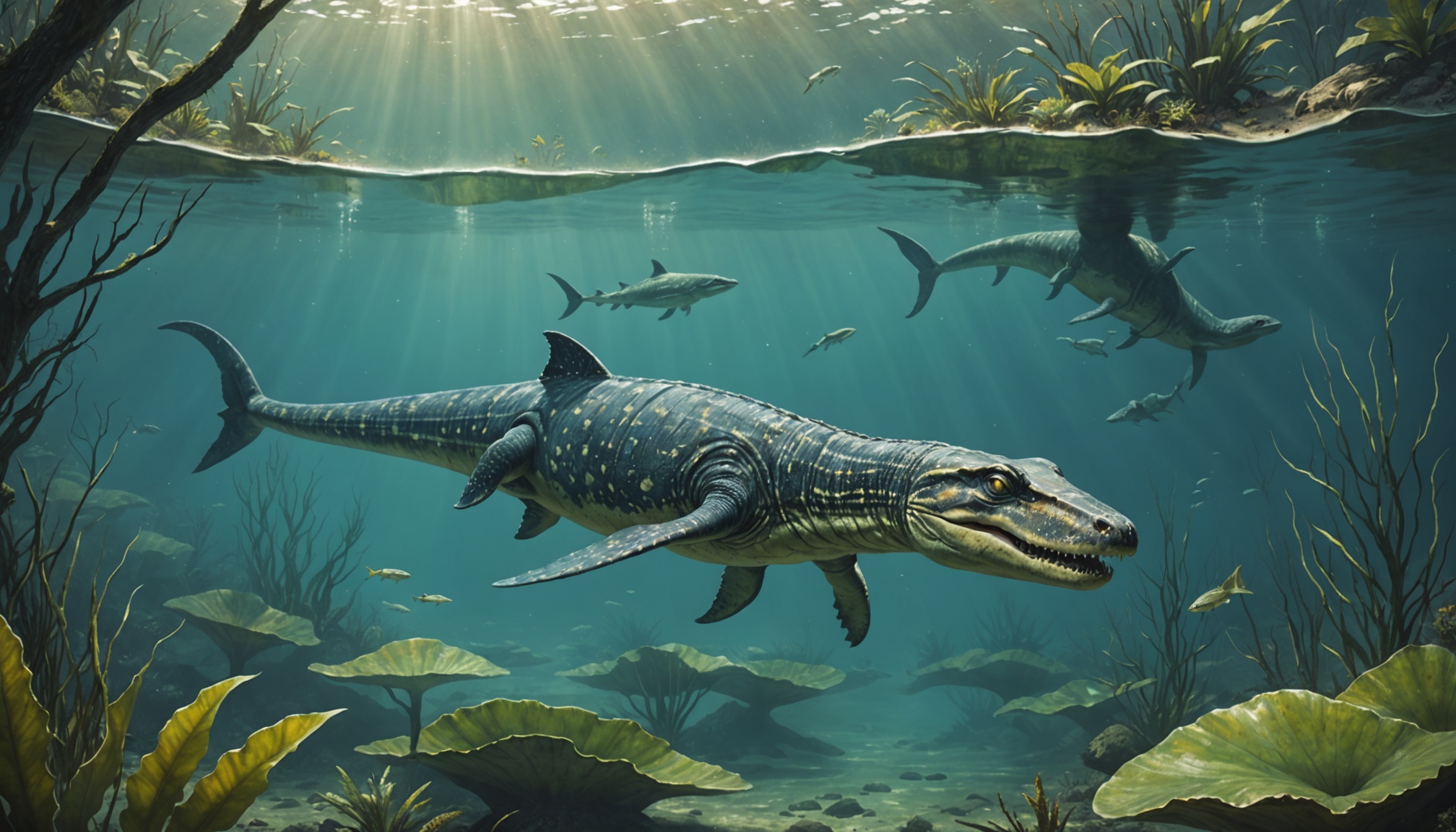
What if mosasaurs, those fearsome marine reptiles of the Cretaceous, hadn't all lived in the oceans? A team of French researchers has just described a previously unknown freshwater mosasaur, named Garamaudo bauciensis, whose bones had lain dormant for nearly thirty years in the collections of France's National Museum of Natural History (Muséum national d'Histoire naturelle). The discovery, made near Aix-en-Provence, forces a rethink of part of what we thought we knew about these great prehistoric predators.
An 85-Million-Year-Old Fossil, Unearthed… in 1997
Contents
The remains of this new species were actually unearthed in 1997, at the Bouc-Bel-Air – Sousquières site in the Bouches-du-Rhône department. It took nearly three decades and the painstaking work of two CNRS paleontologists, Nathalie Bardet (National Museum of Natural History) and Alexandra Houssaye (Mecadev), to identify what was actually hidden within these fragments of jaw, vertebrae, ribs, pelvis, and humerus. Analysis dates the animal to the Santonian, a period of the Late Cretaceous spanning roughly 84 to 85 million years ago.
About 2.5 meters long, this prehistoric predator belongs to the subfamily Tethysaurinae, a group of mosasaurs previously considered exclusively marine — just like the discoveries that regularly shake up the natural sciences.
Why This Discovery Upends Our View of Mosasaurs
What makes Garamaudo bauciensis so distinctive is its habitat: unlike its marine cousins with webbed flippers, it had limbs ending in digits, better suited to a lake environment than to the open sea. Its pelvis, firmly attached to the spine, and its long, flat ribs suggest a laterally flattened body, likely propelled by an undulating swimming motion similar to that of an eel.
This anatomy confirms that within the Tethysaurinae, several lineages independently colonized freshwater environments — a phenomenon of ecological niche partitioning already documented in other groups, as shown for example by the recent description of a previously unknown wild cat species in Bolivia. Mosasaurs, then, were not simply the marine giants we imagine: some adapted to lakes, far from the Cretaceous seas that at the time covered a large part of what is now Provence.
France: A Land Rich in Paleontological Surprises
This discovery adds to a series of recent French studies that are redrawing our understanding of the planet's distant past. CNRS teams are increasingly re-examining old collections in light of new imaging techniques — work that has, for example, made it possible to identify human ancestries that had remained invisible in our DNA or to better understand structures still poorly understood deep within Earth's mantle. These are all reminders that major scientific breakthroughs don't always come from unexplored ground, but often from a fresh look at fossils or data already collected.
For natural science enthusiasts, the latest news on this research can be found in the site's Science section, or in the Planet category for issues related to biodiversity and ecosystems.
What This Actually Changes
- The ecological diversity of mosasaurs is broader than previously thought: some lineages lived in freshwater, far from the oceans.
- Old museum collections still harbor undescribed species, sometimes for decades at a time.
- Garamaudo bauciensis provides new evidence supporting repeated colonization of lake habitats by several groups of Cretaceous marine reptiles.
- French paleontology, driven notably by the National Museum of Natural History and the CNRS, continues to produce internationally recognized advances.
Frequently Asked Questions
What Is a Mosasaur?
Mosasaurs were large marine reptiles that lived during the Cretaceous, roughly between 100 and 66 million years ago. Close relatives of modern snakes and monitor lizards, they ranked among the largest predators in the seas of that era.
Why Is Garamaudo bauciensis Considered Unique?
Because it is a mosasaur adapted to freshwater, with limbs ending in digits rather than flippers, whereas the vast majority of known species in this group lived exclusively in the sea.
Where Was This Fossil Found?
The bones were discovered in 1997 at the Bouc-Bel-Air – Sousquières site in the Bouches-du-Rhône department, near Aix-en-Provence, before being formally described by CNRS researchers.
Sources
ICI Provence-Alpes-Côte d'Azur —
Sciencepost —
Sci.News
Author Profile
Latest entries
 Finance20 November 2026Consumer Credit: Mini-Loans, Split Payments, and Overdrafts Face Tighter Rules
 Planet15 November 2026CO2 Emissions: Why Transportation Remains France's Climate Blind Spot
 Artificial Intelligence12 November 2026Imagine Enterprise: IBM and Microsoft Team Up on AI Agents for Large Businesses
 Economy11 November 2026Livret A Rate: Understanding How It's Calculated and Its Limits
This article was written with the help of artificial intelligence. Editorial policy