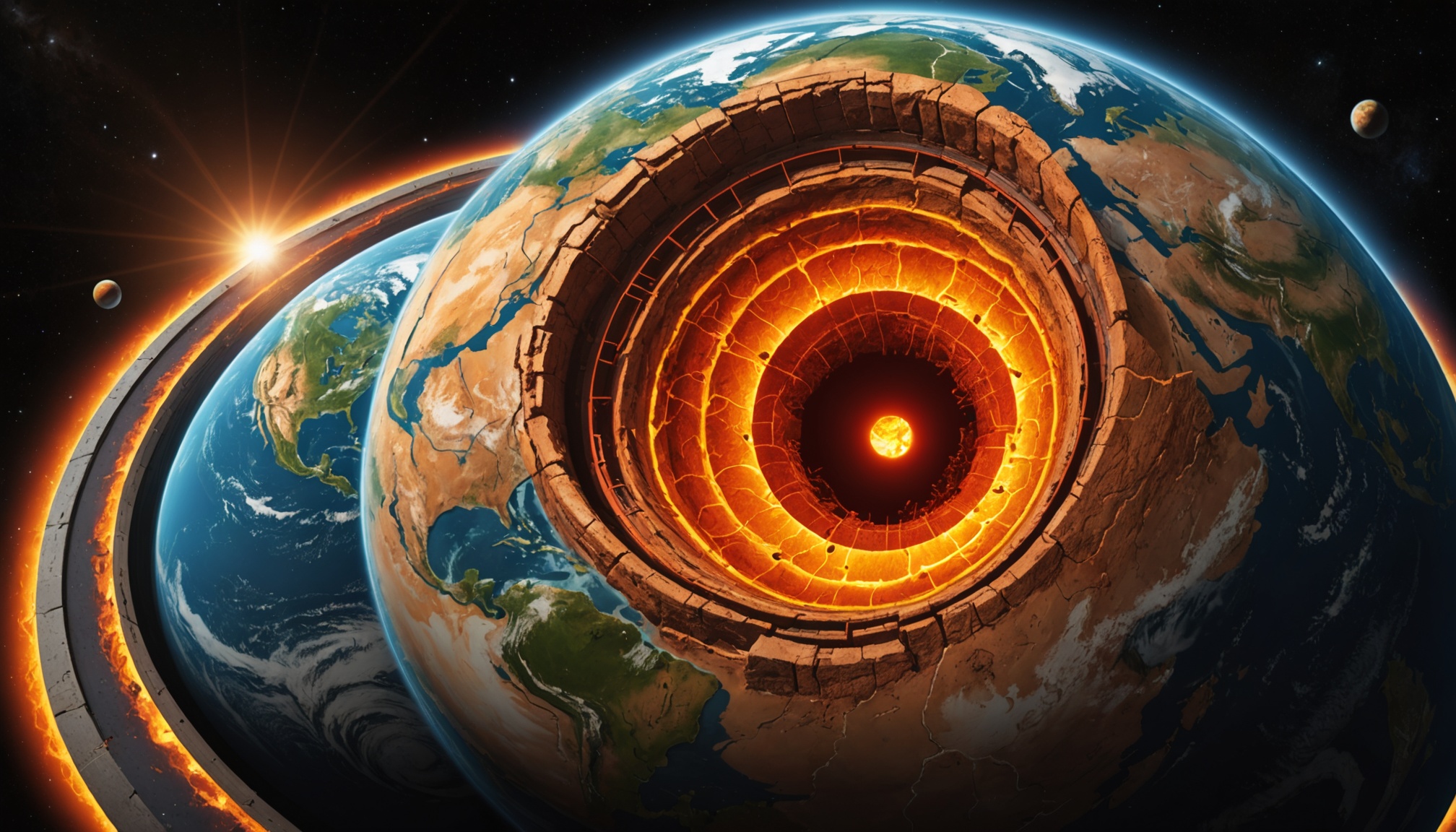
Nearly 2,900 kilometers beneath our feet, where the rocky mantle gives way to our planet's metallic core, researchers have identified six mysterious structures that had previously gone unnoticed. Published in early September 2026 in the journal Journal of Geophysical Research: Solid Earth, the study relies on artificial intelligence to scan seismic signals too faint to be analyzed by the naked eye.
A Boundary Seismology Has Explored for Decades
Contents
The boundary between Earth's core and mantle has long fascinated earth science specialists: it marks the transition between the solid mantle and the liquid outer core, at a depth no probe or drill will ever reach. To map it, scientists have only one tool at their disposal: the seismic waves generated by earthquakes, which travel through the entire planet and bend slightly as they cross zones of differing density or composition.
Among these signals, researchers are particularly interested in PKP precursors, faint waves that arrive a few seconds before the main seismic waves. Their presence reveals the existence of scattering zones at the core-mantle boundary. The problem is that they are faint, buried in noise, and until now had to be identified manually, earthquake by earthquake.
Deep Learning Sharpens the Map Tenfold
This is where the decisive contribution of this new study, led by researcher Yurui Guan and his team, comes in. By training a deep learning system on more than two million global seismic recordings spanning the period from 1990 to 2026, the team automated the detection of these fleeting signals. The result: 174,929 high-quality PKP precursors were isolated, nearly ten times more than all the data gathered by the scientific community until then. This methodological breakthrough shows just how much artificial intelligence is transforming fields that once seemed far removed from digital technology, from seismology to space exploration.
Six Regions Far Larger Than Previously Thought
By cross-referencing this massive amount of signals, researchers uncovered six continuous bands of anomalies at the core-mantle boundary, where previously only scattered, isolated points could be distinguished. These six zones are located beneath:
- the North Atlantic;
- northern Eurasia;
- the South Atlantic;
- southern Africa;
- the Pacific;
- Antarctica.
Each of these regions corresponds to an area where the deep structure of the mantle scatters seismic waves in an unusual way, a sign of a composition or texture different from the surrounding material.
What Is Hidden in These Deep Zones?
The study's authors offer an explanation: the lower mantle may be shaped by a complex mix of tectonic plates swallowed up by subduction millions of years ago, gradual chemical segregation, and localized melting zones. Some of the oldest oceanic crust may have thus ended its journey at the very bottom of the mantle, at the edge of the core, where it continues to influence the propagation of seismic waves. The researchers remain cautious: the maps obtained outline probable zones, not precise boundaries, and further measurement campaigns will be needed to refine the outlines of these structures.
This discovery is a reminder that our planet continues to reveal secrets, provided the right tools are combined: just as patient excavations recently uncovered remains buried for millennia in northern France, here it is decades of seismic recordings that have just been reread in a new light.
Why This Discovery Matters
Understanding the structure of the deep mantle isn't mere idle curiosity: these zones influence how heat rises from the core, partly fueling surface volcanism and, over the very long term, the dynamics of plate tectonics. They also offer a snapshot of Earth's geological history, somewhat like other recent studies have managed to read, in the way snake embryos coil, mechanisms inherited from millions of years of evolution. On a methodological level, this breakthrough also confirms that AI is establishing itself as an essential tool for exploring what remains, by nature, inaccessible to the human eye — a question already raised by a recent article on the theoretical limits of artificial intelligence.
More broadly, this study is part of a larger trend in which the exploration of our planet benefits from the same tools as astronomy: NASA's recent Roman Space Telescope, designed to track tens of thousands of exoplanets, and this seismic map of Earth's mantle ultimately share the same ambition: to see farther, and in finer detail, through computation.
Frequently Asked Questions
How deep are these structures located?
They are located about 2,900 kilometers below the surface, at the boundary between Earth's rocky mantle and liquid outer core.
How did researchers detect these structures?
By training a deep learning system to identify, among more than two million seismic recordings, faint signals called PKP precursors, which reveal scattering zones at the core-mantle boundary.
Where might these six anomalous regions come from?
According to the study's authors, they likely result from a mix of ancient tectonic plates swallowed by subduction, chemical segregation, and localized melting zones in the deep mantle.
Sources
- Phys.org — Six unusual structures identified at Earth's core-mantle boundary with the help of deep learning
- Futura-Sciences — An AI reveals six mysterious structures hidden at the gates of Earth's core
- Yahoo News — Six Never-Before-Seen Mystery Structures Found Lurking Deep Inside The Earth
Author Profile
Latest entries
 Finance20 November 2026Consumer Credit: Mini-Loans, Split Payments, and Overdrafts Face Tighter Rules
 Planet15 November 2026CO2 Emissions: Why Transportation Remains France's Climate Blind Spot
 Artificial Intelligence12 November 2026Imagine Enterprise: IBM and Microsoft Team Up on AI Agents for Large Businesses
 Economy11 November 2026Livret A Rate: Understanding How It's Calculated and Its Limits
This article was written with the help of artificial intelligence. Editorial policy