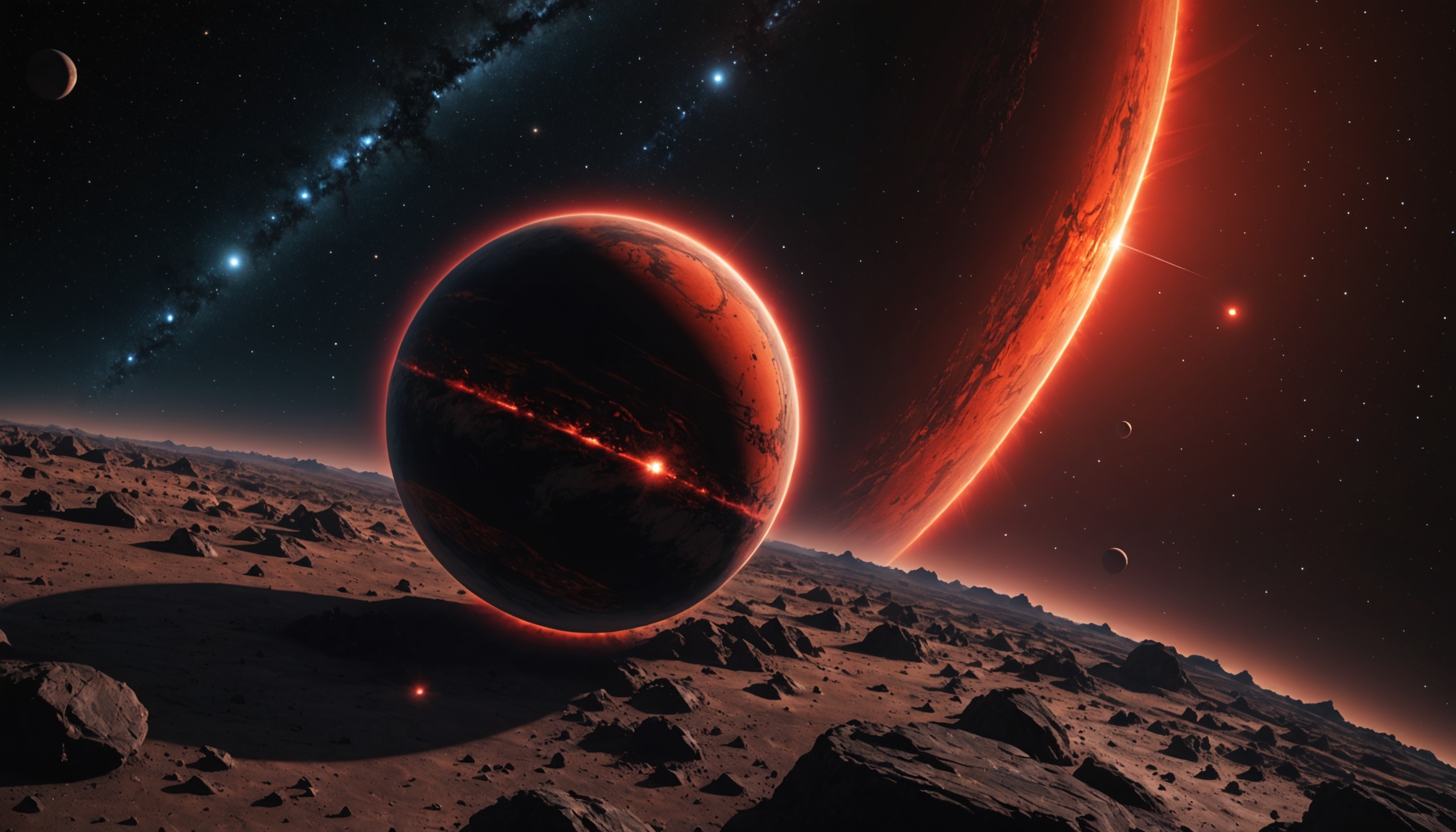
For the first time, astronomers have observational proof that a rocky exoplanet located in the habitable zone of its star has an atmosphere. The planet in question, LHS 1140b, orbits a red dwarf star about 48 light-years from Earth. The announcement, published in mid-July 2026 in the journal Science, marks a milestone that has been awaited for decades in the search for worlds potentially suitable for life.
An Atmosphere Revealed by Escaping Helium
Contents
The signal comes neither from a photograph nor a flyby, but from an indirect method. When LHS 1140b passes in front of its star — a transit observed in September 2024 — some of the starlight travels through the layers of gas surrounding the planet. By analyzing this filtered light with the WINERED spectrograph, installed on the Magellan Clay Telescope at Las Campanas Observatory in Chile, researchers spotted the signature of helium escaping from the planet's upper atmosphere.
This detail changes everything: a gas leaking into space can only be detected if a gaseous envelope exists in the first place. The helium leak thus becomes, paradoxically, proof that there is indeed an atmosphere to lose.
Why This First Mattered So Much
For years, telescopes have been able to spot rocky planets well positioned around their star. The real sticking point lay elsewhere: can these worlds actually hold on to an atmosphere? Around red dwarfs, which are highly active, radiation can literally strip a planet of its gaseous envelope. Without an atmosphere, even a perfectly positioned rock remains a sterile desert.
- A super-Earth: LHS 1140b weighs about 5.6 times the mass of Earth, with enough gravity to hold onto gases.
- In the habitable zone: the region where temperatures would, in principle, allow liquid water on the surface.
- An ideal target: its relative proximity and regular transits make it a prime object for observation.
Habitable Zone Does Not Mean Inhabited
This is the essential nuance, often glossed over in headlines. Detecting an atmosphere is not the same as detecting life, or even water. Being in the habitable zone only means that temperatures could allow water to remain liquid: a necessary condition, not a sufficient one. The exact composition of this atmosphere, its thickness, and its stability remain to be established.
The confirmed facts are therefore limited to this: a helium signal, interpreted as an atmosphere in the process of escaping. Everything else — oceans, organic molecules, actual habitability — remains hypothetical and will need to be tested, without giving in to shortcuts.
What Comes Next Will Hinge on the James Webb Telescope
The coming years will be decisive. Teams plan to use the James Webb Space Telescope to search for water in LHS 1140b's atmosphere, over a timeframe of four to five years. If water vapor were confirmed there, it would be a sign of a stable atmosphere, able to endure despite the star's activity. Such a result would durably shape how astronomers choose the next targets to study.
This breakthrough illustrates the pace of discoveries in science and space observation. It also reminds us how much the study of other worlds, from our own planet to distant exoplanets, now relies on increasingly refined technological innovations.
Frequently Asked Questions
Is LHS 1140b habitable?
Nothing proves this at this stage. We know it has an atmosphere and sits within its star's habitable zone, but neither liquid water nor conditions favorable to life have been confirmed.
How do you detect an atmosphere 48 light-years away?
Through transit spectroscopy: when the planet passes in front of its star, the gases surrounding it leave an imprint on the starlight. In this case, it was the signature of helium that was spotted from a ground-based telescope in Chile.
What's the next step?
Observations with the James Webb Space Telescope, planned over several years, aiming to detect water and better characterize the composition of this atmosphere.
Sources
- Cité de l'espace — An Atmosphere Made of Helium Around the Exoplanet LHS 1140b
- Nature — Found: a rocky exoplanet with an atmosphere
- Sci.News — Potential Atmosphere Detected on Habitable-Zone Exoplanet LHS 1140b
Author Profile
Latest entries
 Food & Drink21 November 2026Beaujolais Nouveau: A Historically Low Harvest, Yet Sales Keep Climbing
 Finance20 November 2026Consumer Credit: Mini-Loans, Split Payments, and Overdrafts Face Tighter Rules
 Planet15 November 2026CO2 Emissions: Why Transportation Remains France's Climate Blind Spot
 Artificial Intelligence12 November 2026Imagine Enterprise: IBM and Microsoft Team Up on AI Agents for Large Businesses
This article was written with the help of artificial intelligence. Editorial policy