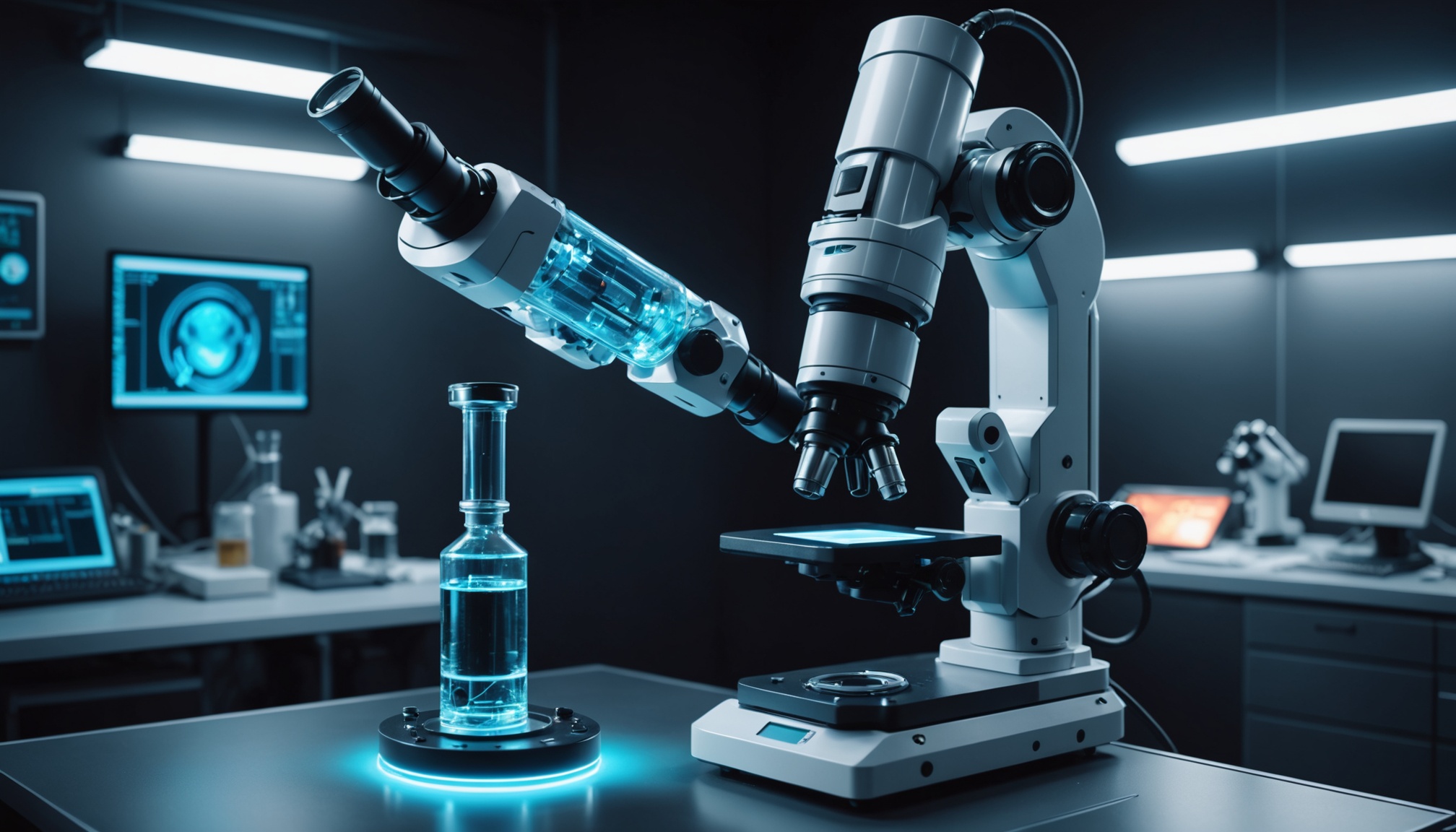
Until now, AI agents lived behind a screen: writing an email, generating code, responding to a customer. With the Model Hardware Standard (MHS), unveiled on August 27, 2026, Anthropic is taking a new step: giving its AI agents the ability to directly control physical devices, from research labs to industrial production lines.
What Is the Model Hardware Standard?
Contents
Anthropic describes MHS as “a shared specification for AI agents to operate safely on physical devices.” The principle mirrors that of the Model Context Protocol (MCP), which standardized how agents connect to software and data: each programmable device receives an “MHS driver” that translates its commands into simple primitives, such as “read the temperature” or “set the temperature.” The company's stated goal is to shrink the integration of new equipment from several weeks or months down to a few hours, or even minutes.
From Microscopes to Robotic Arms: The Intended Uses
The standard primarily targets scientific and industrial environments. According to Anthropic, it can already interface with:
- microscopes and analytical instruments;
- automated liquid handlers, centrifuges, and incubators;
- robotic arms and plate readers;
- more broadly, “any device with a programmable interface.”
In practice, an agent could oversee several instruments at once for drug-discovery experiments, or adjust a laser's calibration on a quantum computer in real time. It's an extension of the trend toward intelligent agents already underway in many fields, this time applied to the physical world.
A Partner Ecosystem Already Mobilized
Anthropic isn't going it alone. On the hardware side, MHS relies on partnerships with AWS (through its Strands Robots offering), Doosan Robotics, Universal Robots, Tecan, and QIAGEN. On the software side, Hugging Face is building the specification into its LeRobot library, and Raspberry Pi is preparing to integrate it into several of its products. Institutions such as Genentech, the University of Washington, Carnegie Mellon, the HHMI Janelia Research Campus, and QuEra Computing are already testing the standard under real-world conditions. AWS's involvement is notable: the cloud giant had, just this summer, announced the shutdown of Bedrock Agents Classic in favor of AgentCore, confirming its shift toward more autonomous, better-equipped agents.
Still a Research Preview, Under Human Oversight
Anthropic is careful to set expectations. For now, MHS is available only as a research preview, limited to select labs and manufacturers; an open-source release is planned, but only once safety evaluations are finalized. The company explicitly acknowledges that “Claude's physical reasoning remains limited,” that the standard “doesn't yet work with hardware that lacks a programming interface,” and that complex manipulations require expert supervision. This caution echoes a broader debate over agents' growing autonomy: after the episode in which OpenAI chose to slow development of its most autonomous models, several tech players have put shared safeguards in place, much like the system described in our article on the SAFE “black box” designed to trace AI agent mishaps.
Why This Bet Matters for Businesses
Beyond the lab, the stakes are economic. Hardware integration remains one of the main barriers to deploying AI agents at scale, a cost some investors are working to rein in: one startup raised $35 million to help companies control the cost of running agents in production. If MHS delivers on its promise of speed, it could accelerate adoption of AI agent tools across industry and research — provided the safety guarantees keep up.
Frequently Asked Questions
Is the Model Hardware Standard already available to everyone?
No. It is currently in research preview, limited to a small group of partner labs and manufacturers. Anthropic plans a later open-source release, once safety evaluations are finalized.
Does MHS only work with Anthropic's Claude models?
The standard is designed to be model-agnostic: it could theoretically be used by other AIs, provided their runtime environment supports the necessary protocols.
What types of devices can it control?
Any device with a programmable interface: microscopes, liquid handlers, robotic arms, centrifuges, automated incubators, or analytical instruments. It does not yet work with hardware that lacks such an interface.
Sources
- Anthropic — Previewing the Model Hardware Standard
- Usine Digitale — Avec MHS, Anthropic prépare le passage des agents d'IA du logiciel aux machines
- CNBC — Anthropic pushes into physical world with new standard to help AI agents operate machines
Author Profile
Latest entries
 Planet15 November 2026CO2 Emissions: Why Transportation Remains France's Climate Blind Spot
 Artificial Intelligence12 November 2026Imagine Enterprise: IBM and Microsoft Team Up on AI Agents for Large Businesses
 Economy11 November 2026Livret A Rate: Understanding How It's Calculated and Its Limits
 Shopping8 November 2026Black Friday: Key Dates and the Budget French Shoppers Are Planning
This article was written with the help of artificial intelligence. Editorial policy