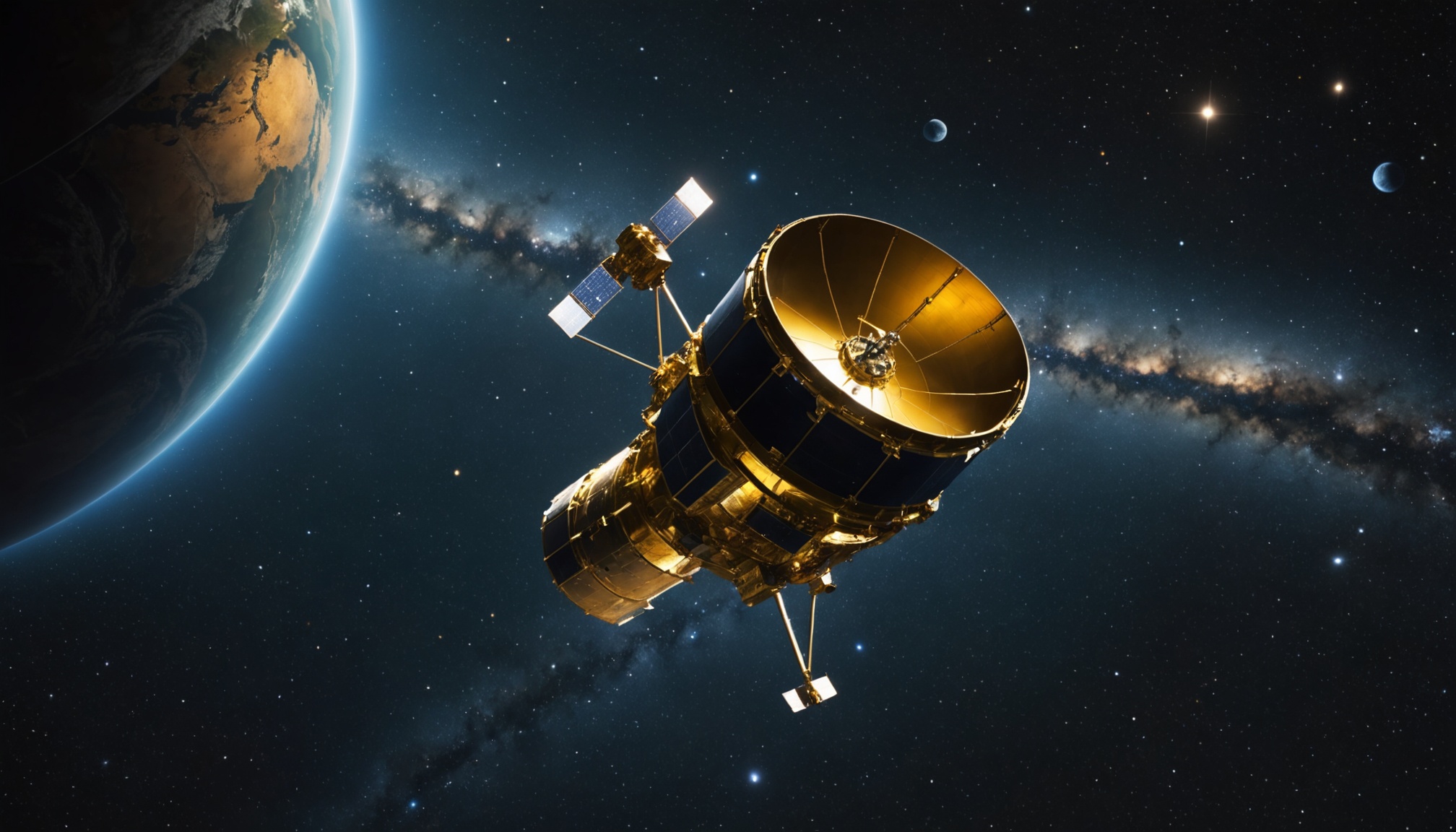
The countdown is almost over: NASA's Roman Space Telescope is set to lift off on August 30 from Kennedy Space Center in Florida, aboard a SpaceX Falcon Heavy rocket. Its mission? To map dark energy, probe dark matter, and above all hunt down up to 100,000 potential exoplanets, more than all the distant-world-hunting telescopes combined so far. That would make this observatory one of the most ambitious instruments ever sent into orbit.
A Tribute to the “Mother of Hubble”
Contents
The spacecraft is named after Nancy Grace Roman, NASA's first chief astronomer, whose persistent advocacy before the U.S. Congress in the 1970s secured funding for the Hubble Space Telescope. Nearly thirty years after Hubble's launch, the space agency is finally completing a project conceived as its direct successor. Teams completed their flight readiness review on August 21, before the spacecraft moved to its launch pad five days later. A final launch review, involving both NASA and SpaceX, is set to take place this Friday to confirm the August 30 launch window at 7:26 a.m. Florida time (around 1:26 p.m. in Paris), with a backup date set for the following day in case of delays.
A Mirror the Same Size as Hubble's, a Field of View 100 Times Wider
On paper, Roman doesn't revolutionize the size of its optics: its primary mirror measures 2.4 meters in diameter, exactly like Hubble's. The difference lies elsewhere, in its roughly 300-megapixel wide-field infrared camera, capable of photographing a patch of sky 100 times larger than its predecessor in a single shot, with comparable sharpness. It's the same family of rockets, from the same provider, that previously propelled a SpaceX rocket to deliberately crash into the Moon to study its internal composition. Once launched, Roman will travel to the L2 Lagrange point, about 1.5 million kilometers from Earth, where it will settle in, shielded from the Sun, to observe the universe for at least five years.
- Primary mirror: 2.4 meters (same as Hubble)
- Field of view: about 100 times wider than Hubble
- Final position: L2 Lagrange point, 1.5 million km from Earth
- Exoplanet goal: up to 100,000 new worlds cataloged
Hunting Hidden Worlds Through Gravitational Microlensing
To spot so many planets, Roman won't rely solely on direct observation of nearby stars. Most of its haul will come from a technique called gravitational microlensing: when one star passes exactly in front of another, more distant star, its gravity briefly bends and amplifies the light from the background star, revealing the presence of any orbiting planets in the process. This method has already proven itself on agentlink.org: it previously allowed astronomers to rediscover a giant planet hidden in old archival data. Roman is set to apply it on an unprecedented scale, continuously scanning hundreds of millions of stars at the center of our galaxy. An onboard coronagraph will also make it possible to directly image certain gas giants by blocking out the blinding light of their host star.
Unraveling the Mysteries of Dark Matter and Dark Energy
Beyond exoplanets, Roman's main purpose is to help us understand why the universe's expansion is accelerating and how dark matter, invisible yet omnipresent, has shaped the structure of galaxies. These questions remain among the most hotly debated in modern astrophysics, in line with what was recently illustrated by the discovery of a supermassive black hole that upends theories on galaxy formation. By observing millions of distant galaxies with unprecedented precision, researchers hope to refine current cosmological models, which are often challenged by observations that don't yet fit together perfectly. For more on this research, check out our other analyses in the Science section of the site.
A Flood of Data to Sort Through
With such a wide field of view and repeated surveys conducted over years, Roman will generate an unprecedented volume of data for an astrophysics mission. Spotting a handful of microlensing signals among millions of light curves is far beyond the scope of manual sorting: science teams are already relying on automated detection algorithms, an approach increasingly close to the artificial intelligence used elsewhere in other areas of tech. This technical challenge, as much as the optical achievement, is what makes this launch especially closely watched by the scientific community.
Frequently Asked Questions
When is the Roman Space Telescope set to launch?
The launch is scheduled for August 30 from Kennedy Space Center in Florida, aboard a SpaceX Falcon Heavy rocket, with a backup date the following day in case of a delay.
How does Roman differ from the Hubble Space Telescope?
Its primary mirror is the same size as Hubble's, but its infrared camera covers a field of view about 100 times wider while maintaining comparable sharpness, allowing it to photograph far more of the sky in a single shot.
How many exoplanets could Roman discover?
Thanks to the gravitational microlensing technique applied on a large scale, NASA estimates the mission could catalog up to 100,000 new exoplanets, in addition to directly imaging certain gas giants using its coronagraph.
Sources
NASA Science – Nancy Grace Roman Space Telescope
Space.com – Nancy Grace Roman Telescope live updates
CNES – Nancy Grace Roman
Author Profile
Latest entries
 Finance20 November 2026Consumer Credit: Mini-Loans, Split Payments, and Overdrafts Face Tighter Rules
 Planet15 November 2026CO2 Emissions: Why Transportation Remains France's Climate Blind Spot
 Artificial Intelligence12 November 2026Imagine Enterprise: IBM and Microsoft Team Up on AI Agents for Large Businesses
 Economy11 November 2026Livret A Rate: Understanding How It's Calculated and Its Limits
This article was written with the help of artificial intelligence. Editorial policy