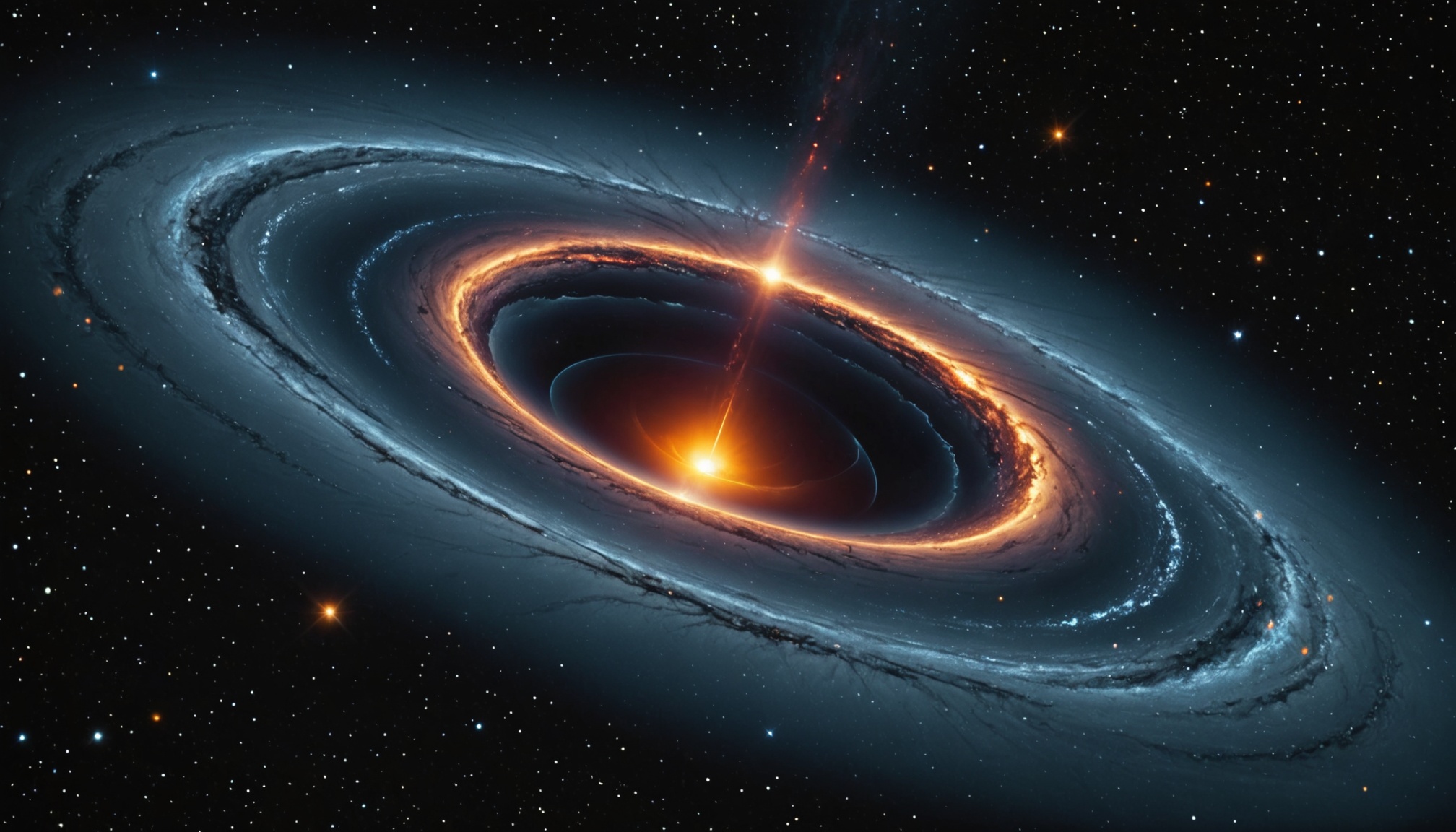
A supermassive black hole spotted by the James Webb Space Telescope has just upended a decades-old theory. Named Abell2744-QSO1, this celestial object appears to have formed before the galaxy that now hosts it, rather than after, as the classic scenario holds. An international team led by researchers from the University of Cambridge published this finding in the journal Monthly Notices of the Royal Astronomical Society, following an initial alert published in Nature.
An Object Observed 700 Million Years After the Big Bang
Contents
The supermassive black hole Abell2744-QSO1 already existed just 700 million years after the Big Bang, more than 13 billion light-years from Earth. Its mass is estimated at roughly 50 million times that of the Sun, while the surrounding region, its future host galaxy, measures only 1,300 light-years in diameter. For astrophysicists, this order of appearance is a problem: in the standard model, galaxies form first, then gradually attract and feed a central black hole.
Why This Discovery Worries Established Models
According to Roberto Maiolino, a professor at Cambridge and co-author of the study, this represents a paradigm shift in how we think about the formation of the universe's first giant black holes. Until now, it was believed that it took at least a billion years for a black hole to reach such a mass, through the collapse of massive stars followed by a slow accumulation of matter. Here, none of that applies: the object appears to have been massive from the very start, with no stellar collapse phase and no host galaxy developed enough to feed it.
- A black hole detected 700 million years after the Big Bang
- A mass 50 million times greater than that of the Sun
- A host galaxy still in its infancy around it
- A challenge to the classic scenario of black hole formation
What This Means for Research
This observation, made possible by the unprecedented sensitivity of the James Webb Space Telescope, has reignited scientific debate over the origin of supermassive black holes. Two competing hypotheses are gaining ground: either these objects form directly from the collapse of giant primordial gas clouds, bypassing the stellar stage entirely, or still poorly understood growth mechanisms allow for an extremely rapid gain in mass during the very first moments of the universe. Teams working in technological research who use Webb's data will need to refine their simulation models to account for this kind of scenario.
Beyond fundamental astrophysics, this discovery also illustrates the growing ability of modern instruments to probe the depths of the early universe, a topic that intersects with broader questions about exploring our planet and its cosmic environment. The telescope's upcoming observation campaigns are expected to target other similar candidates to determine whether Abell2744-QSO1 is an isolated case or evidence of a more widespread phenomenon than previously thought.
Frequently Asked Questions
What is a supermassive black hole?
It is a black hole whose mass reaches several million, or even billions, of times that of the Sun. They are typically found at the center of large galaxies, including the Milky Way.
Why does this discovery challenge current theory?
Because the observed black hole appears to have formed before its host galaxy, whereas the dominant model predicts the opposite: the galaxy develops first, then gradually feeds a central black hole.
What instrument made this observation possible?
The James Webb Space Telescope, thanks to its infrared sensitivity, which allows it to observe extremely distant—and therefore very ancient—objects, formed shortly after the Big Bang.
Sources
- NASA Science — Webb Reveals Black Hole That Formed Before Its Galaxy
- RTBF — A Supermassive Black Hole Born Before Its Galaxy
- Phys.org — Webb reveals black hole that formed before its galaxy
Author Profile
Latest entries
 Food & Drink21 November 2026Beaujolais Nouveau: A Historically Low Harvest, Yet Sales Keep Climbing
 Finance20 November 2026Consumer Credit: Mini-Loans, Split Payments, and Overdrafts Face Tighter Rules
 Planet15 November 2026CO2 Emissions: Why Transportation Remains France's Climate Blind Spot
 Artificial Intelligence12 November 2026Imagine Enterprise: IBM and Microsoft Team Up on AI Agents for Large Businesses
This article was written with the help of artificial intelligence. Editorial policy