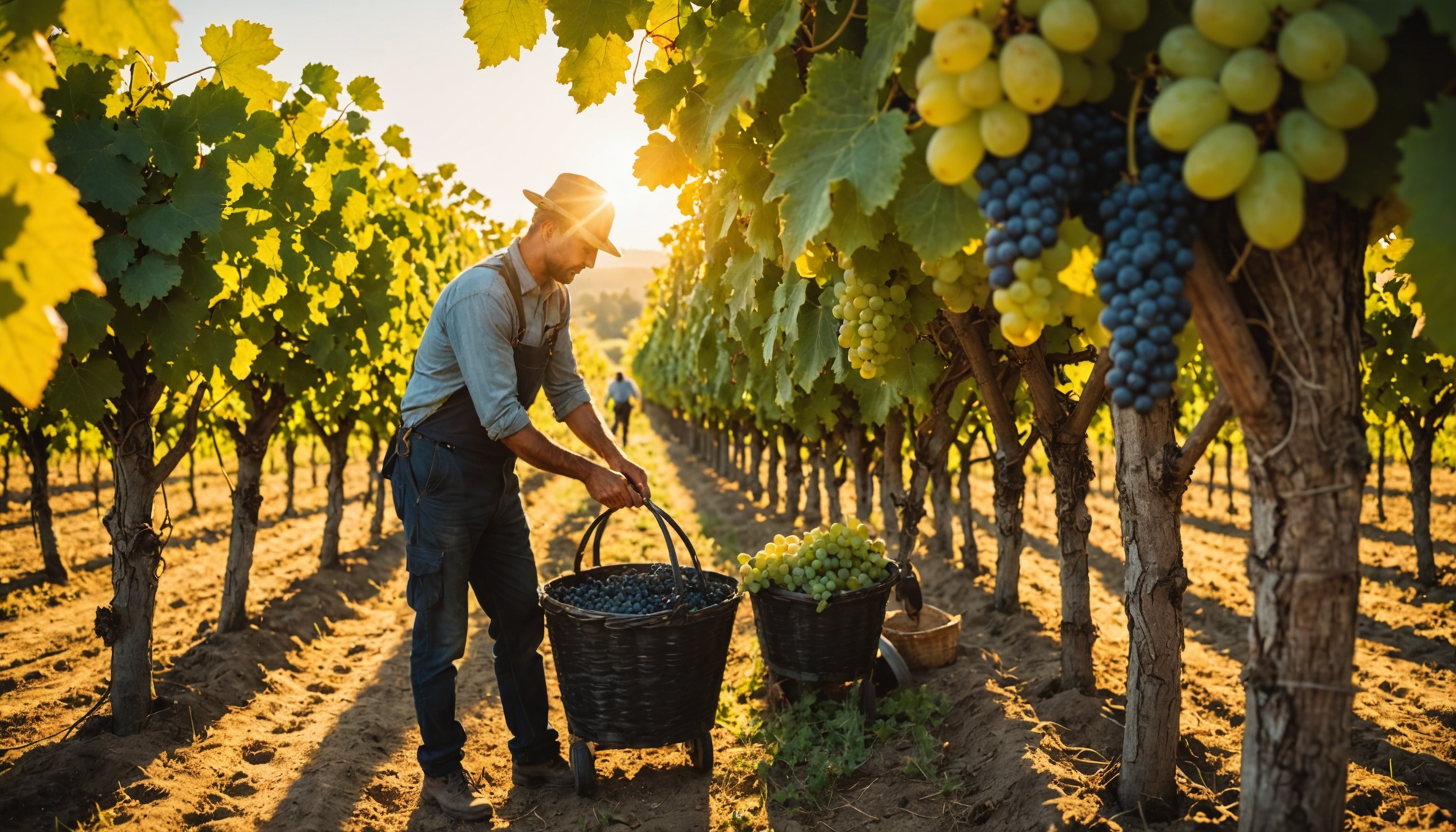
In the vineyards of France, summer 2026 will be remembered as the year the calendar got turned upside down. The early grape harvest began up to a month earlier than normal in several regions, a phenomenon directly linked to the three heat waves that hit the country between May and July. Beyond the climate record itself, the entire wine industry has had to scramble to adapt.
A Record Broken by Two Weeks
Contents
The 2026 vintage has officially become the earliest harvest ever recorded in France, smashing the previous record set in 2003 by nearly two weeks. The causes: a particularly mild winter, a spring that already felt like summer, then a string of three heat waves in May, June, and July, with peaks topping 40°C in several regions of southern and west-central France. July 2026 was in fact ranked the hottest month ever measured in France, a factor that sped up budbreak and then grape ripening by several weeks.
A Calendar Upended Region by Region
In concrete terms, harvest dates were moved up almost everywhere:
- Languedoc: first harvest as early as July 16, an absolute record for France, when picking usually begins in mid-August.
- Champagne: start date set for August 12, the earliest date ever decided by the CIVC (Champagne's wine regulatory board), twelve days ahead of the previous record set in 2020.
- Burgundy: harvest spread from August 10 to 20, compared with the usual September 10–20.
- Alsace: official start date set between August 17 and 19, while harvesting usually begins in mid-September.
- Beaujolais: start date announced for August 27, compared with mid-September in a normal year.
- Bordeaux: harvest expected from mid-August to early September, several weeks ahead of schedule.
In Montgueux, in the Aube department, winemaker Vincent Finot thus became, in his own words, the first winemaker in the history of Champagne to harvest this early in the year.
The Scramble for Grape Pickers, Precocity's Blind Spot
While the heat makes headlines, it has mainly created a less visible logistical challenge: finding enough hands in record time. In Burgundy, the industry estimates it needs nearly 40,000 grape pickers within just a few weeks, which prompted France Travail (the French national employment agency) and the ANEFA agricultural labor association to launch a recruitment campaign as early as the beginning of July, much earlier than usual. This tighter schedule leaves farms less time to organize housing, transportation, and training for seasonal teams—a challenge that is often underestimated compared with the weather issue alone.
What Impact Will This Have on the Wine in Our Glasses?
In terms of quality, an early harvest isn't necessarily bad news: it can preserve the grapes' acidity if properly anticipated. But water stress and sunburn, which affected up to 40% of the grape clusters in some exposed areas, are weighing on volumes. Several estates report significant losses: around 30 fewer hectoliters on the Île de Ré, yields down 50 to 60% in Corrèze, or 15 to 20% lost production in Savoie. The industry is collectively urging caution before drawing final conclusions about the vintage, as harvesting continues until early September depending on consumption trends and location.
This unprecedented early start illustrates above all just how much climate change is already reshaping the day-to-day work of farming professions, with very real consequences for the local economy of wine-growing regions.
Frequently Asked Questions
Why is the 2026 grape harvest so early in France?
Three successive heat waves between May and July, combined with a mild winter and a spring that already felt like summer, sped up budbreak and then grape ripening by several weeks compared with a normal year.
Which regions are most affected by this early start?
Languedoc kicked things off as early as July 16, followed by Champagne, Burgundy, Alsace, Beaujolais, and Bordeaux, each moving up its harvest by two to four weeks depending on the area.
Does an early harvest threaten wine quality?
Not necessarily: faster ripening can preserve the grapes' acidity. The real concern is volume, which has been reduced in some areas due to water stress and sunburn on the grape clusters.
Sources
- ICI — “We've Never Started This Early”: Records of Early Harvests
- Vinabox — 2026 Harvest Dates: Region-by-Region Calendar
- Zoom42 — Early Harvest: An Unprecedented Record for French Vineyards
Author Profile
Latest entries
 Food & Drink21 November 2026Beaujolais Nouveau: A Historically Low Harvest, Yet Sales Keep Climbing
 Finance20 November 2026Consumer Credit: Mini-Loans, Split Payments, and Overdrafts Face Tighter Rules
 Planet15 November 2026CO2 Emissions: Why Transportation Remains France's Climate Blind Spot
 Artificial Intelligence12 November 2026Imagine Enterprise: IBM and Microsoft Team Up on AI Agents for Large Businesses
This article was written with the help of artificial intelligence. Editorial policy