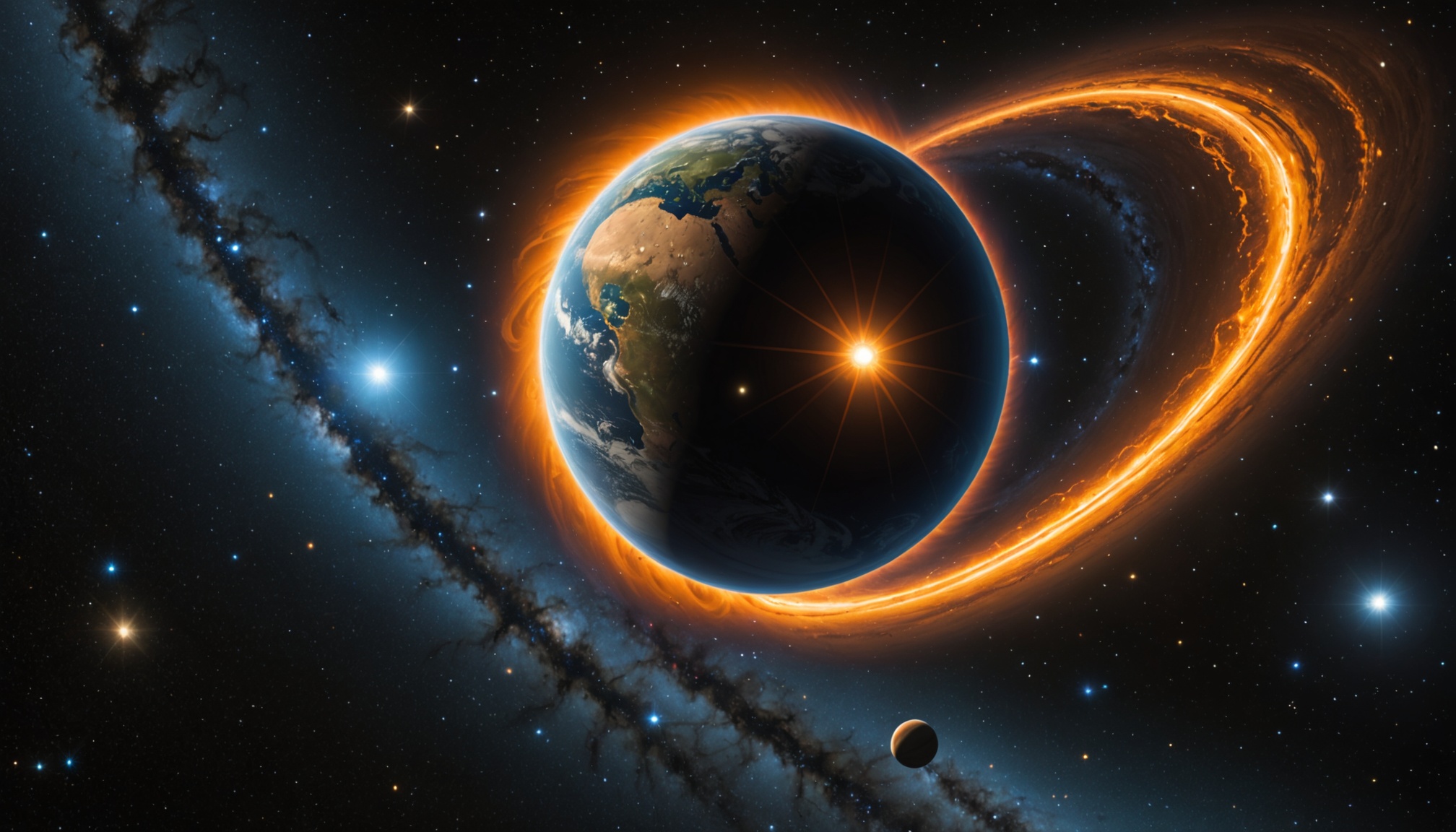
A giant planet has just been revealed in data that has been known for years — and nobody had spotted it. Named Gaia23bra b, this “super-Jupiter” was uncovered thanks to a phenomenon predicted by Albert Einstein more than a century ago: gravitational microlensing. The story of its discovery says as much about the universe as it does about how science is done today: sometimes all it takes is reopening old files with a fresh set of eyes.
A planet spotted twice, five years apart
Contents
It all started in 2023, when the European Gaia space telescope picked up an unusual signal: a brief burst of brightness coming from a distant star, the classic signature of a gravitational microlensing event. It wasn't until later that a team of researchers, re-examining the archives of the American satellite TESS (Transiting Exoplanet Survey Satellite), found traces of the same event in data collected during the same period. The result: the very first planet ever detected by microlensing in TESS's history, even though the telescope was designed for a completely different method — the transit technique.
The planet in question, Gaia23bra b, has a mass of roughly 1.6 times that of Jupiter. It orbits an orange dwarf star — a star whose mass is about 80% of the Sun's — at a distance comparable to the one separating Jupiter from the Sun. The system is located roughly 40,000 light-years from Earth, toward the galactic plane. The findings were published in late July 2026 in The Astrophysical Journal Letters, led by Mallory Harris, a doctoral student at the University of New Mexico.
How Einstein lets us see the invisible
Gravitational microlensing stems directly from general relativity, formulated by Einstein in 1915: a sufficiently massive object — a star, a planet — curves the space-time around it. When that object passes in front of a more distant star, its gravity acts like a magnifying lens and temporarily amplifies the light of that background star. The brightness rises, then fades, over the course of days or weeks. It was this fleeting, non-repeatable light signature that astronomers managed to match between Gaia's data and TESS's data.
Unlike the transit method — which spots a planet as it passes in front of its star and slightly dims its light — microlensing doesn't require the planet to orbit close to its star, nor the system to be nearby. Today it is the only technique capable of detecting Earth-mass worlds on wide orbits, comparable to our own planet's orbit around the Sun.
Why this discovery matters
TESS has already confirmed more than 800 exoplanets since its launch, but all of them through the transit method. Yet fewer than 5% of all exoplanets known to date have been detected through gravitational microlensing, for lack of large-scale dedicated instruments. The fact that a telescope not designed for this purpose still managed to catch one of these events changes the picture: it suggests that other planets of this kind may already be hiding, unseen, in the mission's archives.
As astronomer Diana Dragomir, a co-author of the study, points out, this discovery suggests there are likely other hidden microlensing events in the data TESS has already collected. Rather than building more new instruments, some of tomorrow's discoveries could come from a methodical review of what we already have.
Frequently Asked Questions
What is gravitational microlensing?
It's a phenomenon in which the gravity of a massive object (a star, a planet) bends the light of a more distant body located behind it, producing a temporary brightening. This phenomenon stems from Einstein's theory of general relativity.
How is Gaia23bra b different from other exoplanets discovered so far?
It was not detected using the usual transit method, but through gravitational microlensing — a far rarer technique that can spot planets located far from their star and from us.
Will TESS keep searching for planets this way?
This discovery shows that TESS can, alongside its primary mission, contribute to microlensing detection. Researchers now plan to re-scan its archives in search of other similar events.
To read more about today's biggest technological and scientific breakthroughs, head over to our Artificial Intelligence and Tech / Net sections, or discover other space findings in Planet.
Sources
- Universe Today — Bending Spacetime Reveals New Planet Hidden in Archived TESS Data
- Techno-Science — A giant planet detected using Einstein's relativity
- The Astrophysical Journal Letters — TESS's First Bound Microlensing Planet
Author Profile
Latest entries
 Food & Drink21 November 2026Beaujolais Nouveau: A Historically Low Harvest, Yet Sales Keep Climbing
 Finance20 November 2026Consumer Credit: Mini-Loans, Split Payments, and Overdrafts Face Tighter Rules
 Planet15 November 2026CO2 Emissions: Why Transportation Remains France's Climate Blind Spot
 Artificial Intelligence12 November 2026Imagine Enterprise: IBM and Microsoft Team Up on AI Agents for Large Businesses
This article was written with the help of artificial intelligence. Editorial policy