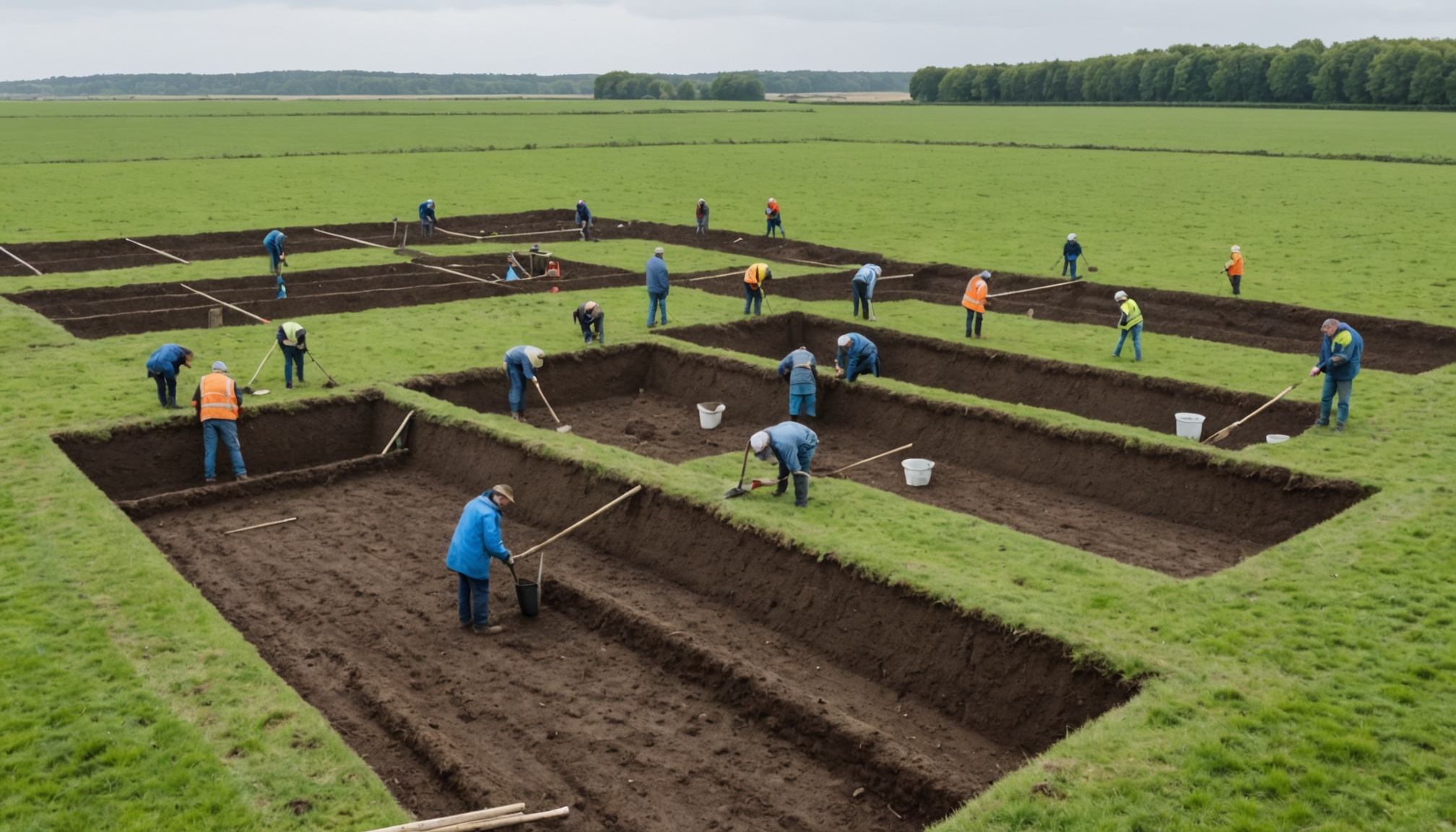
Along the route of the future Seine-Nord Europe canal, in the Pas-de-Calais region of France, a preventive excavation has just uncovered more than 800 archaeological remains at Ruyaulcourt. Conducted by the French National Institute for Preventive Archaeological Research (Inrap), this operation has brought to light a vast rural landscape occupied over several centuries, from the late Iron Age to the Late Roman Empire. A discovery that sheds light, structure by structure, on daily life in the rural areas of northern France more than two thousand years ago.
An Archaeological Project Driven by a Major Infrastructure Plan
Contents
As with many large linear construction projects, building the Seine-Nord Europe canal requires an archaeological assessment and excavation on the affected land ahead of each earthworks phase. It was under this framework that Inrap teams worked at Ruyaulcourt, a small town in the Pas-de-Calais, over an area of about 13.2 hectares. This type of excavation, known as “preventive,” is nothing unusual in itself: France carries out several hundred such excavations every year ahead of road, rail, or waterway projects. But the scale of the Ruyaulcourt site and the richness of its artifacts make this a project closely watched by regional archaeologists.
Two Settlement Clusters, Several Centuries of Rural History
Archaeologists identified two distinct settlement clusters, each made up of several enclosures that overlapped over time. This overlapping pattern points to continuous occupation, reworked on several occasions, from the Second Iron Age (the La Tène period) through late antiquity, a chronological span of roughly five to six centuries. On the ground, most of the remains take the form of ditches and pits: sunken structures that once marked out farming plots, residential enclosures, or storage areas.
- More than 800 archaeological structures recorded across the project site.
- An excavated area of about 13.2 hectares.
- Continuous occupation from the late Iron Age to the Late Roman Empire.
- Two rural settlement clusters with successive enclosures.
What These Ditches Reveal About Ancient Rural Life
Far from being simple holes in the ground, these ditches and pits allow archaeologists to reconstruct how a farming landscape was organized over the long term: the layout of plots, water management, the placement of buildings, and craft and agricultural activities. By cross-referencing data from several successive enclosures, Inrap teams can observe how the same community reorganized its living space across generations, between the end of the Gallic period and the lasting establishment of the Gallo-Roman rural model. It is precisely this continuity, rarely observed at a single site, that gives the Ruyaulcourt discovery its full scientific interest.
Why This Discovery Matters, Beyond the Pas-de-Calais
Major linear construction projects like the Seine-Nord Europe canal unintentionally act as a window into buried heritage. Without this kind of work, most of these remains would have stayed hidden beneath the fields. Every preventive excavation of this scale adds to our understanding of ancient rural life in northern France, a region where traces of Gallic and Gallo-Roman settlement remain, compared with other parts of the country, only partially documented. The data gathered at Ruyaulcourt will feed into regional studies on rural settlement patterns before and after the Roman conquest.
For more on the major trends shaping the news, also check out our Science, Planet, and General News sections.
Frequently Asked Questions
Where exactly is the Ruyaulcourt archaeological site located?
Ruyaulcourt is a town in the Pas-de-Calais department, in the Hauts-de-France region of France, located along the route of the future Seine-Nord Europe canal, which is set to connect the Seine basin to northern Europe's inland waterway network.
Who carried out this archaeological excavation?
The operation was conducted by Inrap, the National Institute for Preventive Archaeological Research, as part of the mandatory assessments and excavations required ahead of construction work on the Seine-Nord Europe canal.
What period do the remains that were discovered cover?
The structures uncovered span continuous occupation from the Second Iron Age (La Tène) to the Late Roman Empire, representing several centuries of rural history in northern France.
Sources
Inrap — A Rural Landscape from the Second Iron Age to the Late Roman Empire at Ruyaulcourt (Pas-de-Calais)
Seine-Nord Europe Canal — Archaeology: A Thousand-Year-Old Landscape Revealed at Ruyaulcourt
Science & Vie — Archaeology News
Author Profile
Latest entries
 Food & Drink21 November 2026Beaujolais Nouveau: A Historically Low Harvest, Yet Sales Keep Climbing
 Finance20 November 2026Consumer Credit: Mini-Loans, Split Payments, and Overdrafts Face Tighter Rules
 Planet15 November 2026CO2 Emissions: Why Transportation Remains France's Climate Blind Spot
 Artificial Intelligence12 November 2026Imagine Enterprise: IBM and Microsoft Team Up on AI Agents for Large Businesses
This article was written with the help of artificial intelligence. Editorial policy