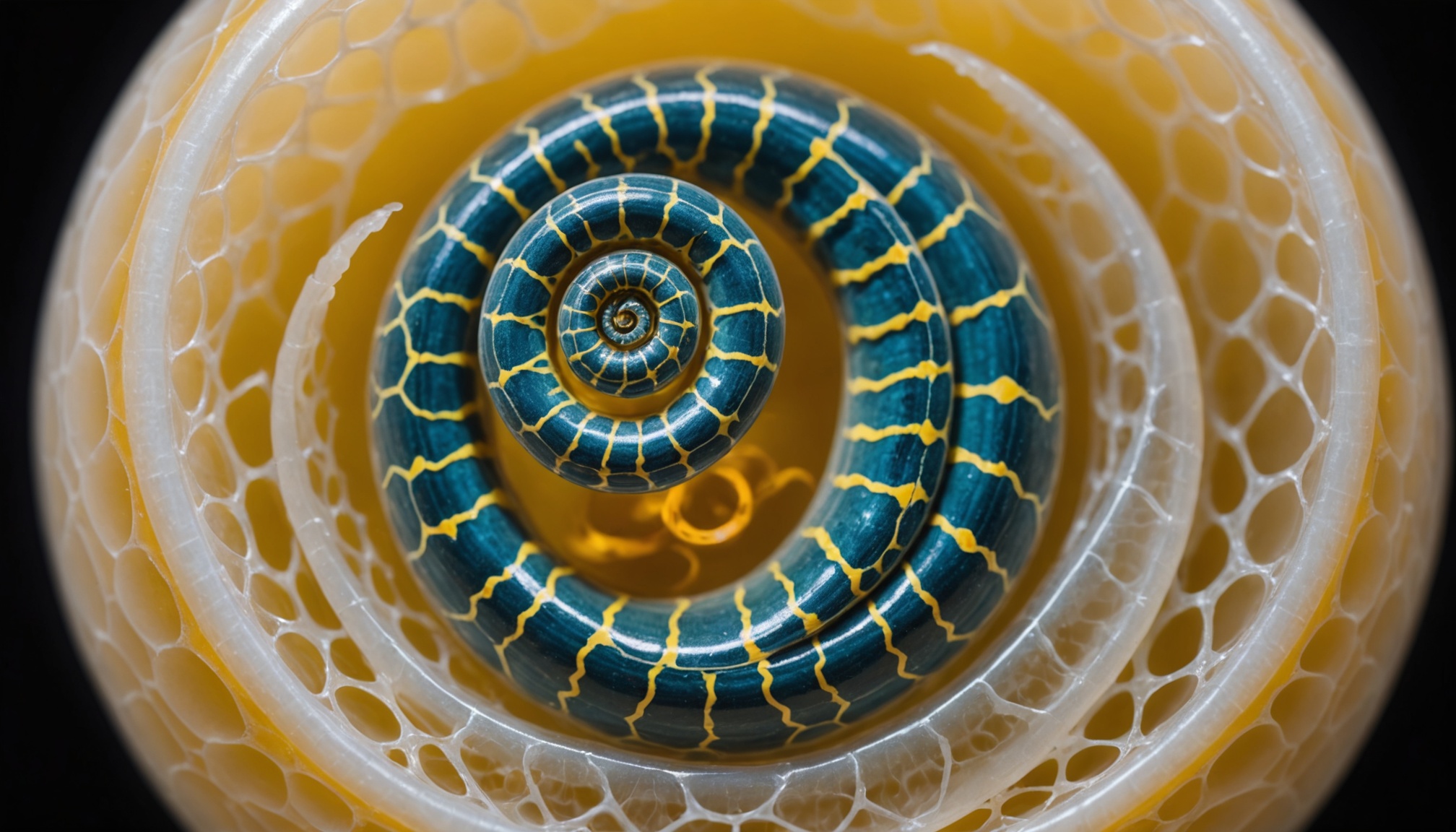
Why are snakes born with such a long body, folded into a space as cramped as an egg? An international research team has just provided an answer to this decades-old question. Published on August 31, 2026, in the journal Current Biology, the study explains why snake embryos almost always coil in the same direction inside their shell.
An Almost Always Identical Spiral
Contents
Led notably by the Canadian Museum of Nature and the University of British Columbia (UBC), with the participation of Carleton University, the University of Ottawa, California State University Los Angeles, and the University of Helsinki, the team examined images of more than 900 embryos from 39 species of snakes and other legless squamates. The result: during the first weeks of development, nearly all embryos coil clockwise. It's only as hatching approaches that the proportion evens out, with half the embryos becoming right-coiling and the other half left-coiling.
The Digestive Tract, a Discreet Conductor
The mechanism identified by the researchers is unexpectedly simple. The embryo's spine lengthens faster than its digestive tract. The latter then acts like a strap that's too short, forcing the growing body to twist and coil to fit in the available space. “It's a surprisingly simple solution to a surprisingly difficult problem,” summarizes Alexandra Weber, lead author of the study and a zoology student at UBC. The position of the yolk, located on the left side of the embryo, would then steer the twist to the right.
To reach this conclusion, the team combined observation of embryonic images with computed tomography (CT scan) imaging, which makes it possible to reconstruct the internal anatomy of embryos in 3D without damaging them. This painstaking work, carried out largely by a researcher still in training, is a reminder that the most significant scientific advances still rely heavily on patient observation and the careful cross-referencing of data rather than on automated tools: at a time when some promise artificial intelligence capable of solving everything on its own, this study illustrates the very real limits of superintelligent AI, a subject that remains largely theoretical.
Why This Contortion Is an Evolutionary Feat
This ability to coil into a spiral isn't just an anatomical detail: it partly explains why snakes can be born with the longest body of any terrestrial vertebrate. Without this mechanical solution, it would be impossible to fit such length into the limited volume of an egg. Biodiversity is full of this kind of quiet adjustment: just recently, the detection of an invasive Japanese beetle species in France was a reminder of just how many surprises wildlife can still hold, even in a country as thoroughly studied as France. Find more curiosities from fundamental research in our Science section.
This discovery comes amid a particularly busy stretch of scientific news in recent weeks: in space, the Roman Space Telescope is gearing up to track tens of thousands of exoplanets, proof that research keeps advancing on every front, from the tiny embryo to the scale of the galaxy. More broadly, this work also touches on our relationship with the planet and its biodiversity.
Key Takeaways
- The study covers more than 900 embryos from 39 species of snakes and legless squamates.
- The digestive tract, shorter than the growing spine, acts like a strap that forces the spiral.
- Near hatching, the proportion of right-coiling and left-coiling embryos evens out to 50/50.
- This contortion is thought to allow snakes to be born with the longest body among vertebrates.
Frequently Asked Questions
Why do snake embryos coil into a spiral?
Because their spine grows faster than their digestive tract. The latter acts like a strap that's too short, forcing the body to twist to fit within the available space in the egg.
Do all snakes coil in the same direction?
Not exactly. During the first weeks, nearly all embryos coil clockwise, but this tendency evens out as hatching approaches, with as many right-coiling embryos as left-coiling ones.
What purpose does this spiral serve for the animal?
It allows the snake to fit an extremely long body into the small volume of an egg, a trait that helps make it the terrestrial vertebrate with the longest body at birth.
Sources
Author Profile
Latest entries
 Finance20 November 2026Consumer Credit: Mini-Loans, Split Payments, and Overdrafts Face Tighter Rules
 Planet15 November 2026CO2 Emissions: Why Transportation Remains France's Climate Blind Spot
 Artificial Intelligence12 November 2026Imagine Enterprise: IBM and Microsoft Team Up on AI Agents for Large Businesses
 Economy11 November 2026Livret A Rate: Understanding How It's Calculated and Its Limits
This article was written with the help of artificial intelligence. Editorial policy