
In brief — Vector databases have become the invisible backbone of modern artificial intelligence. In 2025, these specialized storage systems are transforming the way intelligent assistants access memory and understand the context of queries. Rather than simple keyword searches, they enable semantic search capable of grasping the deep meaning of data. This evolution is paving the way for autonomous agents equipped with genuine persistent memory, capable of learning and evolving without constant retraining. The global market is expected to reach $3.2 billion in 2025, confirming the strategic importance of this technology for organizations seeking to deploy truly contextual AI.
🧠 Why vector databases are transforming the memory of intelligent assistants
Contents
Imagine an AI assistant capable of remembering not just your exact words, but understanding the deeper meaning behind your question. That's exactly what vector databases make possible. Unlike traditional systems that index individual terms, they store and query complex semantic representations — mathematical vectors that capture the very essence of content.
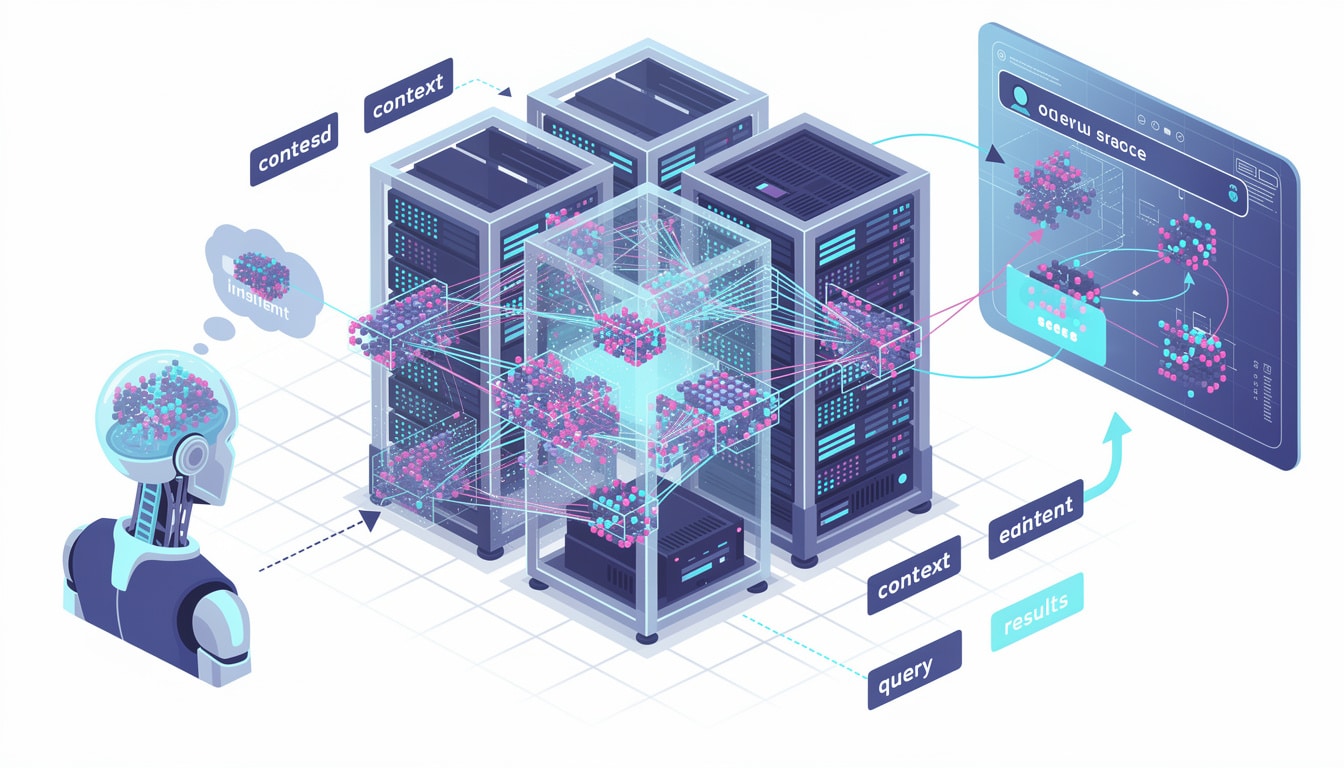
This approach revolutionizes how intelligent assistants work. When a user asks a question, it's transformed into a numerical vector, then compared against millions of other vectors stored in the database. Cosine similarity, a mathematical measure of closeness, instantly identifies the most relevant information, even if it uses different words. 🎯
This mechanism elevates assistants beyond simple text generators. They become systems equipped with persistent external memory, able to consult archives, documentation, or entire corpora without ever forgetting. This is the foundation of RAG (Retrieval-Augmented Generation), an approach that combines the linguistic power of LLMs with access to up-to-date, specialized knowledge.
💾 From simple search to contextual understanding
A classic search engine works on term matching. If you search for “how to optimize GPU performance,” a traditional system will offer you documents containing exactly those words. But a vector database understands that “speed up graphics processing” and “improve visual processor speed” are talking about the same subject. 📊
This ability to grasp semantic nuance transforms the user experience. Intelligent assistants powered by these databases respond with greater precision and context. They capture relationships between concepts, distinguish synonyms, and even detect ironic or metaphorical subtleties that older systems completely missed.
For organizations, this means documentary copilots capable of interpreting complex business queries, customer support systems that understand the requester's real intent, and analytics assistants capable of linking information scattered across thousands of documents. Vector indexing thus becomes a major competitive advantage. 🚀
🔍 How vector databases work: from text to semantic memory
The operation of a vector database relies on a precise technological chain, where each step transforms raw data into representations the AI can use. Understanding this process sheds light on why these systems have become essential for modern assistants.
🔄 The critical step: turning data into embeddings
It all starts with the semantic representation of data. An embedding model, such as text-embedding-ada-002 or nomic-embed-text, analyzes your text, image, or audio, and converts it into numerical vectors. These vectors aren't random — they encapsulate meaning, context, tone, and semantic relationships. 📝
Consider this example: the word “bank” produces a different vector depending on context. In finance, it sits close to “credit,” “loan,” and “interest.” In geography, it's close to “river,” “stream,” and “shore.” The embedding model captures these variations through thousands of mathematical dimensions invisible to the human eye.
This process also applies to images. A photo of a dog generates a unique vector that shares similarities with other dog images, but is clearly distinct from cat images. Multimodal models extend this logic by creating vectors compatible across text and images, paving the way for truly integrated search.
⚡ Indexing and optimization for ultra-fast searches
Storing millions of vectors is one thing; retrieving them instantly is another. That's where sophisticated index structures come in. Algorithms like HNSW (Hierarchical Navigable Small World) and product quantization create architectures that allow the nearest vectors to be found in just milliseconds, even in databases containing several billion entries. 🚄
These optimizations are essential for real-time assistants. When a user asks a question, the system can't analyze every vector in the database: that would be too slow. Indexing creates mathematical “shortcuts,” fast lanes that identify relevant documents without exhaustive searching.
Tools like Pinecone, Qdrant, and Chroma implement these optimizations in production. Qdrant, for example, uses a Rust-based approach offering extremely low latency, while Pinecone manages automatically scalable cloud architectures.
🎯 Semantic search in action: beyond keywords
When a question is asked, it undergoes the same process: transformation into a vector via an embedding model. The database then calculates the distance between this vector and all the others stored. Documents or passages with the highest vector proximity rise to the surface, without depending on exact lexical matches.
Imagine an assistant having to answer “What are the best approaches to reduce data center energy consumption?” Its search will retrieve not only documents explicitly mentioning these terms, but also articles discussing thermal efficiency, liquid cooling, or hardware optimization — all semantically aligned.
This capacity for meaning-based information retrieval radically transforms the quality of responses generated by LLMs. Models are no longer limited to their original training: they dynamically access a rich, current, and relevant external memory.
🏗️ The open source ecosystem: democratizing access to vector databases
Innovation in artificial intelligence accelerates when tools become accessible. In 2025, the open source ecosystem transformed vector databases from an expensive proprietary technology into democratized infrastructure. Projects like FAISS, Chroma, Qdrant, and Milvus allow developers, researchers, and small businesses to deploy sophisticated vector search systems without depending on cloud giants. 💡
📚 FAISS: Meta's raw power, available to all
FAISS (Facebook AI Similarity Search), developed by Meta, remains an essential reference for high-performance vector search. Written in C++ with Python bindings, it offers exceptional speed and remarkable memory efficiency, particularly on GPU. Teams working with massive volumes — millions or billions of vectors — favor it for its aggressive optimization. 🔥
Its widespread adoption in research projects and critical systems confirms its reliability. FAISS particularly shines when latency must be minimal and computational resources are constrained.
🎨 Chroma: simplicity for prototyping and iterating
At the other end of the spectrum is Chroma, a minimalist Python vector database designed for simplicity and quick integration. Built to run locally or in a distributed manner, it integrates naturally with modern frameworks like LangChain, LlamaIndex, and Open WebUI. For anyone wanting to quickly experiment with a RAG assistant or documentary copilot, Chroma offers the gentlest learning curve. 🚀
Its strength lies in accessibility: with a few lines of Python, you can index your own documents and build a contextualized assistant capable of leveraging your in-house knowledge. This simplicity explains its widespread adoption in educational projects and enterprise prototypes.
⚙️ Qdrant: the production balance between performance and flexibility
Written in Rust, Qdrant represents the mature evolution of open source vector databases. It offers a complete REST and gRPC API, ultra-fast performance, and an architecture capable of supporting complex filters and hybrid searches (combining vector search with structured criteria). For production deployments requiring robustness and scalability, Qdrant stands out as a strategic choice. 🎯
Organizations use Qdrant to power real-time recommendation systems, anomaly detection engines, and enterprise documentary assistants. Its mature ecosystem and rich documentation make large-scale adoption easier.
🌐 Milvus: distributed power for critical environments
Milvus pushes ambition further by offering a distributed architecture designed for massive production environments. Capable of managing several billion vectors with high availability, it tolerates failures and scales horizontally. Paired with Zilliz Cloud (its managed version), it represents the solution for organizations that have outgrown a single machine. 💪
Its growing adoption in the financial, pharmaceutical, and technology sectors confirms its maturity and reliability under extreme conditions.
🤖 From classic RAG to Agentic RAG: memory at the heart of autonomy
The evolution of vector databases doesn't stop at search. It's driving a profound architectural transformation: the shift from simple assistants to autonomous agents equipped with genuine cognitive memory. Autonomous agents and automation represent the current frontier of this evolution.
🔗 RAG: the foundation — retrieval and generation
Classic Retrieval-Augmented Generation (RAG) works in three simple steps. The user asks a question; it's vectorized and searched in the database; the relevant passages feed the LLM's prompt, which generates a contextual response. It's linear, predictable, and surprisingly effective for a wide range of use cases. 📋
Imagine a company with thousands of technical documents. Without RAG, a generic assistant would be unaware of this specialized knowledge. With RAG and a vector database, the assistant instantly becomes an expert, retrieving relevant sections and building responses grounded in the organization's reality.
🧩 Agent RAG: decision-making and planning
Agent RAG takes a step further. Rather than performing a single search, the agent dynamically decides when to query the database, how to combine multiple results, and whether a new search is needed. It becomes capable of reasoning about its own responses, detecting contradictions, and planning multiple search steps. 🎲
Frameworks like LangGraph and OpenDevin implement this logic, allowing agents to build complex plans: “First, I'll look up the API documentation. Then, I'll check the code examples. Finally, I'll cross-reference this information with users' frequently asked questions.” This planning capability elevates intelligence beyond the reactive toward the proactive.
🧠 Agentic RAG: living memory and self-learning
Agentic RAG represents the pinnacle: a closed loop where the agent observes its environment, reasons, acts, and then updates its own vector memory. This cycle creates a form of adaptive, autonomous intelligence. The agent records its discoveries, its mistakes, its successes, gradually building an experiential knowledge base. 🌟
Concretely, a monitoring agent could automatically index detected articles, analyze trends, identify anomalies, and store its conclusions to inform future analyses. Agentic RAG transforms the relationship between knowledge and decision-making: vector memory is no longer static but alive, evolving, a reflection of accumulated experience.
🌍 Real-world use cases: how vector databases are reinventing enterprise assistants
The theory is compelling, but it's by looking at real-world deployments that the potential becomes tangible. Across different sectors, vector databases are transforming how organizations build their intelligent assistants. The strategy for integrating autonomous agents shows how companies are structuring these transformations.
📄 Documentary assistants: querying the past in seconds
A pharmaceutical company has 50 years of archives — patents, clinical studies, compliance reports, regulatory correspondence. Traditionally, finding a specific document took days. With a vector database powering an assistant, a researcher simply asks “What is the history of this molecule in our archives?” and the system retrieves relevant passages from among millions of pages. 🔬
This scenario plays out in law firms (case law research), content agencies (retrieving past articles), and HR departments (exploring past policies). Machine learning is no longer reserved for prediction: it becomes a tool for rediscovering and leveraging an organization's existing information assets.
💬 Contextualized customer support: truly understanding the problem
A customer support assistant powered by a vector database of 100,000 past tickets understands that “the app doesn't work anymore on my old phone” and “version incompatibility” describe the same problem. It instantly retrieves proven solutions, suggests precise troubleshooting steps, and, if the customer isn't satisfied, intelligently escalates to a human with all the relevant context. 🎧
The effect is measurable: reduced average resolution time, increased customer satisfaction, decreased workload on teams. Organizations that have implemented this approach regularly report 30-40% efficiency improvements.
🔐 Security analysis and anomaly detection
In cybersecurity, a vector database indexes past incident reports, malware signatures, and known attack patterns. When a new threat emerges, the system vectorizes it and compares it against thousands of previous threats. It identifies similarities that manual analysis would miss, alerting teams to hidden connections. 🛡️
This transforms anomaly detection from a laborious task into a continuous, intelligent process. Performance optimization becomes critical here: every millisecond counts when an active threat must be stopped.
🛠️ Open WebUI and Chroma: democratizing local, contextual AI
Behind all this sophistication lies an important reality: the tools needed to build these systems are now free, open source, and accessible to everyone. Open WebUI and Chroma form a powerful duo, turning technical complexity into a smooth user experience. 🎯
🖥️ Open WebUI: the interface that makes AI accessible without code
Open WebUI is a minimalist yet powerful web interface that creates a bridge between you, your data, and local AI models. You upload your documents — PDF, Markdown, images, text files — and the interface automatically handles vector indexing, storage, and querying. A few minutes later, you're chatting with your own contextualized assistant, without ever exposing your data to the cloud. 🌐
What makes Open WebUI revolutionary is that no technical knowledge is required. You don't need to understand embeddings, vectors, or indexing algorithms. You click a button, select your file, and the system does the rest. It's to local AI what WordPress was to blogging: a transformative democratization.
📦 Chroma as foundation: lightweight, adaptable, integrated
Under the hood, Open WebUI often uses Chroma as its vector engine. Chroma handles the heavy lifting: converting documents into embeddings, optimized indexing, ultra-fast semantic search. Its Python-first nature makes it immediately integrable into existing pipelines. 🔧
Developers appreciate that Chroma is simple enough for a prototype — a few lines of code — yet robust enough to support production deployments. It integrates naturally with LangChain, LlamaIndex, and other modern AI frameworks.
🔄 The complete workflow: from document to contextual answer
The flow is transparent for the user but technically elegant. A user uploads a 500-page PDF on GDPR regulations. Open WebUI automatically breaks it into passages, vectorizes them via an embedding model (locally, without external APIs), and indexes them in Chroma. When the user asks “What are my obligations regarding consent?”, the system retrieves the relevant sections and feeds a local LLM (via Ollama or vLLM) that generates a precise answer. ✨
All of this happens locally, privately, with no token or API fees. It's a living demonstration of how vector databases are transforming AI from a centralized resource into personal, sovereign infrastructure.
🎯 Building your own vector database: principles and use cases
The question many professionals ask is a natural one: should you really create a personal vector database? The answer depends on your context, but for authors, researchers, journalists, and developers, the benefits are often transformative. 💡
🏆 Why a personal vector database makes sense
Imagine being a technical writer for ten years. You've written hundreds of articles, each containing explanations, comparisons, and conclusions. Without a vector database, this knowledge remains scattered across your archives, hard to draw on when writing a new article. With a personal vector database indexing all your past content, you gradually build your own semantic memory.
When you write, you can query this memory: “What was my conclusion about Rust's performance in 2023?” or “What examples did I use to explain multithread synchronization?” The system retrieves your old articles, reinforcing editorial consistency and speeding up your creative process. 📚
For researchers, a vector database indexing your papers, notes, and research data becomes an invaluable personal assistant. For developers, indexing your codebase and its documentation creates a semantic search engine incomparable to simple grep commands.
⚖️ The pragmatic limits to know
However, creating a vector database for everything doesn't make sense. Every vectorized document consumes storage, (initial) computation, and possibly RAM. A database overloaded with irrelevant content produces noise: the search retrieves too many unrelated results, diluting relevance. 🚫
A more effective approach is strategically segmented. You could create several thematic databases: one for your articles and publications, one for technical documentation, one for your research notes. This modularity makes maintenance easier and improves result accuracy.
🚀 Recommended setup: minimalist and extensible
To get started, a simple architecture is enough: Chroma as the vector database, Ollama or vLLM to run an LLM locally, LangChain or LlamaIndex to orchestrate the pipeline. If you want a no-code visual interface, add Open WebUI on top. This stack is free, open source, and deployable in minutes on any modern computer. 💻
As your needs grow — more documents, lower required latency, distributed deployment — you can migrate to Qdrant or Milvus without major changes to the application code. Modern frameworks abstract these infrastructure details, allowing for gradual evolution.
📈 Business impact: beyond the technology
Reducing vector databases to mere technology would be superficial. Their true power lies in transforming business capabilities. A complete guide to enterprise RAG projects explores how these systems generate real operational value.
⏱️ Measurable efficiency gains
Teams using assistants powered by vector databases report a concrete increase in productivity. Researchers find information in minutes instead of hours. Support teams resolve tickets faster. Analysts identify hidden patterns in corpora too large for manual analysis. These gains aren't theoretical — they translate into hours saved and improved quality. 💰
🎓 Capitalizing on tacit knowledge
Organizations have institutional memory scattered across people's minds, emails, and poorly organized documents. A well-structured vector database captures this knowledge, makes it accessible, and protects it against the departure of employees. It's capitalized knowledge, usable long after its original context.
🔮 Accelerated innovation
Easy access to a rich knowledge base encourages experimentation and intelligent reuse. Teams discover connections between domains, apply past solutions to new problems, and combine ideas in unexpected ways. It's an engine of incremental but lasting innovation. 🌟
🔐 Privacy and data sovereignty: why local matters
In an era of concerns about data privacy, the fact that open source vector databases run locally is a major strategic advantage. Your documents, your embeddings, your queries stay on your infrastructure, inaccessible to cloud providers. 🔒
For organizations handling sensitive data — finance, pharmaceuticals, defense, customer data — this sovereignty isn't a luxury but a legal and ethical necessity. GDPR, HIPAA, local compliance laws: local AI offers a natural compliance framework, with no need for clause negotiations or complex certifications.
Even for less regulated organizations, keeping full control of your AI infrastructure provides peace of mind and independence from cloud provider pricing changes or policy shifts. It's a powerful argument in favor of self-hosted, open source vector databases.
🌐 Integration with modern frameworks: LangChain, LlamaIndex, and beyond
The AI ecosystem doesn't exist in isolation. Vector databases shine when they integrate seamlessly with other components. The comparison between CrewAI and LangChain illustrates how these frameworks structure modern AI architectures.
🔗 LangChain: seamless orchestration
LangChain abstracts the complexity of integrating an LLM with a vector database behind an elegant Python interface. A developer can build a complete RAG pipeline in a few dozen lines, declaring the LLM, the vector database, the retriever, and the prompting strategy. LangChain handles the details, letting the developer focus on business logic. 🛠️
📊 LlamaIndex: smart document structuring
LlamaIndex (formerly GPT Index) goes further by intelligently structuring documents before vectorization. It creates hierarchical indexes, analyzes document structure, and extracts relevant metadata. This approach produces more relevant searches and more nuanced summaries. 📋
🤖 CrewAI: multi-agent orchestration
CrewAI, more recent, explores the orchestration of multiple autonomous agents working together. Each has its own access to specialized vector databases, tools, and defined roles. This multi-agent approach increases reliability, transparency, and the ability to tackle complex problems by breaking them down. 🎭
These frameworks aren't competing with each other: they address different levels of abstraction. LangChain is suited to rapid prototyping and simple cases. LlamaIndex excels at sophisticated indexing. CrewAI is optimal for complex multi-agent systems. The choice depends on your problem and your architectural preference.
📊 Metrics and monitoring: ensuring system quality
Like any system in production, vector databases require ongoing monitoring and optimization. Simply indexing documents isn't enough; you must make sure search quality stays high over time. 📈
🎯 Measuring search relevance
Classic search metrics apply: precision (what fraction of returned results is relevant), recall (what fraction of relevant documents was retrieved), and F1 score (the balance between the two). For RAG use cases, additional metrics matter: generation quality (are the generated answers factually correct?) and latency (does response time impact the user experience?). ⏱️
🔍 Monitoring embeddings and drift
As your database grows, the embeddings produced by the models can subtly shift, especially if you update your embedding model. This “drift” can gradually degrade search relevance. Monitoring embedding quality — their mean, their variance, their consistency — helps detect these issues before they seriously impact users. 📉
💡 User feedback as an optimization signal
The best indicator of a problem is often user feedback: “These results aren't relevant,” “This article shouldn't show up here,” “Why does the assistant always miss this question?” These signals identify edge cases and guide optimizations. Instrumenting your system to capture this feedback creates a continuous improvement loop. 🔄
🚀 Future outlook: toward truly autonomous, learning AI
In 2026, the use of vector databases is only just beginning. Emerging trends point toward a new era where these systems are not mere repositories but living cognitive entities, capable of continuous learning and greater autonomy. 🌟
🧬 Long-term memory and ongoing training
Tomorrow's AI agents won't be a blank slate at every conversation. They will have persistent memories, stored in vector databases, allowing them to retain learnings, mistakes made, and user context. This continuity transforms the user-AI relationship: from ephemeral and stateless to persistent and contextualized over the long term. 📚
⚙️ Advanced hybrid and multimodal search
The next generations of vector databases will natively support searches combining text, images, audio, and even video within a unified semantic space. A user could search “show me the meeting moments where this topic was discussed” by querying video, text, and audio archives simultaneously. 🎬
🌍 Decentralization and federation
As sovereignty concerns grow, we'll see federated vector database architectures emerge, where multiple instances communicate while remaining sovereign. An organization could selectively expose fragments of its database to partners without revealing the entire content. 🔐
These developments are transforming vector databases from simple technical accessories into a fundamental pillar of a new generation of AI: adaptive, autonomous, respectful of privacy, and truly intelligent in the cognitive sense of the word. 🎯
Author Profile
Latest entries
 Finance20 November 2026Consumer Credit: Mini-Loans, Split Payments, and Overdrafts Face Tighter Rules
 Planet15 November 2026CO2 Emissions: Why Transportation Remains France's Climate Blind Spot
 Artificial Intelligence12 November 2026Imagine Enterprise: IBM and Microsoft Team Up on AI Agents for Large Businesses
 Economy11 November 2026Livret A Rate: Understanding How It's Calculated and Its Limits
This article was written with the help of artificial intelligence. Editorial policy