Summary: Deploying a multi-agent system is not simply a matter of software licensing. Between infrastructure, integration, training, and maintenance, the real costs can be 2 to 3 times higher than initial estimates. This article breaks down every expense category, compares pricing across the leading platforms, and offers a proven method for budgeting soundly.
In brief:
- 🎯 Multi-agent systems cost between €50,000 and several million euros depending on scale, with integration costs often underestimated
- 💰 Cloud infrastructure accounts for 20 to 35% of the initial budget, while integration and maintenance account for 40 to 50% of the total cost over 3 years
- ⚙️ Frameworks like CrewAI, LangGraph, and AutoGen offer different approaches with distinct pricing implications
- 📊 Recurring expenses (API calls, LLM tokens, vector storage) can balloon quickly if they aren't planned for from the start
- 🔐 Cybersecurity and compliance add 15 to 25% to budgets, particularly in regulated industries (finance, healthcare, legal)
- ✅ A successful rollout requires a phased deployment plan, with a realistic budget audit and a contingency reserve of 20 to 30%
🏗️ Understanding the Real Cost Structure of a Multi-Agent System
Contents
When a company considers deploying a multi-agent system—an architecture in which several autonomous AI agents collaborate to accomplish complex tasks—it often starts from a misleading assumption. It assumes the cost is limited to purchasing a SaaS license or deploying an open source framework. The reality is far more nuanced.
On the ground, I find that most organizations discover, six months after launch, that the real budget includes at least six distinct components that intertwine and influence one another. Failing to anticipate these elements quickly turns a promising project into a financial sinkhole.
The platform or framework itself often accounts for only 15 to 25% of the total initial cost. The remaining 75 to 85% is split between infrastructure, integration, training, security, and ongoing operating costs. This reality is what most initial budgets miss.
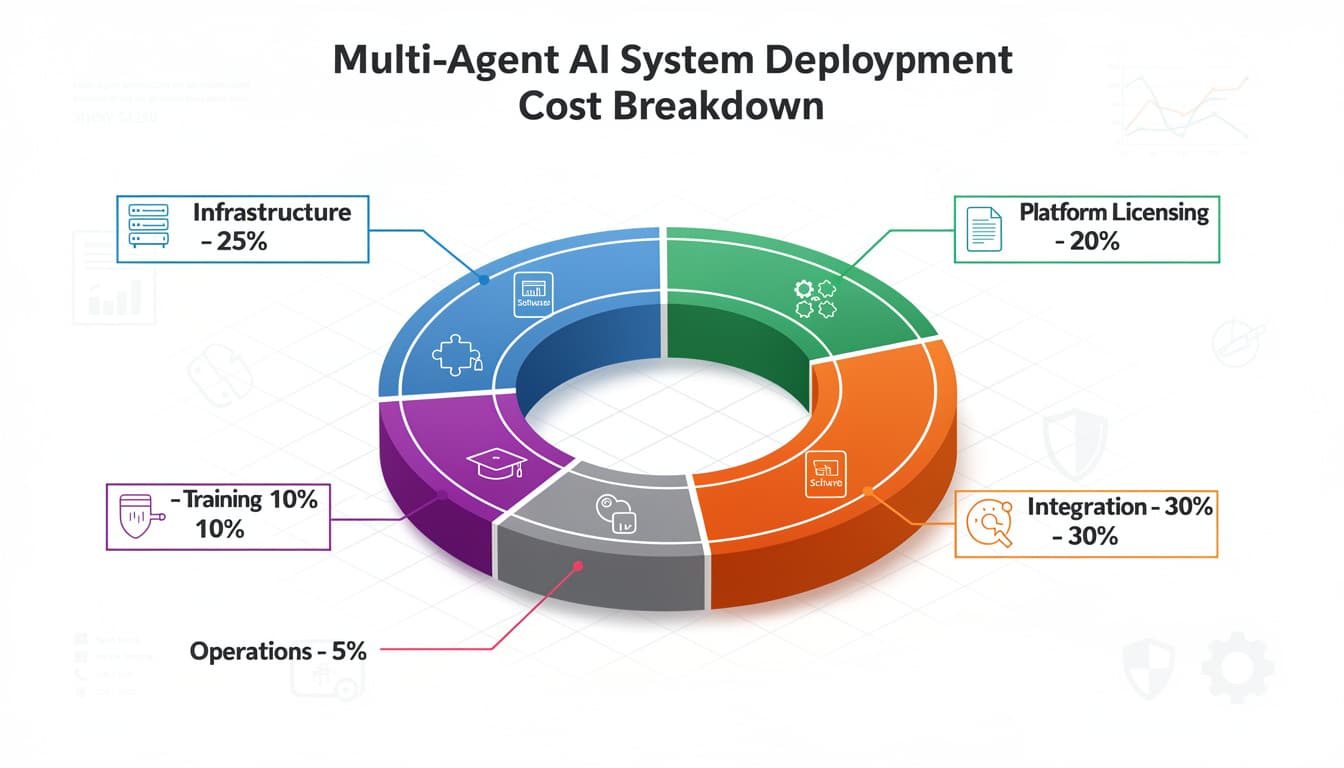
🎛️ The Six Pillars of a Multi-Agent System Budget
Imagine a legal consulting firm that wants to automate contract analysis using specialized AI agents. The first agent reads and categorizes documents, the second identifies risks, and the third suggests amendments. At first glance, it seems enough to configure three agents and connect them to the company's document database. In reality, this requires:
- 🔌 Cloud infrastructure sized to handle parallel API calls and vector storage
- 🔗 Integration work to connect the agents to legacy systems (document management, customer databases, billing tools)
- 📚 Building a vector database containing legal precedents and contract templates
- 🧠 LLM usage fees (API calls, tokens consumed) that vary with the volume of documents processed
- 🔐 Implementing audit and compliance controls (traceability, legal liability)
- 👥 User training and ongoing support so the agents are actually used
Each of these elements generates direct and indirect costs. Ignoring any one of them is like building a house without foundations: the project will hold up temporarily, then collapse.
💸 Detailed Cost Analysis: Where Your Budget Really Goes
Let's review each cost component with real figures observed in 2025 and 2026.
🖥️ Cloud Infrastructure Costs: The Invisible Foundation
A multi-agent system orchestrating several agents cannot run efficiently on basic on-premise hardware. It requires on-demand computing power, scalable storage, and above all, low latency so agents can exchange messages quickly.
Infrastructure costs vary considerably depending on your provider. Google Cloud, AWS, and Microsoft Azure all offer AI orchestration services, but their pricing differs. For a moderate deployment (10 to 20 agent calls per day, 1 to 5 GB of vector storage), the monthly budget typically falls between €500 and €2,000.
This figure rises quickly if you add GPUs for local inference, cross-region replication for high availability, or automated backups across multiple zones. A company deploying a system for 500 end users should budget between €3,000 and €10,000 per month for cloud infrastructure alone.
The classic mistake? Budgeting for a peak load that's never reached, or conversely, under-provisioning and discovering the system crashes during peak hours. The solution is to start conservatively (with a low initial cost), then adjust resources as actual usage patterns emerge.
🧩 Integration and Architecture: The Most Overlooked Financial Bottleneck
Integration is the area where budgets most often go off the rails. Technically, connecting an AI agent to your ERP or CRM seems simple: all it takes is an API and a webhook. In practice, it's rarely that straightforward.
An organization's legacy systems are often fragmented. An agent that needs to analyze a customer order may have to query four different systems: the CRM (for customer data), the ERP (for order history), the warehouse system (for stock availability), and the financial system (for payment terms). Normalizing data from these four sources, handling synchronization errors, and building fallback logic in case a system fails all cost development time.
On average, integration accounts for 30 to 50% of the total initial cost of a multi-agent project. For a three-month integration engagement with a team of two to three developers, budget between €40,000 and €120,000. For more complex architectures (with multiple agents, multiple target systems, strict security requirements), this figure can double or triple.
Hiring a firm specializing in AI architecture may seem costly in the short term (often €150 to €250 per hour), but it avoids building a fragile integration that will need to be refactored six months later at great expense.
🧠 Language Model and API Call Costs
Every interaction between an agent and a language model (Claude, GPT-4, Gemini, etc.) incurs variable fees based on the number of tokens consumed. A token roughly represents four characters.
Let's take a concrete example: an agent analyzing supplier invoices must, for each invoice, call an LLM to extract key elements (amount, supplier, due date). An average invoice generates about 1,500 input tokens (the invoice text) and 500 output tokens (the structured extraction). At an average rate of €0.003 per 1,000 input tokens and €0.012 per 1,000 output tokens, a single call costs around €0.008.
If your organization processes 10,000 invoices per month, that amounts to €80 per month in API costs for this single agent. Multiplied across a dozen agents and the cross-calls between them, the monthly budget can easily reach €800 to €2,000.
This cost is unpredictable at the time of deployment because it depends closely on actual usage. A pessimistic estimate (assuming 50% overhead from retries and non-optimized calls) is often prudent. Build it into your budget as a variable to be adjusted quarterly, not as a fixed constant.
💾 Vector Storage and Specialized Databases
For your agents to quickly retrieve relevant information from thousands of documents, you need a vector database (Pinecone, Weaviate, Milvus). These databases convert text into numerical vectors and enable ultra-fast similarity searches.
The cost depends on data volume. A small company with 100,000 documents and a 2 GB vector database can run on a cloud solution for €100 per month. A large organization with 10 million documents and a 50 GB database should budget between €500 and €1,500 per month.
On top of that, you need to add the cost of keeping the database up to date: every time a new document enters your system, it must be vectorized (API call), indexed, and synchronized. This adds 10 to 20% overhead to your monthly API costs.
🔐 Security, Compliance, and Auditing
Autonomous agents raise formidable ethical and legal questions. Which agent made which decision? Who is liable in case of error? Is the data processed compliant with the GDPR or other standards?
Implementing full traceability, revocation mechanisms (the ability to undo an agent's action), and regular audits requires specific development work. In regulated industries (finance, healthcare, legal), these requirements are non-negotiable.
The cost of these measures falls into three categories:
- 💻 In-house development (logging, alerts, audit dashboards): €20,000 to €50,000
- 🔒 Third-party security tools (secrets management, anomaly monitoring): €200 to €1,000 per month
- 📋 External audits and certifications (SOC 2, ISO 27001): €5,000 to €30,000 one-time
Many organizations discover too late that ignoring security at launch costs far more to fix later. A data breach discovered two years after an unsecured deployment can generate fines and remediation costs that far exceed the project's original budget.
👥 Training, Documentation, and User Support
A sophisticated multi-agent system isn't intuitive to use. Users need to understand what the agents actually do, what their limitations are, and how to supervise them properly.
Plan a training budget from the start: group sessions (€2,000 to €5,000), tutorial video production (€3,000 to €10,000), written documentation (€2,000 to €5,000), launch-time user support (one part-time person for 3 months: €5,000 to €10,000).
You also need to budget for ongoing operational upkeep: bug fixes, performance optimization, and agent updates based on user feedback. On average, plan for 10 to 15% of the initial deployment cost, annualized, for this activity.
📊 Pricing Comparison of Leading Platforms and Frameworks
Three approaches dominate the market: turnkey SaaS platforms, open source frameworks, and specialized agency solutions. Each has its own implications for pricing and control.
☁️ Proprietary SaaS Platforms: All-Inclusive at a Premium Price
Solutions like OpenAI Agents SDK, Anthropic's Claude Managed Agents, or turnkey frameworks offer an integrated approach: you configure your agents through a web interface, connect your data, and the system handles the infrastructure under the hood.
Advantages: Fast setup (2 to 4 weeks), no infrastructure management, vendor support included, scalable features built into the platform.
Typical costs: Between €500 and €5,000 per month depending on the number of agents, API call volume, and the integrations required. For a small or midsize business deploying 3 to 5 agents, expect €1,000 to €2,000 per month.
Drawbacks: Unpredictable API costs, vendor dependency, limitations on deep customization, hidden fees for certain advanced features.
🔓 Open Source Frameworks: Low Cost but High Complexity
Frameworks like CrewAI, LangGraph, or AutoGen offer a more cost-effective approach. You host the agents yourself (or on your own cloud), retain full control over the source code, and only pay for cloud infrastructure and external API calls.
Check out a detailed guide on AI agent frameworks for decision-makers to better compare your options.
Advantages: Zero software licensing costs, full flexibility, the option to run some agents locally (without API calls), and preserved intellectual property.
Typical costs: €0 for software licensing + infrastructure costs (€1,000 to €5,000 per month) + development/integration costs (€40,000 to €150,000). Overall: lower than SaaS in the short term if you have an in-house technical team, more expensive if you need to outsource development.
Drawbacks: Steep learning curve, ongoing maintenance required, no commercial support, and full responsibility for bugs or degraded performance.
🏢 Specialized Agencies: Tailored Solutions with Hands-On Support
An AI agency designs a tailored solution for you, deploys it, and maintains it. You don't manage infrastructure or code; you pay for the value created.
Check out an analysis of AI agency pricing in 2026 to get a sense of market rates.
Advantages: A solution optimized for your use case, full support (design, deployment, maintenance), no internal workload, and industry expertise brought by the agency.
Typical costs: Between €80,000 and €500,000 for a complete project (3 to 6 months), plus €5,000 to €15,000 per month in maintenance. The total cost can be competitive for a large organization, but prohibitive for a small or midsize business.
Drawbacks: Very high upfront costs, dependency on the agency, and less flexibility than in-house development with open source frameworks.
📈 Summary Pricing Comparison Table
| Dimension | SaaS Platforms | Open Source + Cloud | Specialized Agencies |
| 💰 Initial cost | €5,000 to €20,000 | €40,000 to €150,000 | €80,000 to €500,000 |
| 📅 Monthly cost (year 1) | €1,500 to €5,000 | €2,000 to €7,000 | €5,000 to €15,000 |
| ⏰ Deployment time | 2 to 4 weeks | 2 to 4 months | 3 to 6 months |
| 🔐 Security & compliance | Managed by the vendor (with limits) | Your responsibility | Managed by the agency |
| 🛠️ Flexibility | Limited to platform features | Maximum | High (but depends on the agency) |
| 📊 Total cost over 3 years | €60,000 to €200,000 | €65,000 to €300,000 | €150,000 to €1,000,000 |
🎯 Case Studies: Budgeting a Multi-Agent System Across Three Industries
📋 Case 1: Law Firm (50 Employees) Automating Contract Analysis
Goal: Deploy three agents (risk analysis, key element extraction, comparison against templates) for 500 contracts per month.
Initial budget (year 1):
- 🖥️ Cloud infrastructure (Google Cloud, Weaviate vector database): €1,500 per month
- 🔗 Integration with the document management system: €35,000
- 🧠 LLM API calls (Claude, GPT-4): €800 per month
- 🔐 Compliance, traceability, auditing (critical for the legal sector): €25,000
- 👥 Training for lawyers and paralegals: €8,000
- 📚 Building the vector database (historical contracts): €12,000
- 👨💼 First-year user support: €8,000
Year 1 total: €97,300
Recurring annual costs (year 2 onward): €35,000 to €45,000 (infrastructure + API + support)
ROI: If each agent saves a senior attorney 4 hours per week (€250/hour), that's €52,000 in annual savings per agent, or €156,000 for three agents. ROI turns positive before the end of year 1.
🏭 Case 2: Manufacturing SMB (100 Employees) Optimizing the Supply Chain
Goal: Two agents (demand forecasting, supplier order optimization) to reduce stockouts and overstocking.
Initial budget (year 1):
- 🔌 Infrastructure (data warehouse, vector database): €2,000 per month
- 🔗 ERP integration, procurement system, supplier data: €50,000
- 🧠 API calls and compute for real-time analysis: €1,200 per month
- 🔐 Security for sensitive supplier data: €15,000
- 👥 Training for the logistics and procurement team: €5,000
- 📊 Dashboard development for supervisors: €10,000
Year 1 total: €90,400
Recurring annual costs: €40,000 to €50,000
ROI: A 15% reduction in storage costs and 10% fewer poorly anticipated orders equal €80,000 to €120,000 in annual savings. ROI: 0.9 to 1.3x as early as year 1.
🏥 Case 3: HealthTech SaaS Platform (300 Users) Triaging Patient Requests
Goal: One agent automating the triage and routing of 5,000 monthly patient messages to the right professional (nurse, general practitioner, specialist).
Initial budget (year 1):
- ☁️ HIPAA-compliant AI agent SaaS platform (e.g., Claude Managed Agents): €3,000 per month
- 🔗 Electronic health record (EHR) integration: €30,000
- 🔐 HIPAA compliance, encryption, audit trail: €20,000
- 👥 Training for medical staff: €6,000
- 🚨 Customer success and critical incident support: €12,000 (first year)
Year 1 total: €99,000
Recurring annual costs: €50,000 to €60,000
ROI: A nurse currently triages 80 messages a day, or about 2 hours. If the agent automates 70% of that, it's 1.4 hours/day/nurse × 4 nurses × 250 working days/year × €35/hour = €49,000 in savings. Add improved handling of urgent cases (shorter response times): ROI is close to breakeven in year 1, then strongly positive.
🔍 Detailed Financial Assessment: Beyond the Sticker Price
Pricing is only the first layer. You also need to consider hidden costs, unpredictable variables, and how poor planning can blow up budgets.
⚠️ The Hidden Costs People Always Forget
Internal learning curve and mistakes: In the first three months, your team will make configuration mistakes (overly lax security settings, improperly sized API capacity). These mistakes cost time to fix and sometimes unexpected fees. Buffer budget: +15% of the estimated cost.
LLM model changes: You built your system on GPT-4, but GPT-5 launches with superior capabilities and different pricing. Migrating agents to a new model requires refactoring: €5,000 to €20,000 depending on complexity.
Unforeseen technical maintenance: A dependency update breaks your system. A data leak (even a small one) requires an investigation and remediation. These incidents average 10 to 15% of annual operating costs.
Feature creep: Once an agent is deployed, users ask for improvements: “Can it also analyze emails?” or “Can it automatically create tickets?” These enhancements cost €3,000 to €10,000 per additional feature.
📉 How to Project Future Costs Accurately
Don't base your budget on a single estimate. Instead, consider three scenarios:
- 🎯 Optimistic scenario: Moderate usage, few complications. Year 2+ cost = 0.6x year 1 cost
- 📊 Likely scenario: Growing usage, some optimization required. Year 2+ cost = 0.75x year 1 cost
- ⚠️ Pessimistic scenario: Frequent changes, intensive maintenance. Year 2+ cost = 1.1x year 1 cost
Budget based on the likely scenario and plan a contingency reserve of 20 to 30% to absorb the gap with the pessimistic scenario.
💡 Cost-Reduction Strategies Without Sacrificing Quality
Start with a narrow pilot: Instead of deploying ten agents at once, launch one with a small group of users. The initial cost is 60% lower, and you learn a lot about operational reality before scaling.
Use cheaper models for certain agents: Not every agent needs the best model on the market. An agent that simply formats data can use GPT-3.5 or Gemini Flash (much cheaper) instead of GPT-4. Savings: 70% of API costs for that use case.
Optimize API calls through batch processing: Instead of processing one document at a time, process hundreds in parallel (if your use case allows it). This reduces overhead and improves efficiency: -30% to -50% in API costs.
Run certain agents locally: If you're using an open source framework, some simple agents (format checking, filtering) can run directly on your own servers without external API calls. This adds further substantial API savings.
Check out detailed AI agent SaaS pricing for 2026 to understand how to adjust your architecture to available budgets.
🚀 Planning Deployment and Budgeting in Phases
A smart rollout is never a “big bang.” It's a series of well-defined phases, each with its own budget and milestones.
📅 Phase 0: Preparation and Assessment (weeks 1-4, budget €5,000 to €15,000)
Before spending €100,000, validate your hypothesis on a small scope.
- 🎯 Precisely define the business problem to solve
- 🧪 Test a quick proof of concept (use a SaaS service for 2 weeks for €500)
- 📊 Measure potential ROI and expected savings
- 🔍 Identify system dependencies (APIs, databases to connect)
- 💬 Consult internal and external stakeholders (suppliers, partners)
🏗️ Phase 1: Prototype Deployment (weeks 5-12, budget €30,000 to €60,000)
A first agent in production with a small group of pilot users (10 to 50 people).
- ⚙️ Set up minimal infrastructure (cloud, vector storage)
- 🔗 Integrate with one key system (e.g., primary CRM or ERP)
- 🤖 Develop the first agent with full manual oversight
- 📚 Create the initial vector database
- 👥 Train the pilot group and collect feedback
- 🔒 Implement basic security controls
📈 Phase 2: Optimization and Expansion (weeks 13-24, budget €40,000 to €80,000)
Refine the first agent based on feedback, then add 1 to 2 additional agents.
- ⚡ Optimize the first agent's performance (reduce latency, improve accuracy)
- 🔗 Integrate with 1 to 2 additional systems
- 🤖 Develop and deploy agents 2 and 3
- 📊 Set up monitoring dashboards
- 📝 Document procedures and support playbooks
- 🔐 Strengthen security and compliance
🌟 Phase 3: Full Production and Maintenance (from week 25 on, budget €35,000 to €50,000 annually)
All agents in production across the entire organization. Transition to a stable operational mode.
- 🚀 Roll out to all relevant users
- 📞 Set up dedicated user support (tier 1 and 2)
- 🔄 Ongoing maintenance, bug fixes, and optimizations
- 📊 Monthly reporting on ROI and realized savings
- 🔀 Progressive refactoring based on new best practices
📋 Budget Management Checklist for Your Multi-Agent Project
Before signing any contract, make sure you've checked off every one of these points:
- ✅ Have a detailed estimate covering infrastructure, integration, API fees, training, and maintenance
- ✅ Have set a contingency budget of 25 to 30% to absorb the unexpected
- ✅ Have identified the hidden costs specific to your industry (compliance, security)
- ✅ Have planned a phased deployment with clear go/no-go decisions after each phase
- ✅ Have defined how to measure ROI from the start (what savings? what timelines?)
- ✅ Have consolidated variable API costs based on a realistic usage estimate
- ✅ Have planned user support and training suited to your teams' technical level
- ✅ Have signed clear SLAs with any outside provider (agency, SaaS platform)
- ✅ Have confirmed who pays for what (IT department, business leadership, cross-functional budget)
- ✅ Have scheduled a quarterly budget review to adjust based on actuals
This list may seem long, but each point corresponds to a classic source of budget overrun.
🎬 Takeaway: Investing Wisely in AI Agents
Deploying a multi-agent system isn't an ordinary software purchase. It's a structural investment that transforms how your organization operates. Like any investment, it demands a clear understanding of costs, rigorous planning, and active management.
Three key takeaways:
- 💰 The real cost always exceeds the initial estimate by 40 to 60%. Budget conservatively and set aside a reserve.
- ⏱️ Integration and maintenance account for 40 to 50% of the total cost: don't overlook them.
- 🎯 A phased rollout reduces risk and allows you to learn before scaling: it costs more in the short term but pays off more in the long run.
Explore the best agentic AI platforms in 2025 to refine your pricing comparison. Also check out the guide on ITSM and ITAM solutions if your use case involves internal IT management.
Ultimately, the question isn't “how much does it cost?” but “how much savings or value does this actually generate, and am I willing to invest that amount to get it?” Answering that question honestly before you start eliminates nasty surprises and projects that never deliver ROI.
Author Profile
Latest entries
 Finance20 November 2026Consumer Credit: Mini-Loans, Split Payments, and Overdrafts Face Tighter Rules
 Planet15 November 2026CO2 Emissions: Why Transportation Remains France's Climate Blind Spot
 Artificial Intelligence12 November 2026Imagine Enterprise: IBM and Microsoft Team Up on AI Agents for Large Businesses
 Economy11 November 2026Livret A Rate: Understanding How It's Calculated and Its Limits
This article was written with the help of artificial intelligence. Editorial policy