In brief: The rise of free intelligent agents is radically transforming the way professionals optimize their workflow. In 2026, several entry-level AI software options rival the premium solutions of 18 months ago. From text-based virtual assistants to image generation and automation tools, a genuine accessibility revolution is underway. Measurable time savings begin within the first few weeks of use, while free autonomous agents are positioning themselves as essential for any organization looking to build an AI strategy with no upfront investment.
🎯 The Fundamentals of Free AI Agents and Their Impact on Modern Productivity
Contents
The concept of an AI agent has become considerably more democratized. Beyond simple conversational chatbots, today's intelligent agents now have orchestration capabilities, conversational memory, and the ability to execute multi-step tasks without human intervention. This technical evolution creates an unprecedented opportunity: access to sophisticated digital tools without opening your wallet.
The real impact starts with a simple observation. A team of five salespeople using ChatGPT for free to draft client proposals easily saves three hours a week. Multiply that by 52 weeks and 250 teams, and you understand why the time savings generated by these virtual agents are generating so much interest among decision-makers. These aren't marketing promises: they're recovered hours, immediately quantifiable.
The key lies in careful selection. Not all free tools are created equal. Some offer limited but substantial access to the best language models on the market, while others offer watered-down versions. Understanding this distinction becomes critical for anyone looking to build a coherent automation ecosystem without spending a cent.
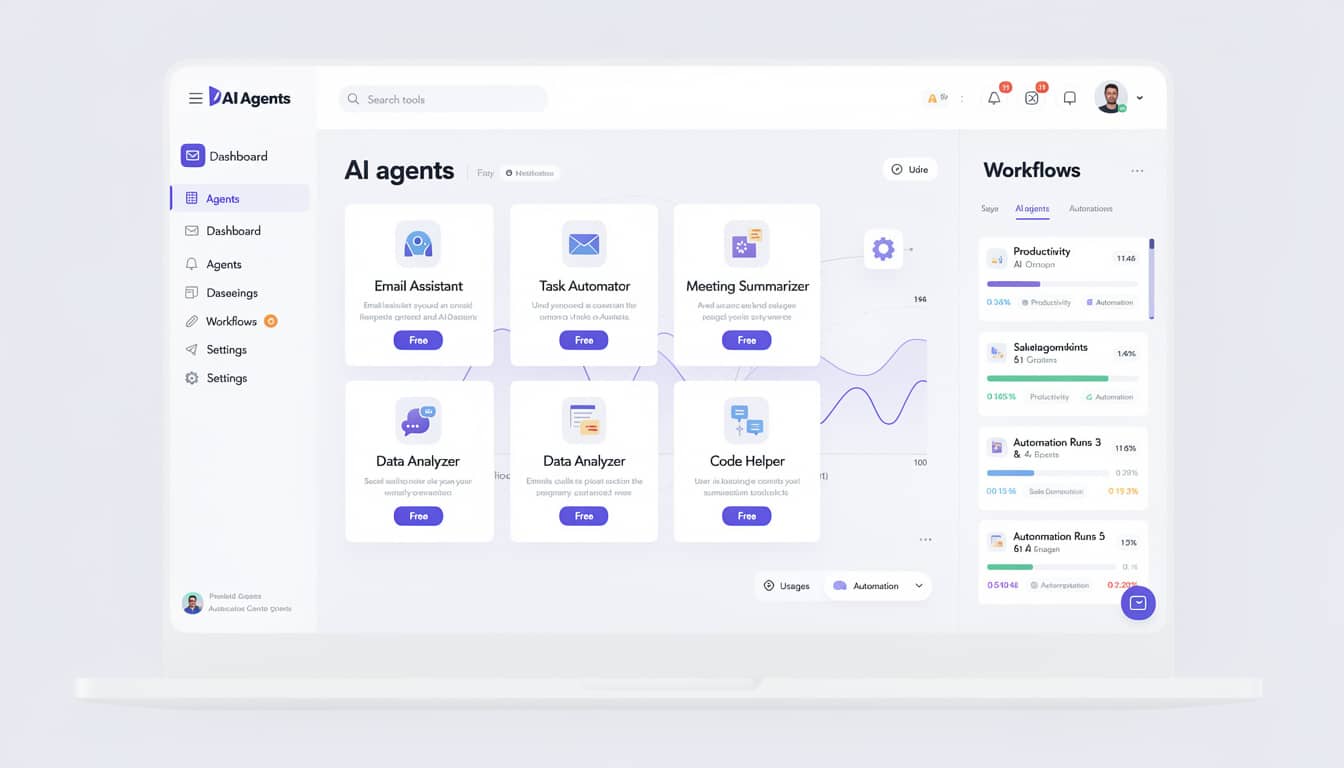
🚀 ChatGPT, Claude, and Gemini: The Three Pillars of Free Virtual Assistants
Three names unquestionably dominate the free AI software landscape in 2026: OpenAI with ChatGPT, Anthropic with Claude, and Google with Gemini. These three giants don't just offer limited trial solutions; they provide substantial versions of their flagship models, with no subscription required.
💬 ChatGPT: The Must-Have for Getting Started and Structuring Your Workflows
ChatGPT remains the most accessible and best-documented entry point for anyone discovering intelligent agents. The free plan provides access to GPT-4o mini, a model capable of handling complex conversations, analyzing files, generating code, and even creating images via DALL-E 3. There is a daily limit, but it's set at a reasonable level for moderate professional use.
What sets ChatGPT apart in the free virtual assistant category is its ecosystem. Custom GPTs (configurable mini-agents) make it possible to create specialized workflows without coding. A manager can build an agent that automatically analyzes team reports, a marketing manager can create an assistant that optimizes product descriptions, all without leaving the ChatGPT interface.
For developers, API integration remains a paid feature, but free prototyping on chatgpt.com is enough to validate an approach before investing in cloud infrastructure. This is precisely why time savings begin immediately: there's no friction to adoption.
📄 Claude: The Formidable Alternative for Document Analysis and Nuanced Writing
Anthropic's Claude occupies a specific but crucial niche: analyzing lengthy documents and writing content that requires deep contextual understanding. With an astronomical context window (200,000 tokens on the paid plan, enough to analyze an entire body of documentation), Claude outperforms its competitors on tasks requiring systematic reasoning.
Claude's free plan provides access to Claude Sonnet 4.5, a mid-tier but remarkably capable model. Lawyers use it to decipher contracts, researchers to summarize academic papers, and consultants to structure analytical reports. The “Artifacts” interface even allows you to create structured content (HTML, SVG, full code) directly within the conversation.
What makes Claude strategically interesting in your arsenal of digital tools is its clear differentiation. Where ChatGPT excels at generating quickly, Claude shines in depth. Using both in rotation, depending on the type of task, multiplies efficiency well beyond what a single tool can offer.
🌐 Google Gemini: The Power of Multimodal and the Google Ecosystem
Google Gemini represents a radically different approach. With the native ability to process images, videos, and even audio files, Gemini 2.0 Flash (free) positions Google as the multimodal option par excellence. For organizations already invested in Google Workspace, this native integration eliminates the friction of context-switching.
The Gemini API also offers a very generous free quota (60 requests per minute for certain tiers), making it an economical option for developers building autonomous agents capable of processing visual data without significant costs. A startup can thus prototype a document recognition system, an image classifier, or a live video analyzer, all for free.
The major limitation remains consistency. Google Gemini sometimes produces variable results depending on the type of task, which is why experienced practitioners position it as a complement rather than a replacement for ChatGPT or Claude. But for exploration and learning, it's a solid foundation.
🎨 Image Generation and Creative Content: Free Solutions That Replace Photoshop
Intelligent agents are no longer limited to text. Free AI software for image generation has advanced to the point where design professionals now use these tools for creative exploration, rapid prototyping, and even final production, depending on the context.
🖼️ DALL-E 3 and Flux.1: Two Competing Approaches to Generative Imagery
DALL-E 3, integrated directly into the free version of ChatGPT, remains the most accessible option for beginners. Its understanding of natural language is remarkable: describing a mood, a style, or a composition in everyday language produces results aligned with intent, without needing to master technical prompt jargon. The daily quota (typically 15 to 25 generations) is enough for moderate creative use.
Flux.1 Schnell, available for free via Hugging Face, represents an incredibly powerful open-source alternative. Available since 2025, this model often generates results comparable to or better than DALL-E 3, with no quota limitation if you use it through a web interface. For projects requiring high volume, Flux.1 becomes the obvious strategic choice.
Stable Diffusion, the veteran of the field, remains entirely open source and free if you have the right hardware. For organizations looking to build an image generation infrastructure without relying on third-party services, Stable Diffusion via ComfyUI or Automatic1111 remains essential despite its steeper learning curve.
🎬 Video Generation: Where Free Plans Become Seriously Useful
Free AI video has long been more of a novelty. In 2026, that's different. Runway Gen-4 offers monthly credits that let you generate a handful of short videos. HeyGen, which specializes in avatars (ideal for presentation videos without appearing on camera yourself), offers one minute of free monthly content. These are no longer demo tools; they're solutions used in production by small teams.
For someone who needs to regularly produce video content, this accumulation of free credits represents substantial savings. A digital content agency can easily rack up two free hours of video per month by combining the free plans of several platforms.
⚙️ Automation and Orchestration: Turning AI Agents into Productive Workflows
Having free access to ChatGPT, Claude, and Gemini is good. Orchestrating these agents into an automated workflow without human intervention is better. This is where the ecosystem of free autonomous agents becomes genuinely relevant for real-world productivity.
🔗 n8n and Make: No-Code Automation for Everyone
n8n and Make (formerly Integromat) make it possible to build workflows connecting ChatGPT, Claude, Google Sheets, Slack, Gmail, and hundreds of other services. n8n's free plan includes substantial recurring execution and access to most connectors. Make also offers a generous monthly task allowance.
A concrete use case: a sales manager sets up a free workflow using Claude that analyzes every incoming email, extracts the key points, and automatically creates a task in the CRM. Zero code, full automation, no cost. The time savings quickly become measurable (easily an hour saved per day for a team handling a significant volume of emails).
These free automation platforms become the missing link between isolated virtual agents and an integrated, productive ecosystem. Check out the complete analysis of AI agent tools to understand how these building blocks fit together.
🤖 CrewAI and AutoGen: Building Sophisticated Multi-Agent Systems
For a more technical audience, CrewAI and AutoGen offer open-source frameworks for building fully autonomous multi-agent systems. A “team” of agents coordinates to solve complex problems: one agent searches for information, another analyzes it, and a third formulates a recommendation, without explicit human direction.
These tools remain free and open source. The cloud infrastructure to run them can be free too (Google Cloud, AWS, or Azure credits for startups). It's the ideal playground for a developer exploring how to integrate intelligent agents into larger enterprise systems. To understand how CrewAI compares to other frameworks, specialized resources offer detailed comparisons.
🔍 Research, Monitoring, and Analysis: The Specialized Agents Replacing Google
Information research has fundamentally changed. Free intelligent agents specialized in web synthesis and peripheral monitoring have redefined what “useful research” means today.
🔎 Perplexity: When the Search Engine Becomes an Analytical Agent
Perplexity breaks completely free of the “classic search engine” model. This free intelligent agent accesses the web in real time, synthesizes the results, and cites its sources directly in its response. For monitoring, industry research, or identifying current facts, Perplexity outperforms Google in most cases.
The free plan includes unlimited searches with the Sonar model (optimized for search). Five Pro searches (using GPT-4o) are allocated daily, enough for reasonable professional use. The limit is never a hindrance for someone doing occasional monitoring or research.
For an organization that needs continuous monitoring without investing in a premium solution, free Perplexity combined with n8n creates an automated monitoring system that compiles industry news directly into a Google Docs document or a Slack channel. Zero cost, maximum impact.
📚 NotebookLM: Turning Your Documents into a Searchable Knowledge Base
Google's NotebookLM may be the most underrated tool in this selection. You upload your documents (PDFs, Google Docs, YouTube videos, transcripts), and NotebookLM creates an “intelligent notebook” that you can query just as you would an expert assistant on the subject. Completely free, with no usage limit.
A consultant can upload all of a client's reports and instantly get cross-referenced summaries, comparative analyses, or thematic extracts. A researcher can ingest 50 academic papers and explore the connections between concepts without reading them manually. This is pure augmented knowledge management.
💻 Coding and Development: Agents for Developers Too
Developers haven't been left out of this free autonomous agent revolution. GitHub Copilot, once reserved for paying subscribers, has offered a substantial free plan since 2025. Tabnine and Gemini Code Assist round out the ecosystem with differentiated approaches.
🛠️ Free GitHub Copilot: Intelligent Autocomplete Made Accessible
GitHub Copilot's free plan includes 2,000 completions and 50 chat messages per month. For a developer working on personal projects or pre-revenue startups, that's plenty. The ability to ask Copilot to explain code, refactor it, or generate tests suddenly becomes accessible at no cost.
Integration with VS Code, JetBrains, and other IDEs means no need to switch tools. It's simply a cognitive upgrade built into your existing development environment. The time saved is measured in minutes per day, which add up quickly.
🔐 Tabnine: Privacy for Security-Conscious Developers
Tabnine Free offers intelligent autocomplete that, by default, never sends your code to third-party servers. For developers working on proprietary or sensitive code, this is crucial. Learning happens locally, making Tabnine a genuinely private agent.
🎤 Transcription, Voice Synthesis, and Multimedia: The Utilities That Save Hours
Beyond text-based models, free AI software for audio and video manipulation is gradually becoming as powerful as premium paid tools.
🎙️ Whisper and ElevenLabs: Free AI Audio
Whisper, OpenAI's open-source model, transcribes audio with remarkable accuracy in 99 languages, including French. Installed locally or used via Replicate, it offers unlimited, free transcription. ElevenLabs offers 10,000 characters per month of text-to-speech, synthesizing convincing digital voices.
Combined in a single workflow, these specialized virtual agents turn audio content into text, enable the generation of synthetic voiceovers, and create automated podcasts. An academic content team can easily save 10 hours a week by automating what used to be a manual process.
Check out the detailed resources on the best free AI software to explore even more industry-specific use cases.
📈 A Gradual Adoption Strategy: From Prototype to Productive Ecosystem
Moving from “testing free intelligent agents” to “building a real automation infrastructure” requires a structured approach. Unlike costly deployments, free plans allow for risk-free experimentation, which fundamentally changes the dynamic.
📋 Week 1: Guided Exploration and Selecting Key Tools
Start with ChatGPT for general tasks, Claude for deep analysis, and Gemini for multimodal work. Three tools, three distinct profiles, no cost. This week's goal: understand where each tool excels and where it hits its limits. Ask the same question to three different agents and compare the answers.
Document your findings. Maybe Claude shines for your contract summaries, ChatGPT for brainstorming, and Gemini for visual analysis. This personalized matrix becomes your guide for the following weeks.
🔄 Weeks 2-3: Gradually Integrating into Your Existing Workflows
Identify a recurring task: drafting emails, analyzing reports, generating product descriptions, processing data. Introduce an intelligent agent into that process. Start simply: copy and paste into ChatGPT, observe the results, iterate.
At this stage, time savings become measurable. A task that used to take 30 minutes suddenly takes 5. That difference, multiplied by how often the task repeats, quickly builds a business case for premium tools or more complex integrations.
🚀 Week 4 and Beyond: No-Code Automation and Multi-Agent Systems
If the previous results are conclusive, bring in n8n or Make to automate fully. Build workflows that turn your autonomous agent infrastructure into a system capable of handling tasks without human intervention. At this stage, a free tool, combined intelligently, quickly replaces a paid premium tool.
Check out detailed resources like the complete list of free AI agent software to discover specialized tools tailored to your specific industry.
This gradual progression creates natural adoption without organizational shock. Learning happens alongside real production work. Teams become self-sufficient in using these digital tools even before you consider a bigger investment.
🎯 Building a Resilient Multi-Agent Stack
A mature strategy combines several tools: ChatGPT for quick generation, Claude for analytical depth, Perplexity for web monitoring, NotebookLM for internal knowledge, and GitHub Copilot for code. Each fills a distinct role. Together, they create an automation footprint that would be impossibly broad for an organization with no AI budget.
Resilience increases as well: if one service goes down, others pick up the slack. If ChatGPT is overloaded, you switch to Claude or Gemini without friction. This diversity, made possible by free access, transforms AI from a fragile tool into robust infrastructure.
To dig deeper into this multi-agent architecture, the comparative analyses of virtual assistants offer solid technical perspectives on agent orchestration.
💡 Pitfalls to Avoid and the Real Selection Criteria
Not all free plans are created equal. Some tools offer limited trials, while others provide a genuinely substantial freemium plan. Understanding this distinction avoids disappointment and maximizes your return on investment (even when that investment is zero).
⚠️ Quota vs. Quality: The Real Dilemma of Free Plans
A tool with a very limited quota but access to the best model can outperform an unlimited tool running a watered-down version of the model. Free ChatGPT with GPT-4o mini and a limited quota outperforms free Copilot with unlimited access to a model that's 18 months older. What matters isn't simply “how much can I use” but “how good is what I'm actually using”.
Test each tool on tasks that represent your actual needs. A made-up task or a benchmark is never enough; your own personalized context reveals the real strengths and weaknesses.
🔒 Data, Privacy, and Ethics
Before integrating a free intelligent agent into a professional workflow, check its data usage policy. OpenAI uses ChatGPT conversations (free plan) to fine-tune its models, unless you explicitly opt out in the settings. Anthropic's Claude does not. Some organizations find the former approach unacceptable for sensitive content.
This nuance is critical for regulated industries: healthcare, finance, law. An otherwise magical free tool loses all its value if it creates compliance exposure. This is especially relevant in the context of a broader debate about ethics and the privileges left behind in the AI rush.
🌱 Skill-Building: An Often-Overlooked Prerequisite
The best free AI in the world becomes useless if your team doesn't know how to use it effectively. Investing a week in learning prompting best practices, context engineering techniques, and multi-agent orchestration pays off far more than a frantic hunt for “the best tool”.
Time savings come less from the tool itself than from the skill of the person using it. A developer who has mastered Claude extracts far more value than a novice developer with access to ten different tools.
This mental shift — from “we need a better tool” to “we need better operators” — completely changes the ROI equation for free autonomous agents. Free training resources are proliferating today, making this learning curve more accessible than ever.
Author Profile
Latest entries
 Finance20 November 2026Consumer Credit: Mini-Loans, Split Payments, and Overdrafts Face Tighter Rules
 Planet15 November 2026CO2 Emissions: Why Transportation Remains France's Climate Blind Spot
 Artificial Intelligence12 November 2026Imagine Enterprise: IBM and Microsoft Team Up on AI Agents for Large Businesses
 Economy11 November 2026Livret A Rate: Understanding How It's Calculated and Its Limits
This article was written with the help of artificial intelligence. Editorial policy