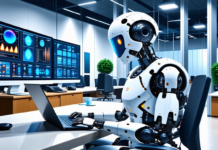
In brief — Smart agents powered by artificial intelligence are radically transforming the professional landscape in 2026. Unlike traditional chatbots, these autonomous systems reason, plan, and learn from their experiences without constant supervision. Increased versatility, growing proactivity, and multimodal understanding mark the main trends in this evolution. The agentic AI market is expected to exceed $300 billion by 2027, but 41% of employers are considering reducing certain positions, while 97 million new roles are expected to emerge elsewhere. This silent revolution is redefining not only how we work, but also the skills expected of everyone.
🤖 These assistants no longer look like your old chatbots
Contents
The distinction between an AI agent and a simple program has never been so stark. For years, we gave precise tasks to software that executed them blindly, with no flexibility or creativity. An AI agent works differently: it understands your overall goal, evaluates several paths to achieve it, and selects the best strategy, much like a seasoned colleague who gains experience with every interaction.
This decision-making autonomy rests on two fundamental pillars: reasoning and planning. Before acting, these systems analyze the situation, consider different options, and develop tailored strategies. That's what sets them apart from simple executors and brings them closer to a more deliberative form of intelligence. Unlike a static program waiting for its next update, an AI agent improves continuously. Every interaction generates learning, refines its skills, and makes it progressively more effective at its mission.
The arrival of large language models was a decisive turning point. These complex architectures give agents a near-natural understanding of our intentions, enabling smooth, context-aware interactions. Today, they're everywhere: drafting emails, organizing calendars, conducting in-depth research, offering personalized advice. This growing versatility marks one of the major trends in the development of applied artificial intelligence.

💡 How these autonomous agents really work
Imagine an assistant that doesn't just carry out your orders, but anticipates your needs and takes relevant initiatives. This new kind of assistant continuously gathers data: your clicks, your messages, your search queries. This constant collection lets it build a deep understanding of your habits and preferences, gradually refining its responses over time.
This continuous adaptation is the key to its effectiveness. Unlike a programmed machine, the agent develops a form of artificial intuition by observing your past behavior. It detects patterns, generalizes what it has learned, and becomes able to guess your expectations before you even state them explicitly. This shift from reactivity to proactivity is what characterizes the most advanced systems currently being deployed.
We now talk about “agentic AI” to describe systems capable of designing their own action plan. Rather than following a rigid script, they define their own strategy for reaching a goal. We're gradually shifting from an era where we told machines “how to do” something to an era where we simply say “what to do” and they find the best path on their own.
⚡ The revolution of versatility and multimodal understanding
For a long time, digital assistants were confined to text. They could read and generate words, but little more. Today, that limitation is disappearing. Next-generation agents see images, understand videos, listen to sounds, and can even interpret computer code. This multimodal understanding is one of the most remarkable trends in the current evolution.
Take a concrete example: you show an image to your assistant and, in a few simple words, ask it to identify a problem, followed by a detailed written explanation. Models like GPT-4o, Claude 3, or Gemini already excel at this kind of hybrid interaction. It's a bit like talking to someone who understands you regardless of the medium used. Interacting with AI becomes more natural, smoother, and more intuitive than ever before.
This sensory richness opens up fascinating, concrete possibilities. A DIY enthusiast photographs a broken part and receives not only a diagnosis but also a repair guide tailored to their skill level. A beginner cook photographs the contents of their fridge and gets recipe suggestions based on the ingredients actually available. A traveler takes a photo of a sign in an unfamiliar language and instantly receives a translation along with cultural context.
🎯 The limitless personalization of smart assistance
What makes this evolution truly revolutionary is that it erases technical barriers. We no longer need to adapt our communication to the machine's constraints — it's the machine that adapts to our natural way of interacting with the world. This invisible revolution doesn't just remove technical obstacles: it opens the doors of artificial intelligence to everyone, regardless of age or digital skill level.
Sectors like healthcare, education, and customer service benefit considerably. A doctor can show an X-ray to a diagnostic agent and receive a preliminary analysis in seconds. A student can share a screenshot of a math problem and get a step-by-step explanation tailored to their level. In customer service, a multimodal agent can analyze a video of a customer describing a product issue and instantly propose a solution.
This transformation is accelerating thanks to agent-building platforms like the best agent orchestrators available, which put the tools to build a personalized smart assistant within almost anyone's reach.
📊 Automation is redefining jobs and the labor market
According to current analyses, the AI market is expected to reach more than $300 billion in 2026, marking an unprecedented acceleration of automation. This explosive growth comes with a complex reality: 41% of employers are considering using AI to reduce certain positions, while at the same time, the International Monetary Fund predicts the creation of 97 million new roles focused on overseeing, training, and managing autonomous systems.
The service sector is undergoing the deepest transformations. Administrative roles, data processing, contract management, transcription — functions that have historically been deeply rooted in our organizations — are experiencing major disruption. According to a study by the International Labour Organization, up to 72% of administrative jobs in some countries are held by women, meaning this professional category faces particularly acute adaptation challenges.
But the story doesn't end there. New jobs are emerging: AI agent supervisor, autonomous systems architect, AI ethics specialist, artificial intelligence trainer. These roles require a deeper understanding of technology and the ability to collaborate effectively with autonomous systems.
🔄 How organizations are really adapting
The most forward-thinking companies aren't just asking their employees to adapt: they're investing heavily in reskilling. A logistics firm redeploys its former flow analysts as autonomous fleet supervisors. A call center turns its human agents into coordinators who manage teams of AI agents and resolve the complex cases those systems can't handle.
Statistics show that 23% of organizations are already deploying agentic AI systems at scale. Those that successfully navigate this transition share one common trait: they see AI agents not as replacements, but as enhancers of human capabilities. One AI agent handles 500 customer requests a day; one human oversees 20 agents and steps in when complexity requires it.
To explore how AI agents are transforming key sectors like the supply chain, detailed analysis resources help decision-makers anticipate the transformations affecting their own professions.
🧠 Continuous learning and human-machine collaboration
What makes these agents truly remarkable is their ability to improve without constant external intervention. Unlike traditional software, which stays static until its next update, AI agents get better with every interaction. They learn from their mistakes, refine their skills, and become progressively more effective at their mission.
This continuous learning process allows them to absorb massive amounts of information. An AI agent can analyze in a few hours data that would take a human months. But the truly transformative element is collaboration with human experts. Picture a master guiding an apprentice, pointing out mistakes and steering them toward better practices. That's exactly what happens with modern agent fine-tuning methods.
A symbiosis is emerging between human intelligence and artificial intelligence. When a specialist corrects an agent, the agent doesn't just absorb the immediate fix — it generalizes that knowledge to similar situations. Each correction acts as an efficiency multiplier. It's a remarkable acceleration of the innovation process and of continuous improvement.
📚 From expert experience to distributed expertise
At a traditional law firm, a senior partner's knowledge stays confined to that one person. With an AI agent trained by that expert, this knowledge becomes distributed, accessible, and applicable to thousands of cases simultaneously. A radiologist trains an agent to detect a rare disease; that agent now diagnoses patients in clinics with no access to specialists.
This democratization of expert knowledge creates a particular dynamic. Geographic and time barriers collapse. An entrepreneur in Africa gains access to the expertise of a consultant based in Singapore, mediated by an AI agent. Individual productivity skyrockets, but only for those who understand how to collaborate effectively with these systems.
Organizations that succeed put in place what might be called a “governance of continuous learning.” They identify key experts, integrate them into the agent training process, and create systematic feedback loops. It's a substantial upfront investment, but the returns become exponential over time.
⚙️ The technical foundations of the next generation of agents
Under the hood, a major transformation is taking place. Rather than bolting new features onto existing models like stacking bricks, developers are now building models that natively integrate agent capabilities into their core structure. Models like OpenAI's o1 or Google's Gemini family embody this new approach.
It's the difference between a house that's had additions tacked on over time and a house designed from the start with a coherent overall vision. These new models naturally integrate reasoning, planning, and the use of virtual tools. The result: more consistent, more predictable agents that are exponentially more effective at solving complex problems.
At the same time, building custom agents is rapidly becoming more accessible. Platforms like AutoGen, CrewAI, or LangChain provide toolkits that let almost any developer build their own smart assistant. It's as if, after years when only a few top chefs could prepare sophisticated dishes, kitchen kits suddenly made those techniques accessible to every enthusiast.
🛠️ From democratization to an explosion of innovation
This democratization is sparking an explosion of innovation waiting around every corner. Startups are building agents to diagnose rare diseases. Universities are developing personalized AI tutors for every student. Passionate individuals are building agents to help elderly people with daily tasks, translate in real time, or manage farms.
Digital transformation is no longer a top-down process imposed by IT departments. It's becoming organic, distributed, fueled by hundreds of thousands of creators using these tools. Every agent created improves the overall ecosystem, generates learning data, and provides insights that feed the next generation of models.
But this acceleration also creates challenges. How can we ensure these thousands of autonomous agents operate safely, ethically, and consistently? How do we prevent a poorly configured agent from causing harm? These are the questions currently driving debate at expert conferences. To learn more about how to implement AI agents in customer service, detailed guides help navigate these complexities.
🌐 Proactivity: when AI anticipates your needs
Remember the first digital assistants? These systems patiently waited for you to ask a question before answering. With the growing autonomy that today's agents have, the paradigm is completely reversed. They can now propose solutions to a problem before you've even formulated a specific request.
Take customer service. Next-generation AI agents no longer just respond to complaints — they actively monitor for potential issues before they escalate. Is your package running late? The agent detects it in the tracking system, proactively contacts you, and offers solutions (delivery to a pickup point, a partial refund, a discount on your next purchase). This shift from reactivity to proactivity radically transforms the customer experience.
This evolution is made possible by real-time analysis of our behavior. By observing your habits, preferences, and past actions, these agents develop an artificial intuition that lets them guess your expectations. It's like having an assistant who knows you so well that it knows what you'll need before you even think of it.
💬 Use cases that are redefining the user experience
A sales director no longer receives a generic monthly report. Their personal AI agent continuously analyzes their sales, detects abnormal trends, identifies customers at risk of churning, and proposes a personalized strategy every week. An HR manager no longer waits for annual reviews: their agent detects signs of low engagement or high potential and raises the alert in time.
In the medical field, a patient-monitoring AI agent detects deterioration before it becomes critical, alerting the doctor or even the patient directly so preventive action can be taken. This anticipatory approach could drastically reduce avoidable emergencies and significantly improve health outcomes.
The impact on the workplace is measurable. Organizations deploying proactive agents report a 30 to 50% reduction in time spent on reactive tasks, freeing up time for higher-value activities. But this requires a redesign of processes: how does an agent know when to step in? What alert thresholds should be set? How do you avoid the false positives that wear people out? These questions determine the success or failure of current deployments.
🔐 Ethical issues and the security of autonomous systems
With an artificial intelligence that anticipates, learns, and acts autonomously, security and ethics issues become critical. These agents collect massive amounts of data: behavioral data, sensitive data, proprietary data. How can we ensure this collection respects privacy? How can we guarantee the data is only used for authorized purposes?
An AI agent at a bank accessing your transactions to improve its fraud predictions — that's useful. The same agent reselling those insights to third parties — that's a serious breach of trust. Responsible organizations put strict governance in place. They define what each agent can do, where it can store data, and how it must encrypt it.
Transparency is becoming an ethical imperative. If an agent denies your credit application, can you find out why? If an agent sends you an alert, how do you know it's right? The most advanced systems are starting to incorporate explainability — clear explanations of the “why” behind each decision. It's an added computational cost, but it's the price of trust.
⚠️ Pitfalls to avoid when deploying agents
Mistakes made in the first wave of agent deployments show what can go wrong. A poorly supervised agent that picks up a human's bad habits. An agent that amplifies biases present in its training data. An agent that unintentionally leaks sensitive information because its security filters weren't robust enough.
To navigate these complexities, understanding the common mistakes made when deploying AI agents is becoming a critical skill for technical decision-makers. Organizations that invest time in understanding this before launching their agents avoid costly crises.
The 2026 trend is clear: AI is no longer just a matter of technology, but a matter of governance. Leading organizations are investing in ethical frameworks, audit processes, and teams dedicated to compliance and societal impact. This is the major shift we're seeing: from “technology first” to “responsible impact first.”
🚀 What future trends have in store
Looking at current trajectories, several strong trends are emerging for the years ahead. AI agents will no longer be isolated tools — they'll form autonomous teams capable of collaborating with one another to solve complex problems. Imagine one agent specialized in research, another in analysis, and a third in writing, all working together to produce a complete audit report without human supervision.
Physical integration is advancing too. Today, AI agents mostly operate in the digital world. Tomorrow, they'll command robots, pilot vehicles, and oversee manufacturing processes. This fusion of the digital and the physical will amplify the impact of automation on every profession, without exception.
The 2024 trend was “generative AI” — massive models capable of generating content. The 2026 trend is “agentic AI” — autonomous systems that reason, plan, and learn. And the trend we're starting to see taking shape for 2027-2028 will be “collective AI” — networks of autonomous agents operating in harmony to amplify collective human intelligence.
🎓 The imperative of skills transformation
In this context, transforming one's skill set becomes essential for anyone who wants to stay professionally relevant. It's no longer enough to master a piece of software or a process. You need to understand how to collaborate with AI, how to supervise autonomous systems, and how to evaluate the quality of their decisions.
Universities are now incorporating modules on “human-AI collaboration” into nearly all their programs. Engineering schools are training students at scale in agent architecture. Business schools are teaching how to lead a team where 80% of the work is automated but the remaining 20% demands exceptional human judgment.
For those entering the job market now, there's a remarkable window of opportunity. Skills that are rare today — understanding how to build an AI agent, how to assess its limits, how to integrate it into an organization — will be exponentially more in demand in 2 to 3 years. Organizations will pay a substantial premium for this talent.
Author Profile
Latest entries
 Food & Drink21 November 2026Beaujolais Nouveau: A Historically Low Harvest, Yet Sales Keep Climbing
 Finance20 November 2026Consumer Credit: Mini-Loans, Split Payments, and Overdrafts Face Tighter Rules
 Planet15 November 2026CO2 Emissions: Why Transportation Remains France's Climate Blind Spot
 Artificial Intelligence12 November 2026Imagine Enterprise: IBM and Microsoft Team Up on AI Agents for Large Businesses
This article was written with the help of artificial intelligence. Editorial policy