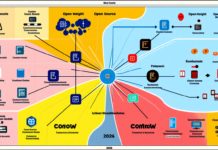
Summary: The landscape of AI agent software solutions for customer service has been profoundly transformed. Companies are no longer content with deploying basic chatbots: they are adopting autonomous systems capable of understanding, deciding, and acting without human intervention. This evolution rests on technologies such as natural language processing, machine learning, and predictive analytics. Available solutions vary considerably in complexity, from accessible low-code tools to sophisticated enterprise architectures. The real challenge lies in aligning technological capabilities with actual business needs, while preserving ethics and transparency.
Brief: AI agents are radically transforming customer service. From conversational chatbots to intelligent automation systems, solutions are multiplying and becoming more specialized. This article explores the complete landscape of these technologies: their architectures, their concrete use cases, pragmatic selection criteria, and the pitfalls to avoid. Discover how companies are deploying these tools to reduce costs, improve customer satisfaction, and free their teams from repetitive tasks, all while remaining clear-eyed about the real limits of these systems.
🤖 Understanding the real nature of AI agents in customer service
Contents
An AI agent is not a magical creature capable of solving any customer problem. It is a software system engineered to accomplish specific tasks, learn from its interactions, and adapt its behavior based on feedback. The distinction is fundamental: where a classic chatbot follows a rigid decision tree, an AI agent has greater decision-making autonomy.
In the field, this difference shows up concretely. During my deployments in the FinTech environment, I observed how autonomous agents outperformed traditional solutions when it came to handling non-standardized requests. A customer calls to discuss a complex billing issue involving multiple contracts? The AI agent can execute a series of orchestrated actions: check the data, query multiple systems, propose solutions, and document the resolution. All of this, without handing the case off to a human at every micro-step.
The underlying technology rests on three pillars: natural language processing (NLP) to interpret requests, large language models (LLMs) to generate contextualized responses, and orchestration systems to coordinate actions across backend interfaces. These components work together to create a smooth and effective user experience.
That said, it's crucial to stay clear-eyed about the limits. AI agents excel in areas where data is well structured, rules are clearly defined, and results are measurable. They run into trouble when the context is ambiguous, exceptions are numerous, or the decision requires a nuanced understanding of emotional context.
🔧 The technical architectures that make the difference
Solutions vary considerably depending on their architecture. Some rely on low-code or no-code architectures, where business teams can configure workflows without writing a single line of code. Others require a heavy technical investment but offer extreme flexibility. No-code AI agent tools allow mid-sized organizations to get started quickly, while custom approaches suit large groups with very specific needs.
A commonly deployed architecture combines an LLM-based dialogue engine with integration connectors (APIs) to business systems. The hallmark of a good architecture is the ability to remember context across multiple conversation turns. With a simple built-in vector database (such as Pinecone or Weaviate), the agent can access relevant business knowledge in milliseconds, thereby improving the quality of responses.
Modern technical teams are adopting frameworks like CrewAI or LangChain to speed up development. These tools offer useful abstractions: prompt management, token management, integration of multiple LLMs, and orchestration of external tools. On a recent project, integrating LangChain cut development time from three months to three weeks.
📊 The solutions ecosystem: from classic chatbots to autonomous systems
The market offers an extraordinarily diverse range of solutions. While the choice can seem paralyzing, understanding the categories helps you navigate it. A detailed comparison of AI customer service software can help you evaluate the options specific to your context, but it's important to first understand the main families of solutions.
First-generation chatbots operate according to strict rules: if the customer says A, offer response X. Effective for basic FAQs, they quickly become frustrating when faced with even a minor variation. Companies often deploy them out of necessity (having something on the website) rather than strategic conviction.
Modern conversational assistants add a layer of intelligence. They understand context, maintain a conversation memory, and can intelligently escalate to human agents. A satisfied customer will find a useful answer; a frustrated customer will be routed to a specialist with a complete contextual summary. This is the optimal balance for many organizations.
Finally, autonomous AI agents for customer service represent the most advanced evolution. They don't just respond: they execute actions, consult multiple data sources, can handle transactions, and even make partially autonomous decisions within predefined limits. One example: an agent that automatically processes a refund request without supervision if it meets certain criteria, while documenting the decision and alerting a human team for audit purposes.
🎯 Solutions specialized by use case
Different business contexts call for different approaches. In e-commerce, customers are primarily looking for responsiveness on basic questions: product availability, order tracking, return policies. NLP-based chatbots dominate this category. In financial services, on the other hand, regulatory complexity and data sensitivity demand more robust solutions with complete audit trails.
SaaS companies have popularized a hybrid approach: AI agents for first-level support (resolving simple, recurring issues) and intelligent tools assisting human agents (real-time suggestions, enriched context, solution prediction). This combination improves overall efficiency without creating friction for customers with complex problems.
The sentiment and data analysis built into these systems offers a benefit that's often underestimated: the ability to identify product trends, recurring friction points, and opportunities for improvement. Customer service data becomes a strategic asset when it is properly processed and analyzed.
🔍 How to evaluate and select the right solution
Faced with a multitude of options, a structured methodology is essential. Start with an honest analysis: what is your real problem? Too many unresolved tickets? Excessive handling time? Declining customer satisfaction scores? The solution only solves the problem you have clearly identified.
Then audit your current situation. What percentage of your requests are FAQs? How many could be handled by a simple system? How many require human expertise? This breakdown determines the level of sophistication required. A company where 80% of requests are repetitive will need an aggressive automation solution. Another, where 70% of cases are unique, may only benefit marginally from pure AI agents.
Technical evaluation criteria deserve attention: API integration with your existing systems (CRM, ERP, internal databases), multi-channel capability (email, chat, phone, social media), security and compliance (the GDPR, SOC 2, encryption), and pricing models (per transaction, per agent, per volume). Too many organizations choose a solution based on an impressive demo without checking these fundamentals.
Request demonstrations based on your real use cases, not marketing examples. Ask to speak with similar customers. Best practices for deploying AI agents in customer relations show that success largely depends on this rigorous selection phase.
⚖️ Balancing innovation and pragmatism
It's tempting to want the most technically advanced solution. Resist that urge. The organizations that succeed best start small, with a very well-defined use case, measure the results, and then expand gradually. This approach reduces implementation risk and allows you to learn to manage the technology before scaling it up.
A complete audit before purchase should include an assessment of total cost of ownership (TCO): beyond the software license, factor in integration, training, maintenance, and adjustments. Many organizations buy a €50,000 solution before spending €200,000 on integration.
Also assess your team's internal capacity to adopt the technology. Sophisticated solutions without adequate internal support quickly become black boxes. Check whether the vendor offers ongoing assistance, regular training, and an active user community.
💼 Deployment models: from pilot to scale
Deploying an AI agent for customer service is not a one-time event, but an iterative process. The implementation strategy largely determines success. Best practices recommend starting with a limited, measurable pilot: a well-defined use case, a small group of users, a fixed duration (typically 6 to 12 weeks), and clear KPIs before, during, and after.
During the pilot, the focus should be on systematically gathering feedback. How do human agents react to the AI's suggestions? Are customers willing to interact with a chatbot, or do they prefer to talk to a person? Are the resolutions proposed by the AI accurate? These lessons are pure gold for refining the solution.
Once the pilot proves successful, scaling up should be gradual. First expand to a second, similar use case, then a third before exploring radically new areas. Each extension lets your team master the technology and identify patterns of success and failure.
Team training is critical but often overlooked. Human agents need to understand how the AI works, how to interpret its suggestions, and how to continuously improve it. The complete guide to AI for customer service offers valuable insights into this organizational transition phase.
📈 Measuring and continuously optimizing
Without measurement, there is no optimization. Define KPIs from the start: first-contact resolution rate, average handling time, customer satisfaction (CSAT), cost per resolved ticket, and volume of requests handled automatically. A real-time tracking system lets you quickly identify what's working and what needs adjustment.
One common mistake is measuring only quantitative metrics. Qualitative data is just as important: what types of problems does the AI handle poorly? Where do customers become frustrated? What new request patterns are emerging? A monthly analysis of conversations helps refine responses and identify areas where the model's training needs to improve.
Also plan for regular retraining cycles. LLMs only remain static on paper. As your business vocabulary evolves, your products change, and customer requests shift, the model needs to adapt. Some companies perform quarterly updates, others monthly, depending on the context.
🌐 The technology infrastructure behind modern solutions
Understanding the technical infrastructure helps you evaluate vendors' promises. Leading customer service solutions rely on a modern stack: workflow orchestrators (agents), language models (typically via cloud APIs such as OpenAI, Anthropic, or open-source alternatives), knowledge management systems (vector databases), and middleware integrations.
Vector databases deserve special attention. They allow an AI agent to instantly access relevant documentation, business policies, or similar prior cases by performing a semantic search rather than a literal one. Instead of searching for the exact word “refund,” the system understands synonyms and retrieves relevant articles regardless of the vocabulary used.
Workflow orchestration is what turns language models into useful systems. A good orchestrator lets you define sequences of actions: “first, check the customer database; then, review order history; then, propose a solution based on commercial policy rules; finally, escalate to a human if necessary.” This orchestration, typically codified in YAML or through visual interfaces, is what makes agents predictable and controllable.
Security and privacy are non-negotiable considerations. Customer data passes through these systems; it must be protected with the same rigor as in your core databases. Require vendors to explain how they handle encryption in transit and at rest, access to your company's data, and GDPR compliance.
🔌 Integration with the existing ecosystem
An isolated AI solution is a useless solution. Integration with the CRM, the ticketing system, product data, ERP systems, and other tools is what actually creates value. The best AI agents for customer service are precisely the ones that integrate seamlessly with your existing infrastructure.
During a recent implementation for an e-commerce client, I saw how a two-way integration between the AI agent and the inventory system changed everything. Instead of offering the customer a solution based on potentially outdated data, the agent checked inventory in real time before responding. It seemed simple, but it cut broken promises by 40%.
Evaluate the quality of the APIs exposed by each solution. The best ones offer modern RESTful APIs with clear documentation, SDKs in the main languages, and a sandbox testing environment to develop without risk. Some solutions offer pre-built connectors for common tools (Salesforce, Zendesk, Shopify), which considerably speeds up deployment.
🎓 Training, ethics, and governance of AI agents
Too many organizations deploy AI agents without seriously thinking about governance. Who is responsible if the agent provides incorrect information? How do you ensure the agent follows the company's commercial and ethical policies? These questions, far from academic, become very concrete after the first incidents.
Model training must be transparent. If you're fine-tuning a generic model on your company's data, make sure you understand what data is included, how it's used, and whether the results will generalize properly. Overfitting (memorizing examples instead of generalizing) is a common pitfall: an agent that performs perfectly on your test data can fail miserably on slightly different cases in production.
Ethics must be codified. Define the types of decisions the agent can make on its own and those that require human validation. For example, an agent might automatically approve a refund of less than €50, but any refund above that amount must go through review. This decision hierarchy prevents systematic errors while retaining the benefits of automation.
Transparency toward customers matters. When a customer interacts with an AI agent, should they be told? Regulations are evolving on this issue. Many pioneering companies have opted for full transparency: “You're talking to an AI assistant, but I'm here to help you.” This builds trust and manages expectations.
🛡️ Audit, compliance, and accountability
Establish a regular audit process. Review random samples of decisions made by the agent to check their compliance with business and ethical rules. Document everything: when the agent was trained, on what data, what changes were made, and why. These records are valuable in the event of a dispute or regulatory question.
GDPR compliance adds a layer of complexity. Users have the right to ask how their data is processed by an AI agent and to obtain an explanation for an important decision that affects them (for example, a credit denial). Make sure your solution can produce these explanations.
Set up an incident reporting process. What happens if an agent makes a serious mistake? How is that mistake captured, documented, analyzed, and used to improve the system? A good AI system doesn't eliminate errors; it makes them rare, traceable, and correctable.
📱 Concrete use cases and lessons from the field
Theory is useful; practice is even more so. Here's how real organizations are using AI agents to transform their customer service.
💳 Fintech sector: automating documentation requests
In the financial sector, documentation requests accounted for 35% of total ticket volume. Each request followed the same pattern: the customer sends an email, an agent checks the document type, sends it, and the customer replies with a follow-up question. An AI agent was configured to handle this flow completely autonomously: receiving the request, identifying the type of document required, sending it automatically with a clear explanation, and handling 90% of follow-up questions via NLP.
The result: handling time dropped from an average of 80 minutes to 5 minutes, and satisfaction rates rose because customers received a document in seconds instead of waiting 48 hours. But the critical lesson was the importance of exception handling. The 10% of requests involving specialized documents or complex situations required intelligent escalation that added rich context for the human agent.
🛒 E-commerce: predicting problems and proactive assistance
An online retailer integrated an AI agent not just to answer questions, but to anticipate them. When a customer opts for express delivery, the agent tracks the package via the carrier's API. If it detects a likely delay, it proactively contacts the customer with an explanation and compensation (a discount on their next purchase). Result: a 45% reduction in customer service requests related to delays, since customers were informed before they even noticed a problem.
Beyond reactive service, this agent also collects data on problem patterns. Are delays concentrated in a particular geographic region? A specific logistics provider? A seasonal period? These insights feed directly into strategic logistics decisions, showing how customer service can become a strategic intelligence hub.
🏥 Healthcare: intelligent triage and contextual escalation
A group of clinics deployed an AI agent for initial triage. Patients ask their questions, the AI agent assesses severity (chronic pain assistance? Emergency situation? Administrative question?), categorizes the request, and routes it to the right department. This step, which used to take a receptionist 15 minutes, now takes 90 seconds.
The success lies in contextual knowledge. The agent has access to patient records (securely, of course), so it can see that Ms. X has a documented allergy and adjust its recommendations accordingly. When escalation to a nurse is necessary, the full context is provided, eliminating the repetitive explanations that frustrate patients.
⚡ 2026 trends and beyond in AI solutions for customer service
The landscape is evolving rapidly. Some trends are becoming clear and deserve attention to guide your investments.
🧠 Toward more specialized, contextual agents
The era of universal generic models is drawing to a close. Organizations are recognizing that the best solution for customer service isn't a single smart agent, but a constellation of specialized agents, each trained on a particular domain. One agent for technical product questions, another for sales inquiries, a third for administrative matters. This specialization leads to more accurate responses and lower operating costs.
Integrating rich context—customer history, behavioral data, external signals—is becoming the differentiator. Agents no longer react to the present request in isolation; they understand the customer's entire journey and adjust their tone, suggestions, and actions accordingly.
🔐 Security and compliance on the front line
As AI agents handle increasingly complex transactions and sensitive data, security is becoming a major selection criterion. Vendors that guarantee a complete audit trail, decision traceability, and compliance with evolving regulations (beyond the GDPR) will gain a competitive advantage.
Organizations also expect codified ethical safeguards. Instead of leaving AI entirely to developers, companies are asking for intuitive tools so that business decision-makers can define the ethical rules themselves.
💰 More transparent, flexible pricing models
Pricing models based on transactions or generated tokens are changing the dynamics of AI investment. Organizations can now experiment on a small scale without a huge commitment. How to choose the best AI solution for customer service in 2025 includes a detailed analysis of pricing structures.
Expect to see hybrid models emerge: a base platform fee plus variable fees based on actual usage. This aligns incentives: the vendor benefits directly from your success with the solution.
🤝 Human augmentation rather than replacement
The vision of 100% automated customer service has turned out to be a mirage. The most mature organizations now talk about “human augmentation”: how can AI be used to make human agents more effective, happier, and more impactful? Agents receive real-time suggestions, enriched contextual data, and automated repetitive tasks. Their time is freed up for complex problem-solving, empathy, and relationship-building.
Interestingly, this approach often increases agent satisfaction. They are no longer mere “message relayers” but experts who use technology to serve customers better. Turnover drops, expertise accumulates, and customers benefit from richer interactions.
🎯 Choosing your technology partner for long-term success
Ultimately, choosing an AI solution for customer service isn't just a technology decision; it's a strategic partnership. You're looking not only for software, but for a partner capable of evolving with your company, advising you, training you, and supporting you through the inevitable challenges.
Ask yourself pragmatic questions: Does the vendor deeply understand my industry? Does it offer clear documentation and an active community? Does its roadmap align with the trends I'm observing? Can it provide customer references in my industry? Does it offer responsive support? The best AI tools for customer service aren't necessarily the most technically sophisticated, but those that best align with your context and ambitions.
Finally, start small and measure scrupulously. A successful pilot is worth a thousand marketing demos. Once you've confirmed that a solution works in your specific environment and generates the expected ROI, you can scale it up with confidence. It's this iterative, rigorous approach that separates successful deployments from technological disappointments.
Author Profile
Latest entries
 Food & Drink21 November 2026Beaujolais Nouveau: A Historically Low Harvest, Yet Sales Keep Climbing
 Finance20 November 2026Consumer Credit: Mini-Loans, Split Payments, and Overdrafts Face Tighter Rules
 Planet15 November 2026CO2 Emissions: Why Transportation Remains France's Climate Blind Spot
 Artificial Intelligence12 November 2026Imagine Enterprise: IBM and Microsoft Team Up on AI Agents for Large Businesses
This article was written with the help of artificial intelligence. Editorial policy