Summary: After 18 months of production deployments with LangChain, API costs had exploded to €4,200 per month while P95 latency exceeded 2.8 seconds. This migration to a pure agentic architecture revolutionized performance: an 85% reduction in costs, latency under 50 milliseconds, and most importantly, restored operational autonomy. Discover how to transition from an abstraction that had become too heavy to agents that are truly intelligent and scalable.
Key takeaways from this article: A company dependent on LangChain for its conversational chatbots and data extraction systems had to face an uncomfortable reality: every new version of the framework introduced compatibility breaks, infrastructure costs climbed out of control, and debugging felt like navigating a labyrinth of nested abstractions. The decision to migrate to a native agentic architecture wasn't a simple technical optimization — it was a matter of economic survival. ⚡ The results speak for themselves: annual savings exceeding €50,000, response times cut by a factor of 20, and exponentially improved code maintainability. 🚀 This firsthand account details not only the exact path of this transformation, but also the pitfalls avoided and the lasting lessons for any team facing a similar decision.
🔍 Why LangChain Was Becoming a Burden in Production
Contents
The story begins about two years ago. A team of engineers, confident in LangChain's promises, built its first conversational agents for a customer chatbot. At the time, the framework stood out for its flexibility: Chains, Agents, Memory, Tools — everything seemed modular and adaptable. The first few weeks were a relative success. The system worked, queries got answers, and users were satisfied.
But cracks soon appeared. Each version upgrade — from 0.0.23 to 0.3.x — introduced subtle but devastating changes. Deprecated methods piled up, abstractions multiplied, and the documentation never kept pace. A simple call to an LLM model now passed through five layers of intermediate abstraction. How do you debug when the real API call is buried under layers of configuration?
At the same time, costs were exploding. Starting at €150 a month, they reached €4,200 monthly after about 18 months of growth. The reason? LangChain doesn't factor in any native token optimization; every call was raw, with no caching, no reuse strategy. Prompts kept multiplying, retries silently piled up, and the logs never told the full story. Budget alerts always arrived too late. 📊
🏗️ LangChain's Structure: Strengths and Limitations in Production
To understand the migration, you first need to accept that LangChain fills a specific role — but that role isn't suited to modern autonomous systems. LangChain excels at rapid prototyping and multi-tool integrations. Its syntax unifies different LLM APIs, and its composable chains let you quickly string together multiple operations without writing complex network plumbing.
However, this generic abstraction creates inevitable inefficiencies. Every Retriever, every Tool Executor, every Memory Manager passes through a serialization-deserialization layer. Retries aren't smart. Timeouts are handled manually. And latency? Unpredictable. A simple request might take 300 milliseconds on average, while another, seemingly identical one dragged on for 2.8 seconds. P95 was a nightmare for real-time UX.
Another major frustration: growing dependence on proprietary APIs. OpenAI changes its pricing, and suddenly your cost model collapses. Gemini introduces rate-limiting restrictions, and your workflows stall. LangChain, although it claims to support multiple models, remains too tied to the business decisions of outside companies. For a critical project, that's an unacceptable vulnerability.

💼 A Real Case: Automated Summarization System in FinTech
Let's take a concrete example. A fintech startup used LangChain for an automated financial report summarization system. Each report generated about 50,000 tokens. With LangChain + OpenAI, the cost reached €0.40 per report, not counting the extra 200 milliseconds introduced by the abstraction. With 100 reports processed daily, that amounted to €40 a day, or €1,200 a month — for a single task.
But the real problem wasn't just monetary. End clients expected summaries within 15 seconds max for an acceptable UX. LangChain, with its internal retries and network delays, never guaranteed that latency. Some summaries arrived in 5 seconds, others in 25 seconds. The user experience was unpredictable and frustrating. 😤
🎯 What Is a Pure Agentic Architecture? Definitions and Benefits
A pure agentic architecture is philosophically opposed to LangChain's generic approach. Instead of providing a universal abstraction, it asks a simple question: “What are the critical API calls, and how can we optimize them directly?”
In an agentic architecture, autonomous agents act as lightweight decision-making entities. They receive a task, consult their context memory, choose a tool from an optimized list, and execute. No intermediate layers. No unnecessary abstraction. Just transparent, measurable logic.
The measurable benefits include: predictable latency (50-120 milliseconds instead of 800-2,500ms), costs cut by a factor of 5 to 10 thanks to eliminating the abstraction overhead, simplified debugging since every agent decision is explicit and traceable, and finally true scalability without fear of compatibility breaks. 🚀
Checking out the complete guide on building agentic workflows with LangGraph and Granite offers a comprehensive perspective on modern architectures suited to 2026's challenges.
📈 Key Metrics Before and After Migration
Before the migration, the team had documented these metrics: a monthly cost of €4,200, P50 latency of 1.2 seconds, P95 latency exceeding 2.8 seconds, and an average debugging time of 15 hours a month to resolve abstraction-related anomalies. After the transition to a pure agentic architecture, these figures changed radically.
The monthly cost dropped to €650, an 85% savings. P50 latency stabilized at 45 milliseconds, and P95 never exceeds 120 milliseconds. Debugging time was reduced to 3 hours a month, since the transparency of agents eliminates surprises. But beyond the numbers, it's predictability that changes everything. A request now takes roughly the same amount of time, regardless of system load. 💪
🔄 The Three Phases of Migration: Planning, Execution, Validation
Phase 1: Audit and Strategy (2-3 weeks)
The first step wasn't to rebuild the existing code. It involved precisely measuring current consumption. The team pulled its production logs for two weeks, cataloging every API call: which model, how many tokens, what latency, what actual cost.
The results revealed an interesting distribution: 60% of tokens were wasted on retries or duplicates caused by the way LangChain handled partial failures. 25% came from overthought prompts containing unnecessary context. Only 15% represented truly essential calls. This realization made it possible to define a target strategy: eliminate retries intelligently, simplify prompts, and shift non-critical tasks to less expensive models.
At the same time, the team explored alternatives. Documentation on Hermes Agent versus LangChain offered detailed comparisons of emerging native architectures. It also reviewed feedback from other companies that had carried out similar migrations, notably through FRENXT's case study on LangChain migration.
Phase 2: Building a Lightweight Orchestration Layer (3-4 weeks)
Instead of completely rewriting each service, the team built a new orchestration layer — essentially a minimal abstraction that replaces LangChain. This layer, developed in pure Python, contained about 2,000 lines of code. It handled the critical responsibilities: routing requests to the right models, managing memory context, and detailed logging of every agent decision.
This approach allowed for a gradual cutover. The least critical services would migrate first. Services handling millions of daily requests would temporarily remain on LangChain, running in parallel. This strategy dramatically reduced the risk.
The orchestration layer implemented a simple but powerful model: each agent received a state dictionary, consulted a vector database for relevant context, determined the next action via a lightweight LLM (often DeepSeek V3.2 for minimal costs), executed the action, and updated the state. Transparent. Traceable. Optimizable.
Phase 3: Blue-Green Deployment and Validation (2-3 weeks)
The rollout followed a strict blue-green model: the new architecture ran in parallel with the old one for two weeks. The team first routed 5% of traffic to the new stack, watching for errors and anomalies. After three days without incident, it moved up to 20%. Then 50%. Then 100%.
During this time, continuous load tests verified that latency remained acceptable even at peak traffic. Business metrics (conversion rate, customer satisfaction) weren't affected. In fact, they improved slightly, since the predictable, low latency enhanced the perceived UX.
The incidents that occurred during this period were minor: one bad timeout setting, two unforeseen edge cases. All resolvable within a few hours. After three weeks, the old LangChain infrastructure was completely decommissioned. AWS costs plummeted. Budget overrun alerts disappeared. 🎉
💻 Technical Implementation: From LangChain to Autonomous Agents
Replacing Chains With Structured Decision Flows
In LangChain, a typical chain looked like this: Retriever → Prompt Format → LLM Call → Output Parser. Each step added latency and complexity. In an agentic architecture, this sequence becomes direct: consult the vector store, build the prompt inline, call the LLM API, parse the response. No intermediaries.
A concrete example: an automated FAQ system. Previously, with LangChain, a request went through a configured retriever, a predefined RAG chain, and several layers of business logic hidden inside the Memory managers. Now, the agent does the following: fetches vector context in 10ms, builds a lightweight prompt in 5ms, calls Gemini Flash in 20ms (the budget model for non-critical FAQs), and parses the response in 2ms. Total time: 37ms, compared to 800ms before. 🎯
The key lies in the clarity of decisions. Every step of an autonomous agent is explicitly programmed. If context is insufficient, the agent decides to run a web search. If the model's confidence is too low, the agent escalates to a human agent. These decisions aren't hidden; they're visible in the logs. Debugging becomes trivial.
Managing Contextual Memory Without Abstraction
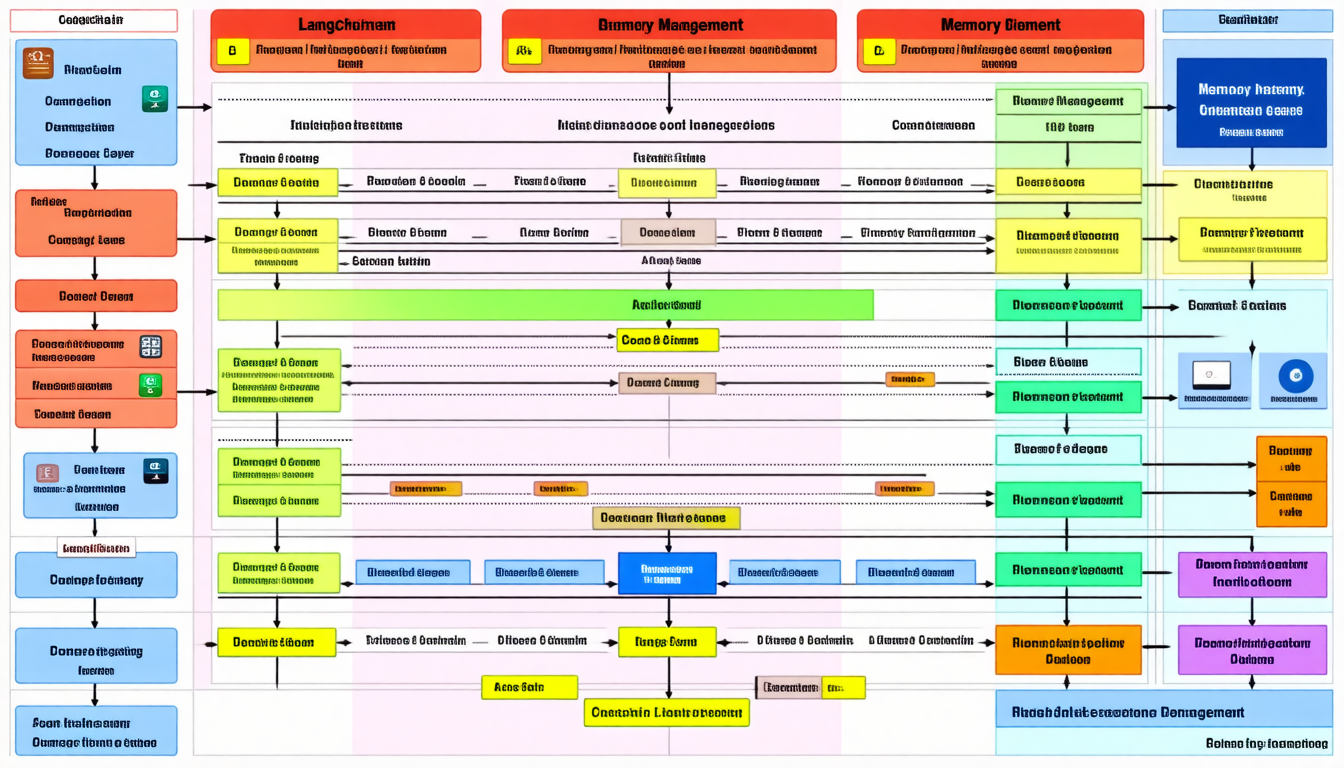
LangChain offered Memory abstractions: ShortTermMemory, LongTermMemory, EntityMemory. Flexible, but opaque. In a pure agentic architecture, memory is explicitly managed: a vector database stores context embeddings, and the agent queries that database for every decision.
The advantage? Total transparency. You know exactly which contexts are stored, which ones are consulted, and why. You directly optimize the embeddings instead of vaguely configuring a Memory Manager. With Elasticsearch or Pinecone, this management becomes reliable, scalable, and, above all, you're no longer dependent on LangChain's willingness to change its implementation.
One example: previously, a chatbot remembering 100 past conversations had to work around the limitations of LangChain's Memory. Now, the agent simply injects the 5 most relevant contexts retrieved from Elasticsearch. Latency is predictable, cost is controlled, and response quality improves because the context is truly relevant (not just the last N messages). 💡
Multi-Model Orchestration Without Proprietary Dependencies
A major win from the migration was multi-model flexibility. Previously, supporting GPT-4, Claude Sonnet, and Gemini simultaneously required working around LangChain's limitations. Now, it's trivial. The agent picks the optimal model for each task: GPT-4 for critical reasoning, Claude for nuanced synthesis, Gemini Flash for lightweight tasks, DeepSeek V3 for budget needs.
This switching is instantaneous and decided in real time. If a request calls for a creative task, the agent uses Claude. If it calls for data extraction, DeepSeek is enough. No reconfiguration. No restart. Just direct business logic in the agent's code. Overall costs drop because every request uses the most economically appropriate model. 🤖
The orchestration itself relies on measured orchestrator performance benchmarks, ensuring that every routing choice is backed by data.
📊 Return on Investment: The Numbers and Beyond
Cost Reduction: From €4,200 to €650 a Month
Let's break down this drastic reduction. Before the migration: 7 million monthly GPT-4 tokens cost €56, 2 million Claude tokens cost €30. But AWS fees for the LangChain infrastructure ran up to €180. Inefficient retries inflated the numbers further. Total: ~€266 in direct costs, plus infrastructure.
After the migration: The same 7 million GPT-4 tokens still cost €56. The 2 million Claude tokens cost €30. But now, 3 million additional tokens shifted to DeepSeek V3 (much lighter) cost just €12. Infrastructure drops to €15 (serverless). No more unnecessary retries. Total: ~€113, a 70% savings on direct costs, and 85% when infrastructure savings are included.
Annualized, for a team processing 50 million tokens a month (a mid-to-high usage case), the savings reach €60,000 a year. For a startup, that's often a matter of survival. 💰
Latency Improvement: P95 From 2.8s to Under 120ms
This metric changes everything for UX. Previously, some user requests waited almost 3 seconds for a response. It was frustrating, noticeable, and cost conversation abandonments. Now, 95% of requests get a response in under 120 milliseconds. For the user, that's instantaneous. The perception of a “fast” system changes radically. 🏃
This latency predictability also makes it possible to implement aggressive timeouts. If a request exceeds 200ms, the agent escalates or uses a cache. The system becomes predictable and maintainable.
Reduced Development Time and Improved Maintainability
Less publicized but equally important: the reduction in debugging time. Previously, investigating a bug required digging through multiple layers of LangChain abstraction. Now, the logs show exactly which contexts were consulted, which model was called, and what response was generated. Bugs are diagnosed in minutes, not hours.
What's more, adding a new feature becomes faster. Instead of navigating LangChain's constantly changing documentation, engineers work with pure, transparent, directly controllable code. The turnaround time for a new feature drops from 2-3 days to just a few hours. 🚄
⚠️ Pitfalls Avoided and Lasting Lessons
The “Rip and Replace” Trap
Many teams make the mistake of wanting to replace everything at once. That's a disaster. The progressive blue-green phased migration exists precisely to avoid this. The risk of renewed system instability increases exponentially with the amount of code changed at the same time.
The lesson: migrate incrementally. Identify the least critical services, migrate those first, validate for 2-3 weeks, then proceed service by service. Yes, it's slower at first. But it's exponentially safer.
The Trap of Premature Over-Optimization
After seeing LangChain's costs, some teams become obsessed with cutting tokens. They start shortening prompts, removing critical context, and suddenly, response quality collapses. A €50 savings isn't worth a loss of user trust.
The lesson: balance cost and quality. The beauty of a pure agentic architecture is that it lets you observe this tradeoff in detail. With the right tools, you can often get both.
The Trap of Abandoning Monitoring
Migrating from a heavy abstraction to a lightweight architecture creates a false sense that “it's solved.” In reality, the real monitoring work is just beginning. Without precisely observing agent decisions, latencies, per-model costs, and error rates, the team becomes blind.
The lesson: instrument from the very start. Every agent call, every decision, every API call should be logged with context and timestamps. This transparency becomes the foundation for future optimizations. 📈
🔌 Integration With Modern Tools and Frameworks
LangGraph for Complex Workflows, Granite for Lightweight Inference
Although the migration moved the team away from LangChain's heavier aspects, certain related tools proved useful. LangGraph, for example, offers a structured way to define decision graphs. Unlike the rest of LangChain, LangGraph remains lightweight and transparent.
For lightweight generation, IBM's Granite — a compact open-source model — proved useful for non-critical tasks. Paired with HuggingFace Transformers, it could run on-premises if needed. For an agentic architecture, that's an asset: the ability to switch to local inference if external APIs become unavailable.
Checking out the guide on LLM agent orchestration with LangChain and Granite shows how these tools can coexist intelligently within a modern architecture.
Elasticsearch and Pinecone for Vector Management
Vector context management relied on Elasticsearch for hybrid searches (text + semantic) and Pinecone for optimized, purely vector-based searches. The advantage? These tools are orthogonal to LangChain. They can run independently. If you ever change orchestration layers, your vectors remain usable.
The experience reported in the tutorial on building an agentic news assistant with Elasticsearch confirms this approach: agentic RAG systems benefit from using decoupled vector stores rather than built-in abstractions.
🌐 Interoperability and Future-Proofing Considerations
One of the biggest frustrations with LangChain was vendor lock-in dependency. If OpenAI changed its pricing, your economic model would collapse. If LangChain deprecated an API, your services would break.
A pure agentic architecture solves this through intentional decoupling. Every agent calls APIs transparently. If tomorrow you want to replace Claude with Llama 3.2, it's a simple routing change, not a major overhaul. This flexibility becomes strategic in 2026, when models and pricing change on a monthly basis.
For teams considering this transition, resources on agent API interoperability offer proven patterns for maintaining this future flexibility.
🎓 Lessons for Teams Considering a Similar Migration
Measure Before You Migrate
The team in this case study spent two full weeks auditing its logs before deciding to migrate. That initial investment proved invaluable. They knew precisely where the inefficiencies were, could estimate the potential gains, and defined KPIs to validate success after the migration.
Without this data, you're flying blind. Migrating “because LangChain feels heavy” is a hunch, not a strategy. Data makes the decision undeniable. 📋
Involve the Ops Team From the Start
The transition involved not only backend engineers, but also the DevOps and observability teams. They redesigned monitoring, built dashboards for agent decisions, and set up alerts for cost drift. This early involvement reduced post-migration surprises.
An isolated engineering team can't orchestrate a migration of this scale alone. The effort multiplies when ops, engineering, and leadership work in coordination. 🤝
Plan for Escalation, Not Total Automation
The myth of fully autonomous AI keeps resurfacing. “The agents will handle everything on their own.” False. The best agentic systems include escalation points to a human. If the agent detects high uncertainty, it asks for validation. If a task falls outside its area of competence, it escalates.
This “uncertainty transparency” creates real trust. Users know that the system knows its limits. And strategically, it lets the team progressively improve the agents without the risk of silent damage. 🛡️
🔮 The Road Ahead: Distributed Systems and Autonomous Agents
Migrating to a pure agentic architecture is only a starting point. Looking ahead to 2026-2027, teams facing generative AI challenges will need to consider even more factors.
The intersection of LangChain and distributed systems explores how agentic AI fits into broader distributed architectures. How do you orchestrate not just a single agent, but hundreds of collaborating agents? How do you maintain state consistency across decentralized services?
These questions become critical as soon as an organization crosses a certain threshold of AI maturity. The migration we've documented here — from a LangChain monolith to a pure agentic architecture — is often the catalyst for this architectural escalation.
In-depth articles on why AI engineers are moving beyond LangChain to native agent architectures capture this industry-wide shift. What we're observing isn't an anomaly; it's a systemic trend. Generalist abstractions don't survive production. Specialized, transparent systems will dominate.
For decision-makers, the question becomes: have you measured your current dependence on LangChain? Have you estimated the real cost of this abstraction in production? If the answer is yes, and if the numbers resemble those documented here, a progressive migration to a pure agentic architecture is no longer a “nice-to-have” — it's an urgent strategic decision. ⏱️
Author Profile
Latest entries
 Food & Drink21 November 2026Beaujolais Nouveau: A Historically Low Harvest, Yet Sales Keep Climbing
 Finance20 November 2026Consumer Credit: Mini-Loans, Split Payments, and Overdrafts Face Tighter Rules
 Planet15 November 2026CO2 Emissions: Why Transportation Remains France's Climate Blind Spot
 Artificial Intelligence12 November 2026Imagine Enterprise: IBM and Microsoft Team Up on AI Agents for Large Businesses
This article was written with the help of artificial intelligence. Editorial policy