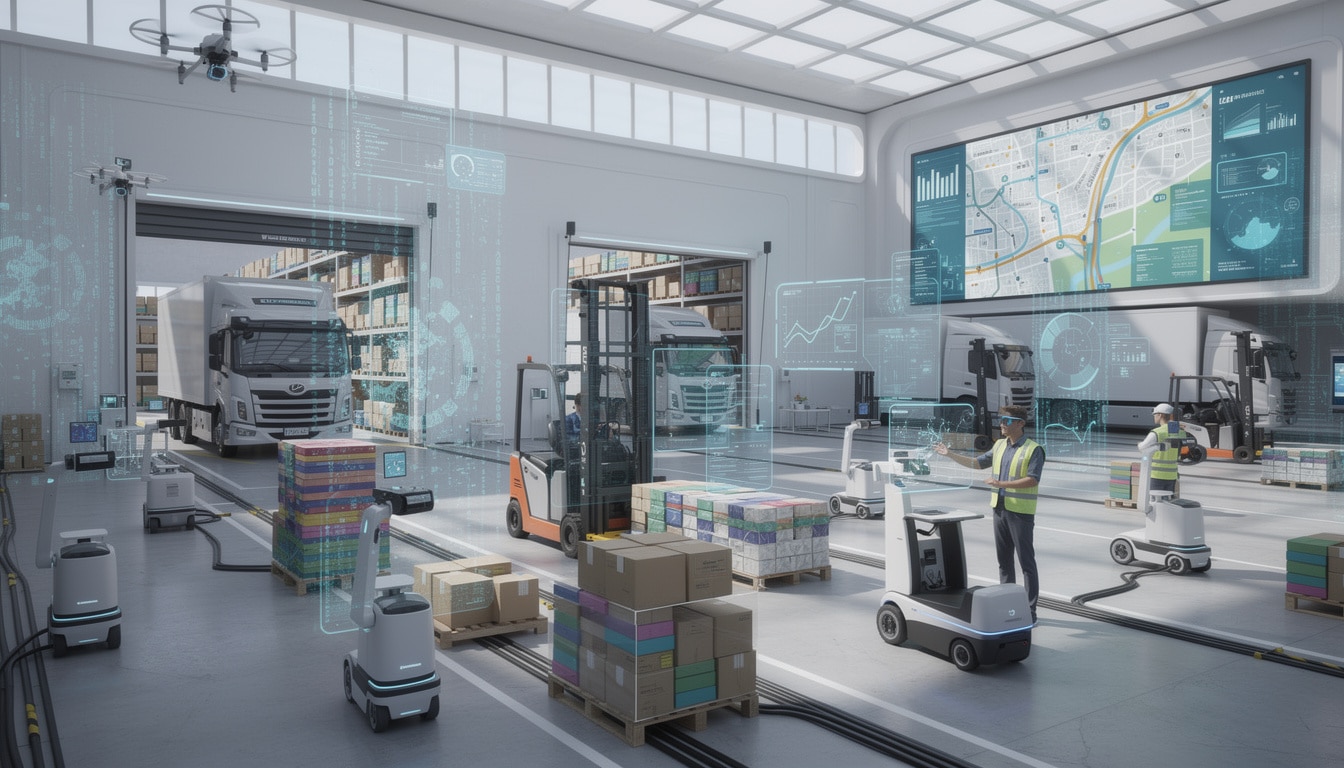
🎯 In brief: Generative artificial intelligence is profoundly redefining the logistics sector, with the potential to reduce operational costs by up to 20% and improve service levels by as much as 65%. Nearly 40% of organizations are already investing in these solutions, while the market is expected to explode from $800 million in 2024 to more than $13 billion by 2032. Concrete use cases—route optimization, predictive maintenance, inventory management, quality control—are transforming supply chains into intelligent, autonomous systems. However, major challenges remain: high implementation costs, legacy system integration, data quality, and the ecological transition. The future belongs to agentic AI agents, capable of executing tasks with complete autonomy, freeing up teams for higher-value functions.
🚀 Generative AI Is Redesigning Global Logistics Operations
Contents
For several years, logistics has leveraged artificial intelligence to fine-tune routes and manage inventories. But the arrival of generative AI has sparked a genuine operational revolution. This technology brings a tenfold increase in analytical capacity, enabling companies to process staggering volumes of data and generate complex solutions that were previously out of reach. The sector fully recognizes this transformative potential: cost reductions of up to 15%, customer service improvements of up to 65%, and a decisive competitive edge in a saturated, demanding market.
The number speaks for itself: 40% of supply chain organizations are already actively investing in generative AI. The market is following this trend with an exponential trajectory, growing from roughly $800 million in 2024 to more than $13 billion by 2032. This acceleration is not a cyclical phenomenon, but rather the symptom of an industry that has finally found a tool capable of solving its structural challenges. The way leaders like FM Logistic are redesigning their supply chain illustrates this ongoing transformation.
For decision-makers and operational teams, this shift is not without tension. While the enthusiasm is genuine, it coexists with justified caution. The technical and organizational challenges remain considerable: data quality, integration with legacy systems, cybersecurity, and the persistent risk that models will “hallucinate”—producing answers that seem credible but are fundamentally inaccurate. This is precisely why organizations must design their AI adoption not as a simple technological migration, but as a strategic transformation aligned with their business objectives.
💡 Real-World Use Cases: Where AI Creates Immediate Value
🗺️ Route Optimization and Fleet Maximization
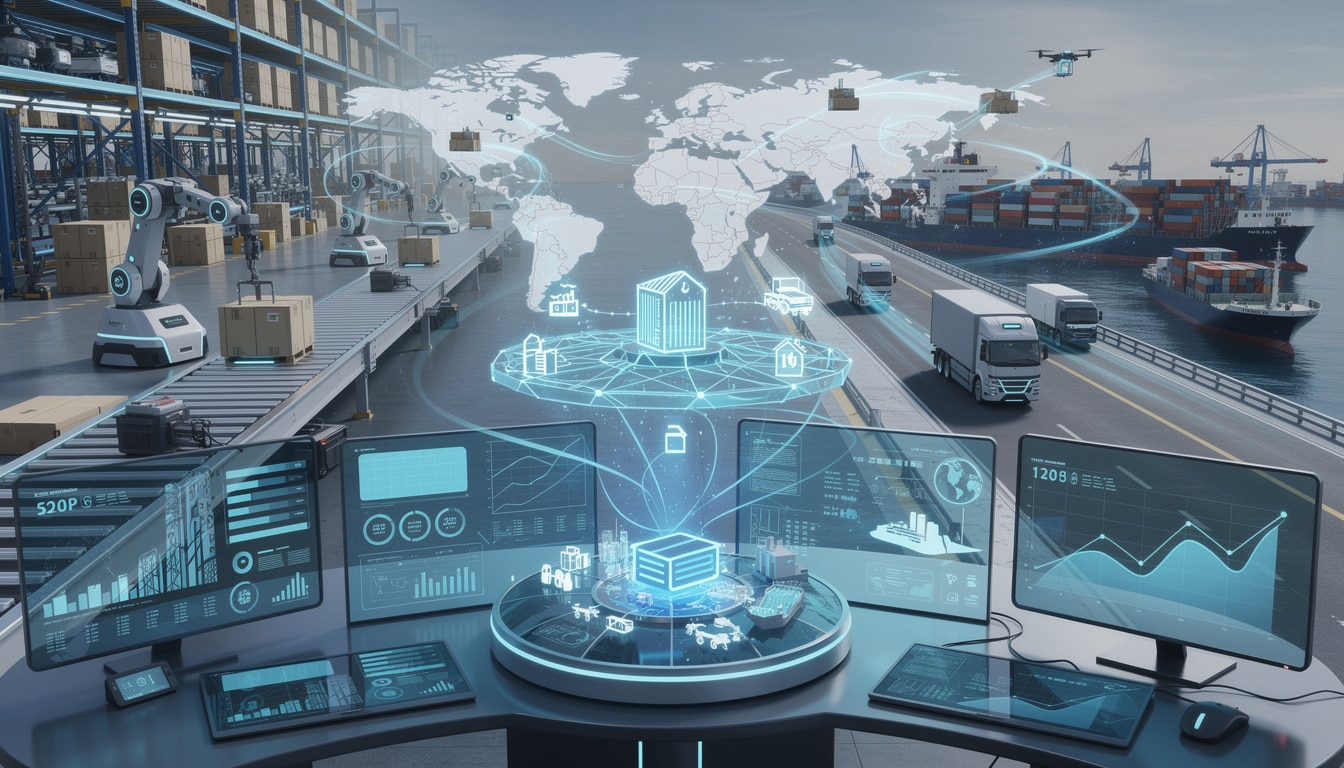
Route optimization is no longer just a matter of legacy algorithms. Generative AI now integrates dozens of variables simultaneously: contractual delivery deadlines, actual vehicle capacity, near-real-time traffic forecasts, geopolitical events that could close certain routes, fuel price fluctuations, and even the condition of port or road infrastructure. This multidimensional capability makes it possible to generate routes that are not only faster, but also more economical and better suited to emergency scenarios.
An often overlooked advantage: the ability to generate contingency plans. A customer requesting an expedited delivery, a road that collapses, a port strike that paralyzes shipments—AI instantly simulates several alternative scenarios and proposes the best compromise in terms of cost, timing, and reliability. It also optimizes truck fill rates, including return trips, thereby reducing the number of empty runs—a massive source of waste in the industry.
📦 Smart Warehouse Design and Order Fulfillment
The magic also happens at the heart of warehouses. Generative AI analyzes order patterns—particularly product associations—and reorganizes the placement of goods to minimize picking times. Imagine an e-commerce retailer where 30% of orders contain soap and sponges: AI would place these items close together to drastically reduce the distances traveled by order pickers.
Beyond physical storage, it tracks the frequency of incoming orders and anticipates bottlenecks. A predictable surge in orders for certain products? AI suggests a preemptive reorganization. The benefits cascade: reduced fulfillment times, fewer picking errors, improved ergonomics for teams, and ultimately, higher customer satisfaction. FM Logistic, for example, uses this intelligence to manage the complexity of mixing regulated products (dry goods and alcohol, sensitive goods), where placement is not just a matter of optimization, but also of regulatory compliance.
🔧 Predictive Maintenance: Anticipating Failures Before They Happen
Traditional maintenance runs on a schedule or on reaction (“it stopped working, let's fix it”). Generative AI flips this paradigm. It continuously analyzes equipment telemetry data—engine temperature, vibrations, energy consumption, load cycles—to detect drift before a breakdown occurs. A hydraulic pump losing 2% efficiency every month? AI flags it at month 6, before the catastrophic month 8.
For a truck fleet, this means a precise, individualized maintenance schedule. Each vehicle benefits from a program tailored to its actual use. The results are tangible: downtime reduced by up to 30% and maintenance costs cut by 10%. These gains immediately impact operational availability and margins. No surprises, no missed deadlines due to unexpected breakdowns.
📊 Predictive Intelligence and Inventory Management: The End of Uncertainty
🎯 Demand Forecasting and Inventory Optimization
Forecasting demand means solving logistics' impossible equation: having the right product in the right place at the right time, without overstocking or running out. Generative AI tackles this dilemma by absorbing disparate signals. It cross-references historical sales, economic cycles, weather data (which strongly influences certain categories), social media trends—yes, social sentiment can predict a surge in demand—and even synthetic data based on simulations.
The result? Radically more accurate forecasts. Operational cost reductions of up to 20% by optimizing the choice between a “just-in-time” strategy (less stock, more responsiveness) and a “just-in-case” strategy (more stock, less risk). Every category, every market, every season benefits from a tailored strategy. Companies can finally navigate between Scylla and Charybdis without capsizing.
🌍 End-to-End Visibility and Dynamic Compliance
Tracking goods is no longer a minor detail—it has become a major factor in competitiveness and compliance. Generative AI aggregates real-time data from multiple sources: IoT sensors, warehouse management systems, carriers, customs, certifying bodies. It provides crystal-clear visibility into every shipment, every batch, every pallet.
Even better, it automatically detects anomalies during handling or transport: a sensitive product exposed to an abnormal temperature, a suspicious delay, rough handling. This early detection prevents cascading complaints and improves quality control. On the regulatory front, Gen AI particularly shines. ESG reports—especially Scope 3 indirect emissions—require massive consolidation of heterogeneous data. AI processes it, verifies it, and generates emissions metrics with precision, automating reporting processes that would otherwise consume months of administrative work.
🤖 The Future of Autonomous Agents: When AI Acts on Its Own
📈 Agentic AI Agents: Autonomy in Action
Generative AI is yesterday. Agentic AI is tomorrow. Beyond analysis and recommendation, these systems directly execute tasks. Inventory management? An autonomous agent that adjusts levels without human intervention. Warehouse space optimization? An agent that recommends and implements rearrangements. Shipment tracking? An agent that checks statuses, identifies delays, and triggers corrective actions.
FM Logistic is already testing these capabilities. The company deploys AI agents to analyze and process IT tickets—a repetitive task that consumes human hours every week. Another application: retrieving proof of delivery (PoD) from carrier portals, checking it against contractual delivery dates, and flagging discrepancies. What once required a dedicated team is now done in fractions of a second, with superior reliability.
The impact on productivity is phenomenal: operational efficiency improvements of up to 30% are expected, along with substantial cost reductions, and above all, employees are freed from robotic administrative tasks to take on strategic roles. AI agents don't replace humans—they elevate them.
🛠️ Navigating Implementation Challenges: From Dream to Reality
💰 Initial Investment and Maintenance Costs: The Economic Equation
Let's be frank: adopting generative AI doesn't come with a modest price tag. Licenses for sophisticated models (ChatGPT Enterprise, Claude, Gemini Pro) require substantial investment. Computing power—GPUs for inference, servers for orchestration—adds a considerable layer of capex spending. For FM Logistic, this effort meant a complete migration to Google Cloud to support its entire logistics infrastructure. A major investment, but one justified by future gains.
Beyond deployment, maintenance consumes ongoing resources. Models drift: trained on yesterday's data, they quickly become outdated. They need to be retrained with new data, their performance monitored, and their hyperparameters adjusted. Without this vigilance, quality degrades imperceptibly until the day decisions become unreasonable.
And then there's talent. Recruiting AI and data science experts has become an extreme sport—talent is scarce, in high demand, and expensive. Many organizations choose to train their existing teams instead, which also requires time and resources. AI-driven automation can seem inexpensive compared to these upfront investments.
📚 Data Quality and Governance: The Forgotten Foundation
AI is voracious for data. But not just any data. Dirty, fragmented, inconsistent data produces dirty, fragmented, inconsistent models. Data analysis in the supply chain runs into a stark reality: information is scattered across dozens of isolated systems, often in incompatible formats, with different standards.
Consolidating this data—creating a “single source of truth”—is a massive undertaking. It requires robust integration architectures (ETL, data lakes, data warehouses), documentation, cleaning, and cross-validation. Without these foundations, no AI model, however sophisticated, can perform well. Data governance adds another layer: who can access what, how to protect sensitive information, how to ensure GDPR compliance and industry regulations. These technical and legal aspects are often underestimated by decision-makers dazzled by AI's transformative potential.
🔗 Integration with Legacy Systems: The Invisible Obstacle
Global logistics runs on aging technology. Mainframes from the 1990s, homegrown ERP systems, proprietary databases—some so deeply embedded in core operations that migrating them is almost suicidal. How can these IT dinosaurs be made to communicate with modern, cloud-based AI solutions and APIs?
This is the invisible challenge blocking hundreds of projects. A few approaches exist: integration middleware that translates formats, APIs that expose data from legacy systems, “lift and shift” strategies to the cloud. But all of them require time, budget, and above all, operational risk. One wrong move and the supply chain grinds to a halt. Not exactly a luxury.
🌱 Sustainability and the Ecological Transition: AI in the Service of the Climate
⚖️ The Energy Paradox: Energy-Hungry AI for a Sustainable World
An awkward paradox: generative AI itself is extremely power-hungry. Training models consumes megawatts, and every inference (every query) consumes resources. How can this be reconciled with the ecological transition that logistics operators must carry out? This is the question every conscientious operations manager is asking.
The answer is nuanced but real. Used intelligently, AI generates energy savings that far exceed its own consumption. Route optimization reduces the number of kilometers traveled—and therefore fuel use and emissions. Better inventory management eliminates unnecessary storage and double-handling. Predictive maintenance prevents failures that would otherwise force the purchase of replacement equipment. Increased productivity means fewer trips to accomplish the same volume of work.
The impact of AI on the supply chain shows how reinventing operations also creates improved sustainability. According to FM Logistic, the net outcome is clearly positive when AI is deployed in the service of sustainability. The challenge isn't to avoid AI—that's impossible given the competition—but to steer it deliberately to amplify positive environmental impacts.
🎯 Responsible Implementation Strategies
A few forward-thinking companies are making deliberate choices: minimizing AI's own footprint (choosing lightweight models, hosting locally when possible, negotiating “green” cloud contracts), maximizing operational efficiency gains, and reinvesting the resulting savings into the ecological transition (new electric vehicles, solar-powered warehouses, decarbonization technologies).
This requires a holistic vision. AI should not be implemented for its own sake. It must serve clear, measurable business objectives aligned with the company's ESG strategy. It is this strategic maturity that separates convincing pioneers from experimenters who spend without a vision.
🎓 Change Management: Preparing Teams and Building Trust
📖 Training and Upskilling: Investing in Human Capital
One of the biggest obstacles to successful AI adoption isn't technical—it's human. Employees, particularly those with years of experience, may fear that AI will make them obsolete. This fear is irrational according to classical economic theory, but it is viscerally real for someone who has built a career on their expertise.
Overcoming this fear requires transparent communication, serious training, and demonstrating that AI only replaces tedious tasks, not jobs. FM Logistic, for example, has invested heavily in training employees, who now use generative AI through Google Workspace. The response has been largely positive because employees saw immediate gains: less time spent on tedious reports, more time spent on high-value decisions.
🤝 Co-Creation and Empowerment: Turning Resistance Into Adoption
The best deployments involve future users from the design stage onward. Frontline operations staff understand the real pain points and the real opportunities. Empowering them to test, experiment, and give feedback turns resistance into buy-in. A team that helped design the solution naturally champions it.
It also means accepting that AI will make mistakes early on. The model hallucinations mentioned by FM Logistic will never fully disappear. Organizations must design their processes around this reality: human safety nets where errors are critical, continuous model improvement, and an acceptance that perfection doesn't exist. AI is a formidable tool, not a savior.
📡 Orchestration and Multi-Agent Architectures: AI at Scale
An often overlooked advantage: generative AI doesn't work in silos. The future belongs to collaborative multi-agent systems. One agent optimizes routes, another manages predictive maintenance, a third monitors quality—and all of them exchange information. Understanding multi-agent system architectures is therefore becoming critical for organizations deploying AI at scale.
These architectures require technical maturity: robust orchestration (who requests what, in what order), management of dependencies between agents, data synchronization, and cascading error handling. Open-source frameworks like CrewAI and LangChain are emerging to simplify this complexity, but integration remains an art, not an exact science. Those who master this orchestration create truly autonomous and resilient systems—a lasting competitive advantage.
For those exploring the available AI agent tools and comparisons, this architectural knowledge has become essential for choosing solutions that integrate with the company's actual ecosystem, not just isolated building blocks.
🔮 The 2026 Horizon and Beyond: What's Really Changing
In 2026, the real question is no longer “whether to use AI,” but “how to use it in a substantial and ethical way.” The market for AI agents in logistics is maturing. Early adopters are measuring concrete gains: cost reductions, service improvements, faster decision-making. Those who lag behind are accumulating a competitive gap that will become insurmountable.
Trends to watch: generative AI will become commoditized, natively integrated into standard software tools (ERP, TMS). The real differentiators will be data quality and the ability to orchestrate intelligent agents—capabilities that are hard to copy quickly. Regulation will become clearer, governing sensitive uses (discriminatory algorithms, bias in pricing decisions). AI ethics will no longer be a nice-to-have, but a fundamental expectation of stakeholders.
The organizations that come out ahead will be those that view AI not as a technological gadget, but as an engine of strategic transformation aligned with their profitability, sustainability, and customer service goals.
Author Profile
Latest entries
 Food & Drink21 November 2026Beaujolais Nouveau: A Historically Low Harvest, Yet Sales Keep Climbing
 Finance20 November 2026Consumer Credit: Mini-Loans, Split Payments, and Overdrafts Face Tighter Rules
 Planet15 November 2026CO2 Emissions: Why Transportation Remains France's Climate Blind Spot
 Artificial Intelligence12 November 2026Imagine Enterprise: IBM and Microsoft Team Up on AI Agents for Large Businesses
This article was written with the help of artificial intelligence. Editorial policy