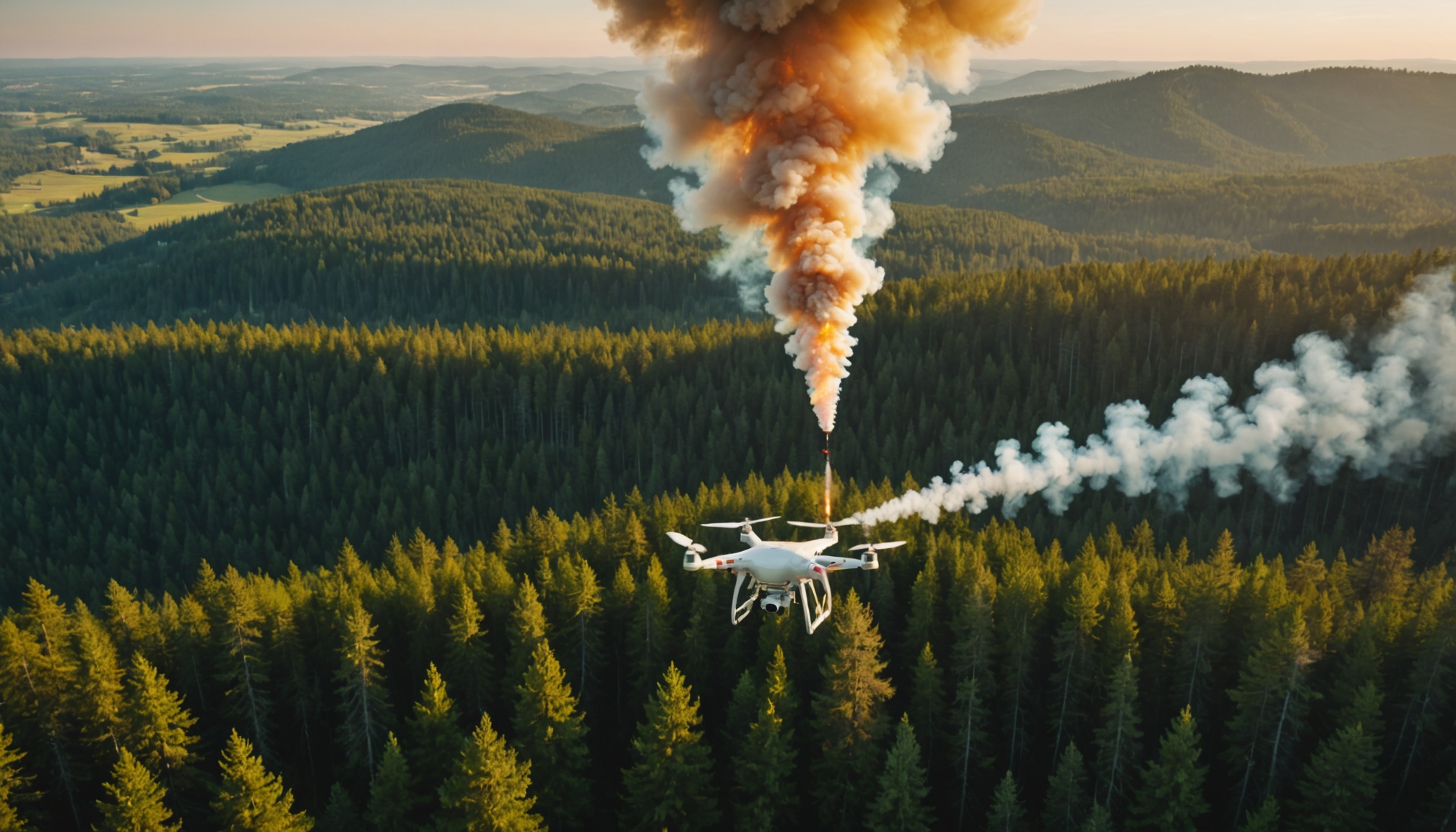
Faced with a particularly severe fire season, France is increasingly relying on artificial intelligence to anticipate and detect fire outbreaks. Between January and July 2026, more than 40,000 hectares had already gone up in smoke across the country, a total already approaching that of all of 2025. In this context, several departments are deploying cameras paired with computer vision algorithms to spot the first wisps of smoke within minutes, or even seconds.
Smart cameras posted in forests
Contents
In Seine-et-Marne, around the Fontainebleau forest — hit hard this year with roughly 2,200 hectares burned — firefighters are now using eight cameras equipped with artificial intelligence, backed up by a thermal-imaging drone. The system detects and geolocates a fire outbreak in real time, even before it becomes visible to the naked eye from traditional lookout posts.
In Indre-et-Loire, a network of twelve so-called “smart” cameras continuously monitors the forested areas. Their promise: to spot any suspicious smoke in under three minutes and automatically send an alert to the fire department's call center, which can then launch a response without waiting for a human report.
An open-source, nonprofit-driven model on the rise
Behind some of these installations is the nonprofit Pyronear, which develops an open system for analyzing forest imagery. Every thirty seconds, its algorithm examines video feeds from cameras installed on elevated points and automatically identifies smoke columns before generating an alert sent to emergency services. This open-source approach is winning over an increasing number of local governments, which see it as a way to quickly equip their territory without depending on a single private provider.
Beyond simple detection, platforms like SecureFire are betting on predictive models capable of simulating how flames spread by combining several factors: terrain, wind speed and direction, and vegetation type. These simulations help command officers anticipate which zones to evacuate first and position personnel and equipment before the fire even reaches them.
- Automated smoke detection in under 3 minutes in certain departments
- Thermal-imaging drones for precise geolocation of fire outbreaks
- Predictive models of flame spread based on wind and vegetation
- Open-source systems led by nonprofits like Pyronear
A technological response to a growing risk
These tools come against a backdrop of droughts and heat waves that are lengthening the fire season in France, including in regions historically less exposed, such as the Île-de-France region. The departmental fire and rescue services (SDIS, France's local fire departments) present these technologies as a complement to human resources, not a substitute: the final decision to intervene always remains in the hands of firefighters. Still, the widespread rollout of these systems also raises funding questions, as every municipality or group of municipalities must invest in the equipment and maintenance of the cameras and servers that run the image-analysis models.
To learn more about the practical uses of AI in safety and everyday life, our Understanding AI Agents – Use Cases section offers several deep dives, while our Tips section regularly covers the right habits to adopt during periods of fire risk.
Frequently Asked Questions
How does artificial intelligence detect a fire outbreak?
Fixed cameras installed on elevated points continuously film forested areas. A computer vision algorithm analyzes the images at regular intervals, sometimes every thirty seconds, to spot a column of smoke and trigger an automatic alert to the emergency call center.
Do these technologies replace human lookouts?
No. Fire and rescue services present these tools as a complement to existing systems. Automated detection speeds up the alert, but assessing the situation on the ground and deciding whether to intervene remain the responsibility of human teams.
Which French departments are equipped as of 2026?
Several departments, including Seine-et-Marne around the Fontainebleau forest and Indre-et-Loire, have deployed networks of AI-paired cameras. Other local governments rely on open-source nonprofit projects like Pyronear to quickly expand their coverage.
Sources
- France 24 — Wildfires in France: artificial intelligence comes to firefighters' aid
- France 3 Régions — “The AI flags what it detects as a fire outbreak”
- Smart City Mag — Wildfires: how IoT, drones, and AI improve fire detection
Author Profile
Latest entries
 Food & Drink21 November 2026Beaujolais Nouveau: A Historically Low Harvest, Yet Sales Keep Climbing
 Finance20 November 2026Consumer Credit: Mini-Loans, Split Payments, and Overdrafts Face Tighter Rules
 Planet15 November 2026CO2 Emissions: Why Transportation Remains France's Climate Blind Spot
 Artificial Intelligence12 November 2026Imagine Enterprise: IBM and Microsoft Team Up on AI Agents for Large Businesses
This article was written with the help of artificial intelligence. Editorial policy