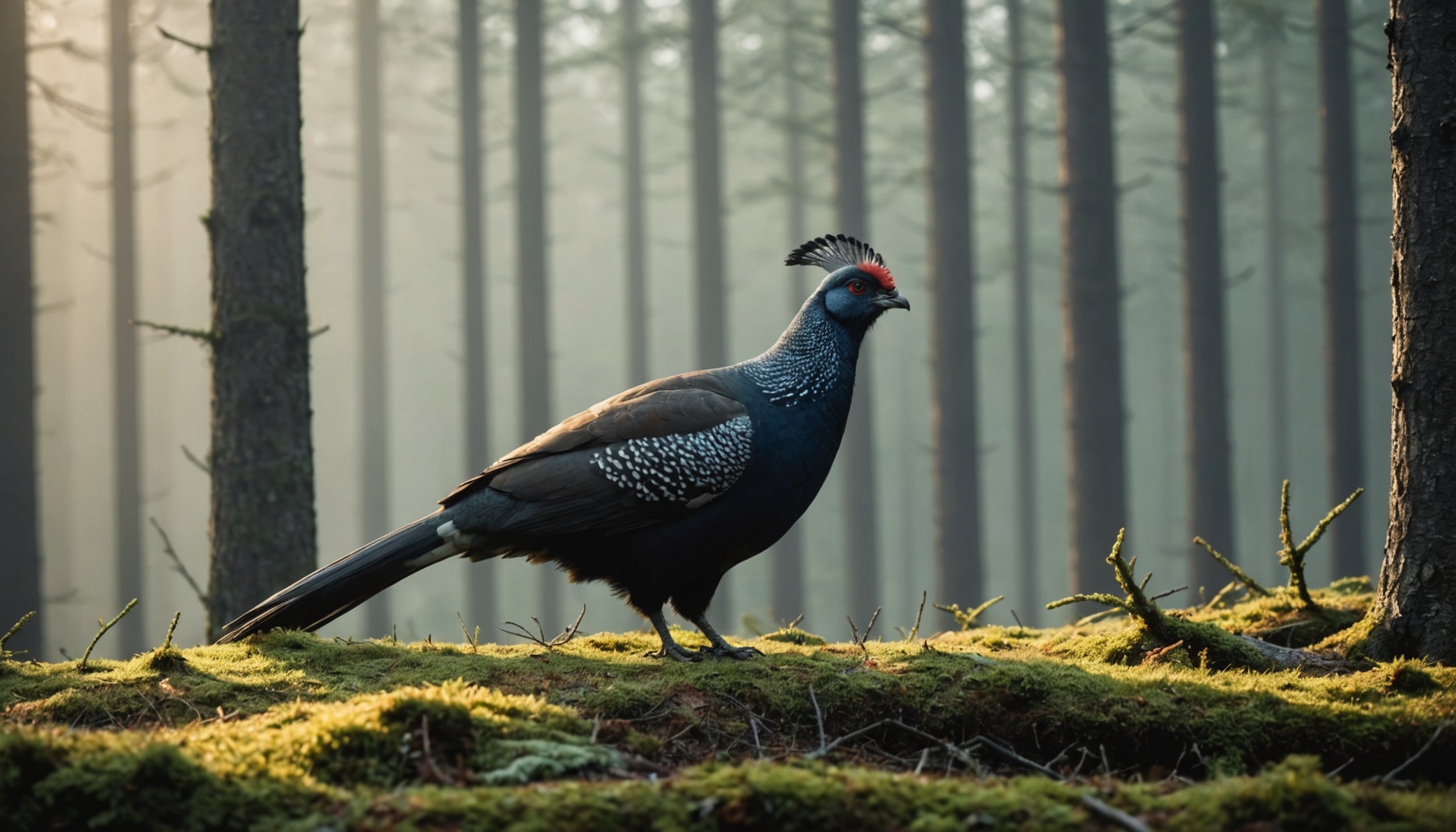
After twenty years of legal tug-of-war between conservation groups and hunting associations, France's capercaillie is finally set to receive full protected status. This summer, the Ministry of Ecological Transition submitted for public consultation a draft decree that unambiguously puts an end to the hunting of this large mountain grouse, which is on the verge of extinction across much of the country.
A Species on the Brink of Disappearing
Contents
The assessment leaves no room for doubt: France is now home to only about 4,500 individual capercaillies, the overwhelming majority of which — nearly 4,000 birds — survive in the Pyrenees. The Jura mountains harbor only about 330, the Vosges barely 200, and the species has simply vanished from the French Alps. Even in its last Pyrenean stronghold, the population has fallen by nearly 80% since 1960, earning it “vulnerable” status on the French Red List of the IUCN (International Union for Conservation of Nature).
- ~4,000 individuals in the Pyrenees, the species' last major stronghold
- ~330 in the Jura and ~200 in the Vosges
- -80% decline in Pyrenean numbers since 1960
- Species extinct in the French Alps
This decline stems from a combination of causes that have been accumulating since the 1980s: degradation and fragmentation of forest habitats, disturbance from human and tourist activity, predation, and now climate change, which is disrupting breeding conditions at high altitude.
What the Decree Actually Changes
The draft decree, put forward jointly for the capercaillie and the alpine ptarmigan, repeals the hunting moratorium introduced in 2022 and replaces it with a permanent ban. In practical terms, it becomes strictly forbidden to kill individual birds, as well as to destroy their nests, breeding sites, and resting areas — which in turn strengthens how the species must be taken into account in forestry and mountain tourism development projects. According to the Ligue pour la protection des oiseaux (LPO, France's bird protection league), which has brought several legal challenges over the past twenty years, this text marks a historic step forward for the conservation of mountain grouse species.
On the hunting associations' side, the news has been met with more reservation: several voices point out that capercaillie hunting had already been suspended in practice across nearly all the relevant mountain ranges since the 2022 moratorium, and they are questioning what compensation is planned for mountain areas where hunting remains a local economic resource.
A Symbol for Mountain Biodiversity
Beyond the specific case of the capercaillie, this decision illustrates a broader trend: the gradual strengthening of France's legal framework for the most emblematic endangered species, as scientific monitoring data continues to accumulate. For hikers and mountain tourism enthusiasts, vigilance remains essential: the breeding season, between spring and early summer, remains the most sensitive period for these notably skittish birds, and respecting marked quiet zones remains the best way to help protect them. This matter, closely followed by both nature conservation groups and rural stakeholders, should reach its regulatory conclusion in the coming months, once the ministry has reviewed the results of the public consultation.
More broadly, this news is a reminder of just how fragile the balance of biodiversity in France remains, and how dependent it is on administrative decisions that can sometimes take a long time to come to fruition.
Frequently Asked Questions
How many capercaillies are left in France?
About 4,500 individuals, including nearly 4,000 in the Pyrenees, 330 in the Jura, and 200 in the Vosges. The species has disappeared from the French Alps.
What does the new full-protection decree change?
It repeals the 2022 hunting moratorium and establishes a permanent ban on killing individual birds and on destroying their nests, breeding sites, and resting areas.
Why has the capercaillie been declining since the 1980s?
Forest habitat degradation, disturbance from human activity, predation, and, more recently, climate change are the main identified causes of its decline.
Sources
LPO — Press release on capercaillie protection,
France Nature Environnement — Let's Protect the Capercaillie,
Chasse Passion — The Capercaillie Nears Official Protected Status
Author Profile
Latest entries
 Food & Drink21 November 2026Beaujolais Nouveau: A Historically Low Harvest, Yet Sales Keep Climbing
 Finance20 November 2026Consumer Credit: Mini-Loans, Split Payments, and Overdrafts Face Tighter Rules
 Planet15 November 2026CO2 Emissions: Why Transportation Remains France's Climate Blind Spot
 Artificial Intelligence12 November 2026Imagine Enterprise: IBM and Microsoft Team Up on AI Agents for Large Businesses
This article was written with the help of artificial intelligence. Editorial policy