
📊 Summary: The artificial intelligence revolution in business is no longer limited to classic chatbots. Since 2024, autonomous agents have been radically transforming the way organizations automate their processes. Unlike traditional generative AI, which answers one-off questions, an autonomous agent makes decisions, learns from its mistakes, and orchestrates complex actions independently. According to Gartner, 33% of enterprise software applications will incorporate AI agents by 2028. This comparison explores the fundamental differences, concrete use cases, and selection criteria for choosing the right solution.
🎯 In short: Autonomous agents outperform traditional artificial intelligence in decision-making autonomy and learning capacity. Classic generative AI performs isolated tasks (writing, translation, image generation), while autonomous agents orchestrate complete workflows, integrate multiple business tools, and adapt to unpredictable situations. The French market offers sovereign solutions like Dust, which guarantee EU hosting and GDPR compliance. Choosing between these two approaches depends on your needs: speed and flexibility for classic AI, deep automation and scalability for autonomous agents. The winning companies often adopt a hybrid strategy, combining the strengths of both to maximize their ROI.
🤖 Understanding the Fundamental Difference Between Autonomous Agents and Traditional Artificial Intelligence
Contents
Before choosing a solution, you need to truly grasp what sets an autonomous agent apart from traditional artificial intelligence. This distinction isn't just a matter of marketing; it reflects a major architectural and functional difference that directly impacts your ability to automate your business processes.
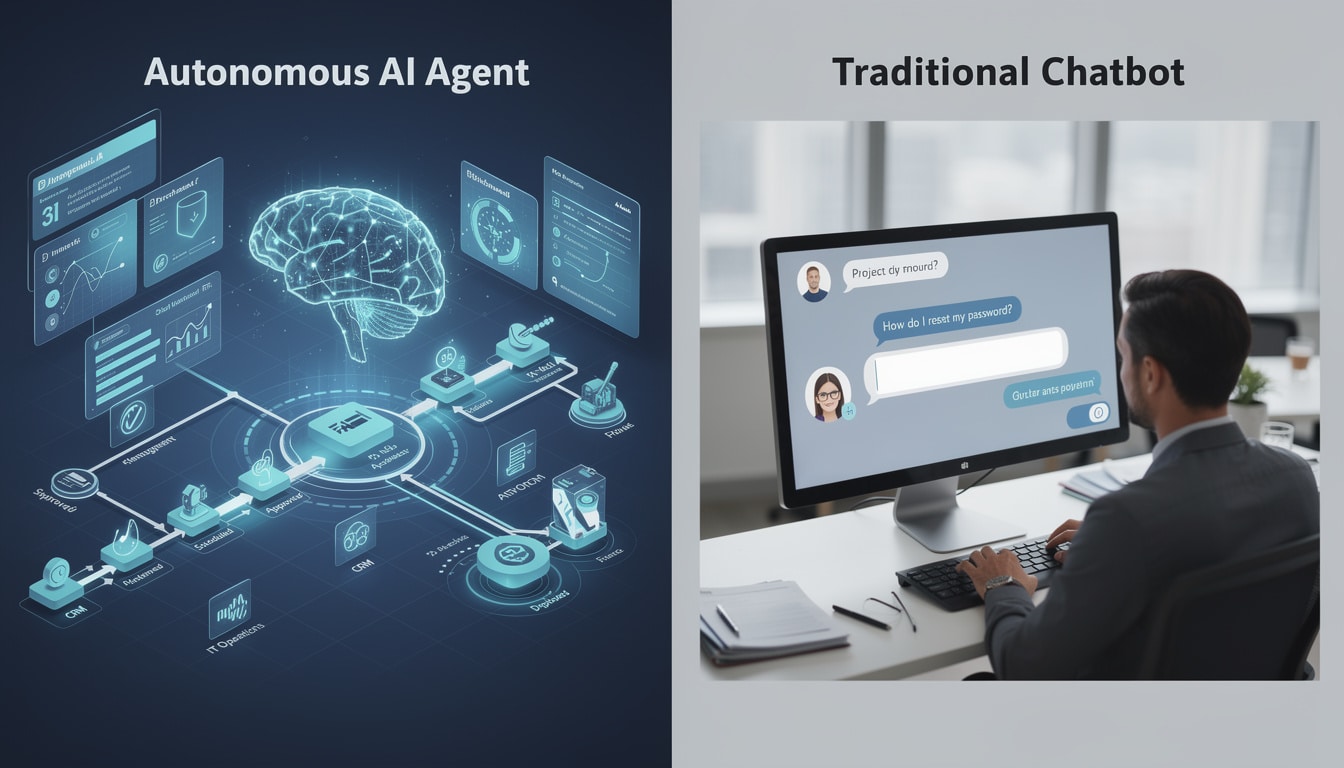
Traditional artificial intelligence operates on a simple transactional model: you ask a question, the AI responds. It's reactive. A traditional chatbot, ChatGPT in its basic conversational form, or an e-commerce recommendation system all operate under this paradigm. You send a request, the model generates a response based on its neural networks and training data, and then the interaction ends there. There's no persistent memory of context beyond the current session, no autonomous decision-making, no adjustment based on previous results.
An autonomous agent, on the other hand, operates on a continuous and proactive model. It receives a goal (for example: “Process all pending customer requests before 5 p.m.”), then plans the necessary steps, makes decisions, executes actions, observes the results, and adjusts accordingly. It has long-term memory, accesses external tools (CRM, databases, payment systems), and can escalate issues to humans when necessary. It's proactive and continuous.
🧠 The Crucial Role of Learning and Adaptation
One of the most critical differences shows up in learning capacity. A classic generative AI doesn't improve over the course of your interactions. You could use ChatGPT a thousand times, and the model won't learn your personal preferences or the nuances of your industry. It applies the same AI algorithms and the same parameter weights to every conversation.
An autonomous agent, by contrast, has feedback and adjustment mechanisms. Every decision made, every mistake committed becomes an opportunity for improvement. If an agent tasked with sorting customer requests notices that it misclassifies 15% of urgent cases, it can adjust its decision-making logic, reweight its criteria, or request human intervention for those edge cases. This continuous learning loop makes the difference between a solution you tolerate and a solution you love.
⚙️ Decision-Making Autonomy and Contextualized Decisions
Let's imagine two scenarios to illustrate this divergence. A customer sends you an email about a delivery delay. With classic AI, you have two options: either the AI generates a generic text response (“We apologize for the inconvenience”), or it extracts the key information from the email. But it does nothing else. No check of customer history, no verification of the order's actual status, no automatic compensation.
With an autonomous agent, here's what happens: it reads the email, extracts the order number, queries your order management system to check the status, consults the customer's history (first complaint or repeat customer?), evaluates your company's compensation policies, makes a decision (discount, free shipping, loyalty bonus points), sends a personalized response, updates the customer record, and schedules a follow-up. All of this in a few seconds, with no human intervention. It's this decision-making autonomy that transforms your operations.
🎯 Use Cases That Reveal the Real Differences in Application
Understanding the theoretical differences is useful, but it's on the ground that the distinctions become obvious. Each approach shines in specific contexts, and understanding these use cases helps you make the right choice for your organization.
✅ Traditional Artificial Intelligence Excels at One-Off, Non-Sequential Tasks
Classic generative AI remains unmatched for isolated, fast tasks with no dependencies. Need to write a product description for your e-commerce store? A generative AI model produces one in 30 seconds. Need to translate content into 12 languages? A specialized translation AI does the job without complaint. Looking to generate a banner image for a marketing campaign? Midjourney or DALL-E churn out several visuals in under a minute.
These tools are fast, inexpensive to use, and require no complex integration with your critical systems. They also excel at exploratory tasks, text content analysis, code generation, and brainstorming. For any situation where you need a one-off answer without executing actions within your business ecosystem, classic AI is the ideal solution.
🚀 Autonomous Agents Transform Complex, Repetitive Business Processes
Autonomous agents shine in contexts where you need to coordinate multiple systems, make contextualized decisions, and ensure follow-up. Take customer support request handling. An autonomous agent can be trained to handle 80% of these requests without human intervention: analyzing the nature of the problem, consulting the knowledge base, checking customer accounts, proposing a solution, and, if needed, escalating to a human.
Real-world applications include automated sales prospecting (an agent that identifies potential leads, qualifies them according to your criteria, adds them to your CRM, and prepares outreach emails), real-time inventory management (an agent that monitors stock levels, triggers automatic orders, and notifies suppliers), or regulatory compliance (an agent that scans your internal documents, identifies GDPR risks, and generates audit reports). These use cases involve lasting, measurable AI performance.
🔄 Multi-Tool Orchestration: The Superpower of Autonomous Agents
A crucial point that changes everything: orchestration. You use Slack, Salesforce, Google Sheets, Zapier, and 10 other tools. Classic AI doesn't know how to make them talk to each other. It answers your question, period. An autonomous agent, on the other hand, brings them together. It can launch a complete marketing campaign: read a brief in Notion, generate the copy with Claude, create visuals with DALL-E, schedule social media posts via Buffer, and send notifications in Slack at every step. That's what true integration means. Smotly's comparison of AI agents in business illustrates this perfectly, showing how specialized agents orchestrate your existing workflows.
📊 Comparative Analysis: Advantages and Limitations of Each Approach
Now that you understand the fundamental differences, let's look concretely at the advantages and limitations of each. This analysis will help you assess which one truly fits your needs.
💪 Strengths and Weaknesses of Traditional Artificial Intelligence
Key advantages: Generative AI models are extremely accessible. ChatGPT, Claude, and Gemini are available through a simple web interface. You don't need any technical knowledge to get started. Entry costs are low (some free plans, subscriptions starting at €20/month). Response quality has improved dramatically over the past two years, with models now able to understand context, nuance their answers, and handle ultra-long content. You also get real flexibility: you can use generic AI for a thousand different use cases without reconfiguration.
Severe limitations: No real autonomy. The AI will never take action unless you (or someone) explicitly asks it to. No lasting memory. Every conversation starts from scratch (even though long-context handling is improving). No native integration with your critical business tools. The AI generates text, an image, or code; it's up to you to integrate it into your workflow. Hallucination and bias risks remain present. The AI can confidently invent false information (this is called a hallucination). Unpredictable costs with heavy usage. The more tokens (text units) you generate, the more it costs.
💎 Strengths and Weaknesses of Autonomous Agents
Fundamental advantages: Full autonomy. The agent operates 24/7 without human supervision (for the tasks it has been authorized to handle). Deep integration with the ecosystem. An autonomous agent can orchestrate your CRM, ERP, databases, and payment systems in a single action. Continuous learning and adaptation. The more the agent works, the more it improves. Scalability. An agent can handle thousands of requests without any loss of quality. Potentially strong ROI on time-consuming processes. Full traceability. Every decision, every action is logged and auditable.
Real limitations: More complex and costly to set up. Configuring an autonomous agent requires real expertise (system architecture, API integration, data management). Risks tied to autonomy. If poorly designed, an agent can make flawed decisions at scale. Increased dependence on the quality of data and business rules. An agent doesn't compensate for bad input data. Less flexibility than generic AI for ad hoc use cases. You have to anticipate tasks and configure them in advance. Compliance and ethical concerns. Autonomous AI raises ethical questions: who is responsible if the agent makes a mistake? How do you maintain transparency?
🌍 The French and European Market: The Rise of Sovereign Solutions
Since 2024-2025, a movement has been gaining momentum in France and Europe: demand for sovereign AI solutions, hosted in the EU and compliant with GDPR. American giants (OpenAI, Google, Microsoft) dominate on technological power, but they don't address the privacy and data control concerns that French companies demand, particularly in regulated sectors.
🇫🇷 Dust: France's Answer to the Challenge of Sovereign Autonomous AI
Dust embodies this ambition. Founded by former OpenAI employees, the French startup offers an AI agent platform hosted in France and the EU. Unlike American competitors, Dust guarantees that your data never leaves European territory. No transfer to OpenAI's or Google's servers. For banks, insurers, the public sector, or healthcare, this is a major asset.
Dust doesn't develop its own AI model (which would be very costly). Instead, it adopts a “model-agnostic” approach: you access GPT-4o, Claude, Gemini, and Mistral through its secure interface. You choose the model best suited to each task. This flexibility contrasts sharply with Microsoft Copilot Studio (limited to the Microsoft ecosystem) or Salesforce Agentforce (optimized for the Salesforce CRM).
In terms of concrete AI comparison, Dust offers: 50+ native connectors to French and European business tools, deployment in 48 hours (versus weeks for a large-scale integration), support in French from a team that understands European regulatory concerns, transparent pricing starting at €50/month per user, and extensive customization even without technical coding.
For French SMEs and mid-sized companies, Dust represents a rare opportunity: gaining access to autonomous agent technology without being locked into a large American corporation, while meeting your legal obligations. Discover how the best AI agents are transforming smart automation for companies of all sizes.
🔗 The Expanding European Ecosystem
Dust isn't alone. Mistral AI (France) develops high-performing open-source models. Hugging Face (a French/German hub) democratizes access to models. On the backend, frameworks like LangChain and CrewAI make it easier to build autonomous agents without starting from scratch. The EU itself is investing heavily in sovereign AI through Horizon Europe funding and national project calls.
This context means you're no longer forced to choose between technological power (reserved for the giants) and sovereignty. Robust solutions are emerging in Europe. Before signing with an American giant, explore French alternatives. You might be surprised by the quality and responsiveness of French support.
🎓 Decision Criteria and Selection Matrix for Your Business
You're now convinced that autonomous agents could transform your organization. But how do you choose the right platform among the many available options? Here's a structured approach based on proven criteria.
🏆 Assess Your Critical Business Processes
Start by identifying processes that are currently time-consuming and repetitive. Ask yourself these questions: How much time do my teams spend each week on recurring manual tasks? Processing customer emails, data entry, sorting documents, validating files. Which processes do human errors cost the most in? Billing, compliance checks, inventory management. Where does responsiveness really make a difference? Customer requests, technical escalation, financial approvals.
Create a list of your 3-5 priority processes. For each one, estimate the potential impact of automation: how much time freed up, how many fewer errors, what quality-of-service gain. An autonomous agent handling 80% of obvious support requests can free up 20-30 hours per week for a team. That's huge.
💼 Decision Matrix: Classic AI vs. Autonomous Agent
Choose classic AI if: You mainly need to generate content (writing, images, videos) without executing business actions. Your processes are highly ad hoc or unpredictable. Your budget is limited and you're looking for a quick ROI with low spending. You lack the technical resources to configure a sophisticated agent. You're in an exploration phase and want to validate ideas quickly.
Choose an autonomous agent if: You have well-defined, repetitive processes. Automation needs to integrate multiple systems (CRM, ERP, databases). You're looking to significantly reduce your teams' manual workload (freeing up 20+ hours per week). Compliance and traceability are critical. You're ready to invest upfront (configuration, integration) for a strong long-term ROI. You have a team or partner capable of supporting the implementation.
🔐 The Non-Negotiables of Security and Compliance
Whatever your choice, never compromise on these points:
🔒 Data encryption: Both transit and storage must be encrypted. Ask for TLS 1.3+ certifications and AES-256 encryption. 🛡️ Authentication and access: SSO (Single Sign-On), MFA (multi-factor authentication), granular permission management. A team should only access data and features that are relevant to it. 📋 Audit and traceability: Every action by the agent must be logged with a timestamp, user, and result. Essential for audits and investigations. 🌍 Data localization: For regulated sectors (healthcare, finance, defense): require EU hosting and native GDPR compliance. 🤝 SLA and support: Guaranteed availability (e.g., 99.5% uptime), responsive support in your language, a transparent product roadmap.
🔗 Integration: At What Real Cost?
A platform advertises 50+ native connectors. Great. But what if your critical business system is proprietary or very old? Ask: Is an API available and well documented? Are webhooks and events supported? Is there support for custom integrations? How much does it cost in time and expertise? An integration sold to you as “easy” but that eats up 200 hours of consulting is hiding the real costs.
🚀 Adoption Strategies and a Roadmap to Get Started
Having understood the theory and chosen a platform is great. But real success lies in adoption. Here's how to get started pragmatically without missteps.
📍 Phase 1: Diagnosis and Quick Pilot (Weeks 1-6)
Week 1: Express audit. Assemble a small group (you, a few key team members, your CIO or CTO). Identify 2-3 genuinely time-consuming processes. Measure: how much time, how many errors, what the impact would be if it were automated. Document the exact workflow of the process (I send this email, I receive this response, I update the CRM…).
Weeks 2-4: Setting up the first agent. With your solution partner or your team, configure a simple agent for one of these processes. Don't try to be perfect. The goal is to test the platform in your real-world context. Connect it to your CRM, your email, your knowledge base. Train the agent on 50-100 recent examples.
Weeks 5-6: Field pilot. Launch the agent in “controlled mode.” It handles 20-30% of requests; the remaining 70% still go to humans. Each week, analyze its decisions. When it gets something wrong, understand why. Adjust its rules. Collect user feedback. Measure the time saved.
📈 Phase 2: Scaling Up and Optimization (Weeks 7-16)
If the pilot works (you're freeing up at least 10 hours a week, errors are decreasing), scale up gradually. Move to 50% of requests handled by the agent. Train your teams to supervise the agent, give it feedback, and manage escalated cases. Start generating your first ROI figures. Share the results internally to build momentum.
🌟 Phase 3: Expansion and Replication (From Week 17 Onward)
Build on your success. Reapply the model to other processes. You now have mastery of the technology, your teams understand it, and resistance is fading. Consider even more ambitious use cases: multi-team agents, orchestration between complex systems, advanced learning loops.
⚠️ Classic Pitfalls to Absolutely Avoid
Pitfall 1: Launching too big, too fast. Too often, an agent gets configured for 5 processes at once, deployed without supervision, it goes off the rails, and the technology gets blamed. No: test small, validate, then scale. Pitfall 2: Poor-quality input data. An agent is only as good as the data it consumes is clean and structured. If your emails are chaotic or your CRM is poorly maintained, the agent will be chaotic too. Clean up your data before launching. Pitfall 3: Ignoring the human factor. The agent doesn't replace your team. It frees them up. Organize the skills transition, provide training, and highlight the new role (supervision, optimization, complex cases). Pitfall 4: Neglecting compliance. Got a new autonomous agent? Audit it with your CIO and compliance officer. Document its decisions. Test its limits under exceptional conditions.
🎯 When to Really Get Started: The Go Signal
You're ready to begin if: You've identified at least one process that eats up 5+ hours a week. You have management support (budget, time). You have a team or partner for the implementation. You've accepted that it won't be perfect at first (perfection will come gradually). Explore the available resources: the complete guide to agentic AI in 2026 offers rare depth on autonomy in business and can speed up your internal learning.
To sum up: the difference between an autonomous agent and classic AI is as great as the difference between a worker who is handed instructions for every task and a manager who makes decisions, self-corrects, and drives the project forward on their own. Choosing is choosing your operational model. Whatever your choice (generic AI, autonomous agent, or a hybrid mix), what matters is acting now. The market is changing fast. Those who start in 2025-2026 will have a lasting head start in 2027-2028. Don't wait for the perfect AI; test, learn, optimize.
Author Profile
Latest entries
 Food & Drink21 November 2026Beaujolais Nouveau: A Historically Low Harvest, Yet Sales Keep Climbing
 Finance20 November 2026Consumer Credit: Mini-Loans, Split Payments, and Overdrafts Face Tighter Rules
 Planet15 November 2026CO2 Emissions: Why Transportation Remains France's Climate Blind Spot
 Artificial Intelligence12 November 2026Imagine Enterprise: IBM and Microsoft Team Up on AI Agents for Large Businesses
This article was written with the help of artificial intelligence. Editorial policy