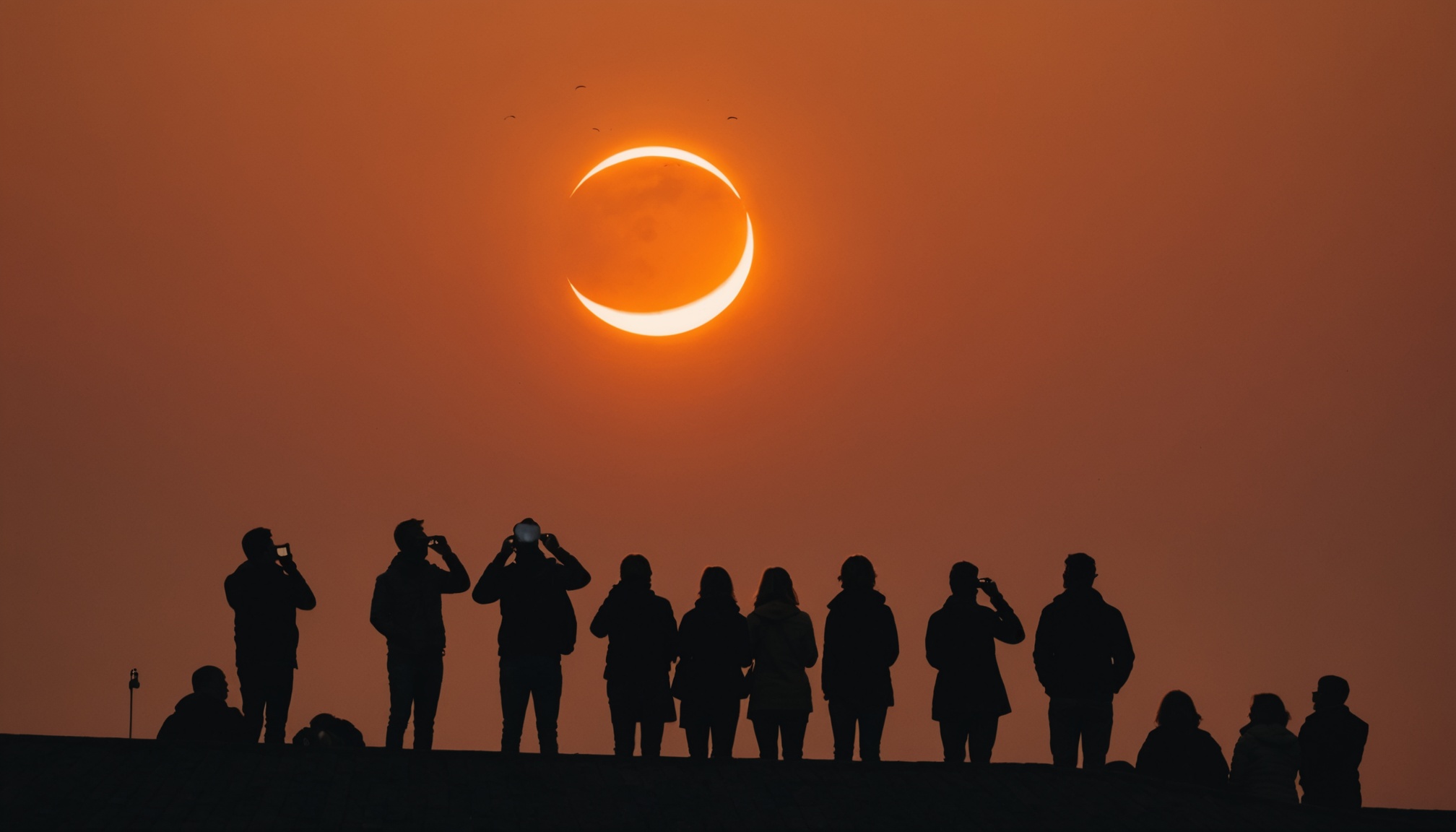
This Wednesday, August 12, a solar eclipse will cross the North Atlantic before plunging Spain into darkness in the early evening. It's a rare event, as it is the first total eclipse visible from European soil in several years. From France, the phenomenon will only be partial, but it remains spectacular to observe, provided a few simple safety rules are followed.
A Shadow That Travels from the Arctic to North Africa
Contents
The Moon's shadow cone begins its path over the Arctic Ocean, briefly crosses southwestern Iceland near Reykjavik, where totality will last about one minute, then speeds across the North Atlantic before reaching land in Spain. The path of totality enters through Galicia, moves up toward Castile and León, then reaches the Balearic Islands, offering up to 1 minute and 48 seconds of total darkness for some observers in Spain. The eclipse ends at sunset over North Africa.
What People in France Will See
Mainland France lies outside the path of totality: the phenomenon will only be partial there, with the solar disk obscured by about 55-60% as seen from Paris, and up to 78-82% on the French Riviera, where the viewing angle is most favorable. The eclipse will begin around 7:20 p.m. French time and reach its peak around 8:10-8:20 p.m. depending on the region, late in the day, which should make it easier to watch for those coming home from work.
The Often-Overlooked Angle: Why a Partial Eclipse Remains Dangerous
Many people assume that a partial eclipse, less spectacular than a total one, poses less risk to the eyes. This is a common misconception: even when 80% of the solar disk is obscured, the portion that remains visible is still bright enough to permanently damage the retina within seconds, with no pain felt at the time. Unlike a total eclipse, there is no phase here during which one can safely remove eye protection, since the Sun never fully disappears when viewed from France.
The glasses used must carry the CE marking and the ISO 12312-2 reference. Binoculars, a camera, or a phone without a dedicated solar filter do not protect the eyes and can even concentrate light dangerously. A simple, free alternative is to project the Sun's image onto the ground through a kitchen sieve or colander, with each hole acting as a tiny pinhole camera.
Next Appointment in Europe
After the one on August 12, the next total solar eclipse to cross European territory is not expected for several years, which explains amateur astronomers' enthusiasm for this event, despite its only partial nature in France.
Frequently Asked Questions
Can the eclipse be viewed with the naked eye from France?
No. Since the phenomenon will remain partial across all of France, certified ISO 12312-2 glasses must be worn at all times, or an indirect projection method such as a colander should be used.
What time should people in France watch the sky?
The eclipse begins around 7:20 p.m. French time and reaches its maximum between 8:10 and 8:20 p.m. depending on the region, just before sunset.
Why is the eclipse total in Spain but not in France?
The path of totality, where the Moon completely covers the Sun, is only a few hundred kilometers wide. It crosses northern Spain and the Balearic Islands; outside this narrow band, the eclipse is only partially visible, as is the case everywhere in France.
Sources
CNES – Solar Eclipse of August 12, 2026, a Phenomenon Visible in France
L'Espace des sciences – Solar Eclipse of August 12, 2026
Solar Eclipse 2026 – Time, Map, and Guide for France
Find all our science and planet news, as well as our practical tips for safely enjoying astronomical events.
Author Profile
Latest entries
 Food & Drink21 November 2026Beaujolais Nouveau: A Historically Low Harvest, Yet Sales Keep Climbing
 Finance20 November 2026Consumer Credit: Mini-Loans, Split Payments, and Overdrafts Face Tighter Rules
 Planet15 November 2026CO2 Emissions: Why Transportation Remains France's Climate Blind Spot
 Artificial Intelligence12 November 2026Imagine Enterprise: IBM and Microsoft Team Up on AI Agents for Large Businesses
This article was written with the help of artificial intelligence. Editorial policy