
🎯 In brief: Multi-agent systems represent the natural evolution of generative artificial intelligence, making it possible to orchestrate multiple specialized agents to automate complex business processes. Unlike a single monolithic agent, this distributed architecture divides cognitive tasks among autonomous but coordinated entities, each mastering a specific domain. This approach solves the limitations of traditional LLMs: context loss, hallucinations, and the inability to handle multi-step workflows. At the heart of this transformation lies intelligent orchestration, where each agent communicates according to standardized protocols (notably the Model Context Protocol), guaranteeing reliable, traceable, and governed execution. The operational gains are immediate: reduced human time, improved result quality, and risk control thanks to built-in supervision.
💡 Key takeaways: An AI agent never acts alone in a critical environment; multi-agent architecture enables intelligent collaboration where each component remains specialized and manageable. Orchestration determines 80% of overall performance—more important than the power of the model itself. MCP (Model Context Protocol) standardizes connections between agents and business tools, paving the way for interoperable ecosystems. Quality data is the absolute foundation: no agent can make correct decisions based on corrupted information. Human oversight remains essential for high-impact decisions, even in “autonomous” systems. High-ROI use cases are found in repetitive, multi-step processes where the business context is well defined.
🚀 Why a Single AI Agent Is No Longer Enough to Orchestrate Business Complexity
Contents
The history of generative AI in business follows a predictable trajectory. Teams start with a simple prompt: send a question to an LLM and get a response back. Then they move on to RAG (Retrieval-Augmented Generation), allowing the model to read internal documents. Next comes the single agent, capable of triggering an isolated action. But by 2025-2026, this model reaches its limits—and IT directors discover this the hard way.
Picture this concrete scenario: a bank asks a single agent to analyze a customer's credit data, check their history, look up current exchange rates, check internal risk thresholds, write a summary report, and send a notification to the account manager. In theory, a powerful LLM should be able to do this. In practice? The agent loses context by the fourth step, confuses risk thresholds, forgets the customer's name, or generates nonsensical figures. The reason isn't a lack of intelligence—it's a lack of specialization and governance.
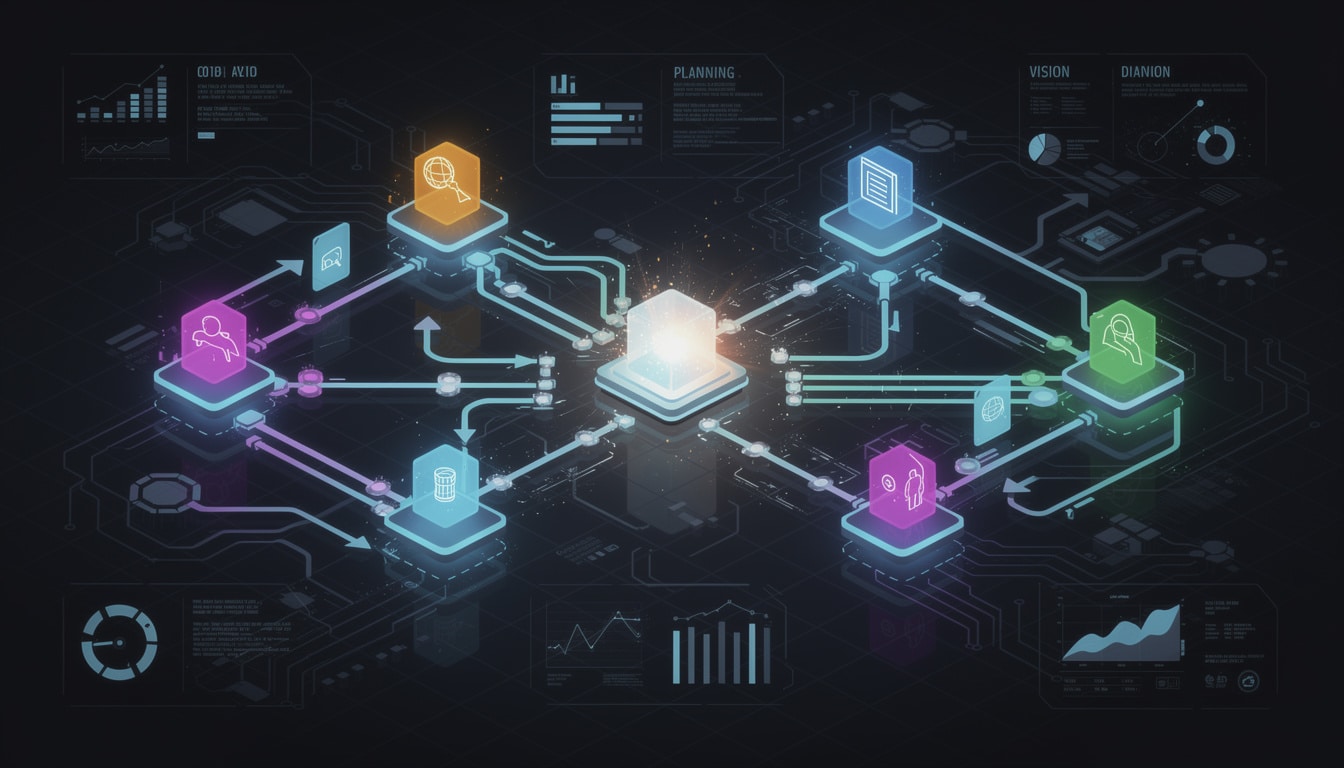
A single agent is a one-man band. A multi-agent system is a team. And it's the organizational structure—not the raw power of the model—that transforms generic AI into reliable automation. This is why multi-agent architectures are becoming the standard for orchestrating complex workflows: they mirror how humans naturally solve difficult problems.
🔍 The Limits of the Monolithic Model Exposed in Production
When a company deploys a single agent for a real business process, three problems systematically appear. The first is context loss: as the agent accumulates reasoning steps, its attention becomes diluted. It starts strong, but after the fifth action, it forgets the initial constraints or confuses priorities. This is a neural problem, not a software bug.
The second problem is the difficulty of iterating. If the agent makes a mistake at stage 3, everything that follows is compromised. There's no way to fix it without restarting the entire chain. With several specialized agents, each one can be improved, tested, and deployed independently—that's the genius of modularity.
The third problem is opaque traceability. When a single agent's decision produces a problematic result, it's nearly impossible to replay the reasoning to understand why. Execution logs become indecipherable. With a well-designed multi-agent architecture, every step, every tool call, every decision is precisely recorded—a critical element for regulatory compliance and continuous improvement.
🏗️ The Fundamental Components of a High-Performing Multi-Agent Architecture
Building a multi-agent system isn't just about adding more agents. It starts with understanding the six essential building blocks that make them work. Each of these building blocks plays a distinct role, and how harmoniously they're integrated determines the system's success or failure. Ignoring any one of them is like building on sand.
The first building block is the reasoning engine—typically an LLM or a hybrid model—which acts as the “brain” of each agent. It interprets instructions, analyzes data, and produces reasoning. But be careful: it's not the one that decides the overall objective. Its role is strictly confined to its area of expertise.
The second building block consists of tools and extensions. An agent must be able to act on the real world through APIs, connectors, and business functions. This is where the Model Context Protocol (MCP) plays a major role: it standardizes how agents access tools, ensuring secure and scalable integration. With MCP, every tool exposes a consistent interface, whether it's a database, a web service, or a custom function.
The third building block is structured memory—both short-term memory (the immediate context) and long-term memory (accumulated experience). Without memory, the agent starts from scratch with every interaction. With well-designed memory, it adjusts its behavior and learns from past mistakes.
The fourth building block is the action module—the executor that turns reasoning into concrete results. In a multi-agent system, this module also handles coordination: passing tasks from one agent to another, aggregating results, and managing dependencies.
The fifth building block is the orchestrator, or supervisor agent. This is the “conductor” that receives the overall request, breaks it down into subtasks, assigns each task to the most competent agent, and gathers the results. The orchestrator doesn't execute the tasks itself; it delegates intelligently and supervises.
The sixth and final building block is the communication interface—the channel through which the system interacts with human users, other agents, or external systems. This is where the user experience is forged, but also where security and authentication issues come to the surface.
These six building blocks, properly assembled, create a resilient architecture capable of handling complex business workflows with a level of reliability no single agent could achieve. But their mere presence isn't enough: it's their coordinated orchestration that makes the difference.
⚙️ Orchestration Patterns: Sequential, Hierarchical, and Collaborative
How do you get multiple agents to communicate with each other without running into infinite loops or drifting completely off the objective? This is the fundamental question of orchestration. The answers take the form of three distinct patterns, each suited to different business contexts.
🔗 The Sequential Model: A Cognitive Assembly Line
In this pattern, agents work in series, like an industrial assembly line. Agent A extracts a piece of data, passes it to Agent B, who summarizes it, who then passes it to Agent C, who turns it into a report. The flow is deterministic, controllable, and easy to debug. If a step fails, you know exactly where to trace the problem.
This model excels at well-standardized administrative processes. For example, a bank's new customer onboarding workflow: Agent 1 validates documents, Agent 2 checks background information, Agent 3 creates system accounts, Agent 4 sends credentials. No discretionary decisions, just a logical sequence of steps.
The danger of the sequential model emerges when situations call for flexibility. If Agent 2 detects an unexpected anomaly, the linear flow has no mechanism to branch off onto an alternate path. It either continues blindly or stops entirely.
📊 The Hierarchical Model: Supervisor and Specialized Executors
Here, a Supervisor Agent holds decision-making authority. It receives the complex request, analyzes the “fleet” of available agents (a web-scraper agent, a SQL agent, a calculator agent), and dynamically delegates based on context. The Supervisor gathers the partial results and formulates the final response.
This pattern is far more robust in the face of unpredictability. If a user asks a nuanced question combining finance, weather, and logistics, the Supervisor mentally breaks down the request, calls the finance agent, then the weather agent, then the logistics agent, and synthesizes the three responses into a coherent analysis. This is exactly what modern agentic architectures implement at the core of autonomous systems.
The cost is complexity: the Supervisor must be intelligent and well-instrumented to delegate correctly. If poorly configured, it becomes a bottleneck that slows down the entire system.
💬 The Collaborative Model: Debate and Collective Emergence
More ambitious and trickier to master, this pattern places several agents in a virtual discussion space where they debate. A “Financial Conservative” agent debates an “Aggressive Growth” agent over an investment plan. Their diverging viewpoints create a depth of risk analysis that no single agent could produce on its own.
This model generates emergent intelligence, but at the cost of unpredictability. Agents can diverge in opinion, get stuck looping on their positions, or converge on a biased conclusion if the debate isn't properly framed. An arbiter must therefore be added—often a human—who listens to both viewpoints and decides.
The collaborative pattern shines particularly during the exploration and innovation phase: multi-perspective brainstorming, complex scenario evaluation, or multi-domain diagnostics. But it's ill-suited to operational processes that demand fast, predictable execution.
🛠️ Designing an Effective Multi-Agent System: The Key Steps
Moving from concept to production requires a structured approach. Improvising exposes you to fragile, costly, and unreliable deployments. Here's how successful organizations do it.
🎯 Step 1: Frame the Business Need and Identify Use Cases
It all starts with an uncomfortable question: what is the problem, really? Many organizations confuse “having an AI agent” with “solving a business problem.” In reality, the best multi-agent use cases target repetitive, time-consuming activities with low initial risk but high potential ROI. An insurance company might use a multi-agent system to automatically process minor claims, freeing up humans for complex cases that require judgment.
Scoping also means drawing clear lines: which decisions must remain under human supervision? What level of autonomy is acceptable? Gathering information can be 100% autonomous, but a money transfer always requires human approval. Without these clear boundaries, you're building a system that will slip out of your hands.
🔧 Step 2: Select the Technical Stack and Models
The choice of LLM, orchestration framework, and integration tools depends entirely on context. Do you have agents specialized in natural language? Choose a powerful general-purpose model like GPT-4 or Claude. Need speed and cost savings? Consider Small Language Models (SLMs) fine-tuned on your business data. Have data sovereignty requirements? Explore open-source models like Llama or Mistral.
For orchestration, modern frameworks like LangGraph, CrewAI, and AutoGen each offer different strengths. LangGraph shines for its flexibility; CrewAI for its ease of learning; AutoGen for its multi-agent robustness. The choice depends on your team and your control requirements.
A beginner architecture often favors simplicity: a central (hierarchical) orchestrator with 3-5 specialized agents, integrated through clear, well-documented APIs. This approach is predictable and scalable.
🔌 Step 3: Implement and Connect the Agents
This is where the real complexity begins. You need to create each agent (define its role, responsibilities, and constraints), connect its tools via MCP or proprietary connectors, structure its input and output data, and orchestrate the calls between agents. Every connection is a potential point of friction: poorly formatted data, network timeouts, failed authentications.
A good practice is to start small: a single workflow that works end-to-end, even with just two agents. Once this foundation is stable, you can add more agents and make the orchestration more complex.
🧪 Step 4: Test, Observe, and Continuously Iterate
A multi-agent system in production needs to be observed continuously. Which agents are called most often? Where do errors concentrate? What's the average processing time per workflow? Observability dashboards aren't a luxury—they're an operational necessity.
Testing must cover several levels: unit testing of each isolated agent, integration testing of the complete flow, and load testing to verify the system doesn't collapse under traffic. Often, the sneakiest bugs only appear under stress—an agent might work perfectly at 10 requests per minute but go off the rails at 100 requests per minute.
Iterations need to be fast and structured. A week of observation, an update to the prompts or routing logic, another week of testing. This is how you gradually improve reliability and performance.
📈 Step 5: Optimize Performance and Cost Efficiency
Once the system is stable in production, the challenge becomes optimization. Agents that communicate with each other consume tokens. Inefficient orchestration can quickly produce exponential bills. You therefore need to track costs: how much does each agent cost on average? Which agent generates the best ROI? Are there unnecessary loops to eliminate?
Optimization also depends on model choice. You can often replace a costly step (a GPT-4 call) with a simple logic rule or a lighter model. The secret: use the best tool for each task, not the most powerful one everywhere. An agent that validates a form entry doesn't need GPT-4; a small specialized model is enough and costs 10 times less.
📱 Real-World Use Case: A WhatsApp Agent for Orchestrating Appointments
Let's show how this works in practice. A services startup wants to automate appointment scheduling via WhatsApp. Customers send their availability in natural language (“Hey, I'm free Tuesday afternoon or Thursday morning”), and the system needs to extract the time slots, check the calendar, confirm the appointment, and log it in the CRM—all without human intervention.
🔄 The Detailed Architectural Flow
The user sends a WhatsApp message via the WhatsApp Business API. The message reaches the backend, which cleans it (removing sensitive data), adds context (customer profile, history, time zone), and passes it on to the multi-agent system. Here's how the agents orchestrate the process.
Agent 1: Intent Analyzer. It receives the raw message and detects the business intent. Is it an appointment request? A cancellation? A reschedule? Thanks to the LLM, it understands “Tuesday afternoon” or “end of day” and translates them into structured time ranges (Tuesday 2 PM-6 PM). If the intent is unclear, it formulates a clarifying question and follows up with the user. This agent is ultra-specialized: natural language understanding, nothing else.
Agent 2: Availability Checker. It receives the time slots extracted by Agent 1 and checks them against reality: calling the “Calendar” MCP tool to verify which slots are actually free. The agent doesn't invent anything—it queries the source of truth and gets a binary answer: free or busy. If the answer is “busy,” it asks Agent 1 to propose alternatives.
Agent 3: Confirmer and Recorder. Once a time slot is validated and accepted by the customer, this agent creates the calendar event, sends the invitation, and updates the CRM. It also ensures traceability: every action is logged with a timestamp and a signature.
Central Orchestrator. It receives the initial message, passes it to Agent 1, receives the time slots, sends them to Agent 2, manages the negotiation loop if certain slots are taken, and finally triggers Agent 3 for the final confirmation. If something fails at any step, the orchestrator handles the fallbacks: “I didn't understand that, can you rephrase?”, or “That slot is no longer available, let's try something else.”
⚡ Benefits for the Business
The startup saves 20-30 hours of human labor per week: no more need for a dedicated person to respond to appointment requests. Customers get an immediate confirmation 24/7 on WhatsApp, without waiting for a human. Errors drop drastically: no double-booking, no mistranscribed time slots. Every interaction is logged, usable to continuously improve service quality.
And here's the crucial point: this system is only stable because of specialization. Each agent does exactly one thing. If you had built a “super-agent” capable of understanding natural language, checking the calendar, creating events, and handling exceptions, that single monolithic agent would be hard to debug, expensive to improve, and fragile in production. Multi-agent architectures make this simple.
🔐 Governance, Risk, and Supervision in Multi-Agent Orchestration
As soon as you deploy autonomous agents capable of making decisions and executing actions, technology becomes secondary. What really matters is governance. Without a clear framework, even the best models become dangerous.
🛡️ Security and a Strictly Defined Scope of Action
Each agent must have minimal access rights: it can only access the data and tools it needs for its task, nothing more. An order-processing agent doesn't need access to HR databases. A financial analysis agent doesn't need to create users. These limits aren't arbitrary restrictions; they're security safeguards.
Communication flows between agents must be encrypted. Tool calls must be authenticated. Execution logs must be immutable. These requirements quickly turn a toy prototype into a production-ready system.
👁️ Human Oversight and Real-Time Dashboards
Even in an autonomous agent system, someone must be able to hit “pause” in case of an anomaly. This requires dashboards that display, in real time, the status of each agent, the number of errors, decisions made, and resources consumed. Alerts must trigger immediately if an agent strays from its normal parameters.
Certain decisions—significant money transfers, critical database changes—must require explicit human approval before execution. This is the “Human-in-the-Loop” model that balances autonomy and control.
📝 Full Explainability and Traceability
When an AI agent recommends an action or makes a decision, you must be able to replay the entire reasoning to understand the “why.” That means logging: which prompt was sent to the model? Which tools were called? What data was retrieved? What was the result? Full transparency isn't a nice-to-have—it's a regulatory requirement in healthcare, finance, and other regulated sectors.
Microsoft's documentation on AI agent design patterns heavily emphasizes this point: observability and traceability are just as critical as functionality itself.
⚙️ Cost Management and Preventing Infinite Loops
An agent that debates endlessly with another agent, or that calls the same tool in a loop, can blow up your cloud bill within hours. You therefore need to implement circuit breakers: limit the number of iterations, set timeouts, and impose spending thresholds per workflow. If these limits are reached, stop immediately and alert a human.
Tracking costs is just as vital as monitoring latency. Which agent consumes the most tokens? Which workflow generates the best ROI? These metrics guide your optimization and investment decisions.
🚀 The Future Evolution: Toward Distributed Agent Ecosystems
We're at a turning point for generative AI. Monolithic LLMs won't disappear, but they're becoming components within a larger architecture: multi-agent systems capable of collaborating, reasoning, and acting in complex environments. What's emerging is a new layer of collective intelligence.
🌐 The Model Context Protocol: Standardizing Interoperability
Until recently, each AI platform had its own conventions for connecting agents to tools. OpenAI had one approach, Anthropic another, Microsoft a third. This fragmentation slowed innovation and created technical silos that were costly to maintain.
The Model Context Protocol (MCP) changes the game. It offers an open, unified standard for agent-to-tool communication. With MCP, any Anthropic agent can interact with a tool hosted on Azure, which can communicate with a Lambda function on AWS. Interoperability becomes real. This is why MCP has rapidly become central to modern agentic architectures—it's the “common language” that lets ecosystems grow.
🎨 The User Interface Directly Within Agents (MCP UI)
A major shift currently underway: agents will soon not only return text and images, but also interactive interface components—forms, dynamic tables, charts, action buttons. OpenAI already integrates this capability, and Shopify paved the way with its commerce tools. Imagine: an agent asks for confirmation on a large payment, and the user can interact directly with an embedded form, without leaving the conversation.
This radically increases the usefulness of agents by making them more interactive, less text-based, and more visual.
🧠 Hybrid Architectures and Distributed Intelligence
The future won't be monolithic. What's emerging are architectures that combine: general-purpose LLMs for abstract reasoning, specialized SLMs for precise tasks, vision models for visual data, and rules engines for deterministic business logic. Each component plays a specific role in the overall orchestration.
This heterogeneity makes it possible to combine power with efficiency. You only use GPT-4 when you truly need it; the rest of the time, lighter, cheaper models are enough. It's a far more pragmatic approach than the “best model for everything” philosophy.
📊 End-to-End Business Process Automation
Multi-agent systems are becoming virtual coworkers embedded in business tools: CRM, ERP, HR suites, customer support tools. An agent can read a support ticket, extract the issue, check the knowledge base, propose a solution, or escalate it to a human—all seamlessly for the end user.
The real value isn't the technology—it's the reduction of operational friction. Fewer manual steps, less context-switching, fewer human errors, and more time for value-added tasks.
💡 Key Metrics for Measuring the Success of a Multi-Agent System
Deploying a multi-agent system is good. Steering it correctly is better. Without the right metrics, you're navigating blind and making decisions based on gut feeling rather than facts.
⏱️ Performance and Operational Reliability
Average response time per workflow. How long does the orchestrator need to process a request from start to finish? If you're targeting 30 seconds and getting 3 minutes, something is wrong—a slow agent, a blocking tool call, a network issue. Continuous monitoring identifies the bottleneck.
Success rate. What percentage of workflows complete correctly on the first try? A 95% rate means 5% of requests need a retry or human intervention—that's probably acceptable. A 70% rate means your system isn't ready for production. You need to fix the agents or the orchestration.
Error rate by agent. Identify which agent is most often the source of problems. If the Analysis Agent fails 15% of the time while the Confirmation Agent fails 1%, you know where to focus your improvement efforts.
💰 Economic Efficiency and ROI
Cost per transaction. On average, how much does it cost to process a request? (tokens consumed, infrastructure, maintenance). Divide this cost by the human time saved, and you get the ROI. If an agent saves 2 hours of human labor for $10 in infrastructure costs, that's a profitable investment.
Model usage. What percentage of transactions use GPT-4 (expensive) vs. SLMs (economical)? The more you delegate to lightweight models, the more you optimize costs without sacrificing quality.
🎯 Business Satisfaction and Operational Impact
User adoption rate. If business teams use the system for 20% of their target tasks, that's a success. For 80%, it's a massive success. For 5%, there's a trust or UX problem to solve.
Cycle time reduction. Measure tasks before and after implementation. A process that used to take 4 hours and now takes 30 minutes has freed up 3.5 hours of human productivity per transaction. Multiply that by annual volume, and you see the real impact.
📋 Compliance and Governance
Audit trail coverage. Are 100% of agent decisions logged and traceable? If the answer is “no,” you have a major compliance risk. If “yes,” you can audit and continuously improve.
Governance violations. How many times has an agent attempted to access resources outside its authorized scope? Even a single occurrence is a problem that needs to be fixed immediately.
🎓 Continuous Learning and Iterative Improvement
A multi-agent system deployed in production is never “finished.” It's a living organism that must continually adapt to business changes, discovered bugs, and AI innovations.
📈 Feedback Loops and Prompt Adjustments
Every week, analyze failed workflows. Why did the agent get it wrong? Was it a natural language comprehension issue (insufficient prompt) or a data access issue (faulty tool)? The quickest improvements often come from fine-tuning the prompt—adding context, clarifying instructions, specifying constraints.
But be careful: adjustments must be rigorously tested before deployment. A prompt change that improves 90% of cases can break the other 10%. That's why automated A/B testing across thousands of cases is essential.
🔄 Versioning and Controlled Rollback
Version every component of the system: the LLM model version, the prompt version, the orchestration logic version. If an update degrades performance, you can roll back to the previous version in minutes—not days.
This requires mature deployment infrastructure: CI/CD pipelines, automated testing on every commit, canary deployments to a small percentage of users before a full rollout. This isn't a luxury—it's professional diligence.
🚀 Horizontal Scalability and Adding New Agents
As your use case evolves, you'll likely add new agents to cover additional domains. The architecture must allow for this growth without a major overhaul. That means a clear, stable orchestration interface, an extensible routing system, and infrastructure capable of supporting more parallel calls.
A good multi-agent architecture can go from 3 agents to 30 agents without any major conceptual change. A poor architecture collapses beyond 5 agents.
🌟 Beyond the Hype: When to Actually Implement a Multi-Agent System
Not every problem deserves a multi-agent architecture. Knowing when to use it and when to keep things simple is a critical skill.
✅ Signs You Need Multi-Agents
The workflow has 4+ distinct steps. If your process is truly linear (retrieve data → calculate → return result), a single agent is enough. But as soon as there's branching, loops, or a need for cross-verification, multi-agents become relevant.
Multiple areas of expertise are involved. A workflow combining finance, HR, and logistics probably requires three specialized agents working together, rather than one confused jack-of-all-trades agent.
Volume is significant. If you're processing 100 requests a day, the overhead of multi-agent orchestration is justified by the gains in reliability and maintainability. For 10 requests a month, it's overkill.
Traceability is critical. In finance, healthcare, or compliance, you need to audit every decision. Multi-agents naturally offer this granularity.
❌ When to Keep It Simple
A single-step workflow, or two tightly dependent steps. “The user asks a question, the model answers.” No need for multi-agents. A single agent works perfectly fine and is much simpler to maintain.
Very low volume or ad hoc usage. If it's a tool that humans rarely use or use unpredictably, multi-agents add complexity that isn't offset by any efficiency gain.
Highly dynamic and unpredictable context. If every request requires completely reinventing the logic (no reproducible patterns), multi-specialized agents lose their advantage. The adaptability of a general-purpose LLM becomes more valuable.
📚 Practical Resources and Tools to Get Started
If you're convinced that multi-agents is the right approach, here are some resources to help you take action.
For the conceptual design, the LinkedIn article on designing effective multi-agent systems offers an excellent summary of patterns and common mistakes. For a more technical approach, explore these learning resources on multi-agent orchestration, which detail concrete implementations.
The most mature implementation frameworks are LangGraph (for maximum flexibility), CrewAI (for rapid prototyping), and AutoGen (for robustness). Start with a simple prototype—two agents cooperating on a basic task—to get familiar with the concepts before scaling up.
For specific business cases, explore how to orchestrate AI for complex processes, which offers real-world automation examples across different industries.
Finally, the complete guide to multi-agent systems summarizes the architectures, patterns, and best practices as of 2026, ideal for a structured read on the discipline.
🔑 The essential takeaway: Multi-agent architectures aren't a technological gimmick—they're an architectural solution to real problems, namely the limits of single agents when facing business complexity. With rigorous orchestration, strict governance, and continuous iteration, these systems unlock massive operational gains: human productivity, increased reliability, and total traceability. Start small, learn fast, then scale up.
Author Profile
Latest entries
 Finance20 November 2026Consumer Credit: Mini-Loans, Split Payments, and Overdrafts Face Tighter Rules
 Planet15 November 2026CO2 Emissions: Why Transportation Remains France's Climate Blind Spot
 Artificial Intelligence12 November 2026Imagine Enterprise: IBM and Microsoft Team Up on AI Agents for Large Businesses
 Economy11 November 2026Livret A Rate: Understanding How It's Calculated and Its Limits
This article was written with the help of artificial intelligence. Editorial policy