
In brief: Autonomous agents are transforming businesses in 2026, but deploying them in a large corporation requires a rigorous integration strategy. Between technology choices, change management, and GDPR compliance, organizations must navigate complex challenges. Discover how to structure this shift from traditional SaaS to Agent as a Service, identify high-ROI use cases, and manage autonomy without sacrificing human control.
Brief: The adoption of autonomous AI agents in large corporations isn't just about deploying a technology. It's a complete organizational transformation that challenges existing workflows, required skills, and governance models. Companies that succeed in this transition combine a clear vision, measurable use cases, and strong management involvement. With 25% of large organizations in pilot phase by the end of 2026, timing becomes critical for those who haven't yet begun their digital transformation.
🚀 Why the Adoption of Autonomous Agents Is Reshaping the Technology Landscape of Large Corporations
Contents
For several years, large organizations have been investing heavily in digital transformation. But this year, something is fundamentally changing: the ability to automate not just tasks, but entire processes without constant human intervention. Autonomous agents represent this decisive turning point.
An AI agent is not a chatbot waiting for your question. It's a system capable of breaking down a complex objective, accessing multiple enterprise tools (CRM, ERP, databases), making intermediate decisions, and adjusting its course based on the results obtained. In practical terms: you give it a business objective, the agent breaks it down into steps, orchestrates existing systems, and delivers a result.
What's the difference from traditional automation? Flexibility and adaptability. A traditional RPA workflow stops at the first exception. An AI agent looks for a solution, escalates intelligently, or finds an alternative. That's why IT and business leaders at large corporations see it as a major boost to their operational efficiency.
The 2026 landscape is accelerating this adoption. Language models have stabilized, multi-agent orchestration frameworks are maturing (CrewAI, LangGraph), and most importantly, early customer feedback shows tangible gains: a 40 to 60% reduction in support costs, a 35% increase in sales productivity, or even 80% of administrative tasks eliminated. These figures are no longer theoretical: they are measured facts from organizations like yours.
But be careful: this potential only exists if you structure your integration strategy correctly. Many large corporations deploy agents without a coherent roadmap and end up with tools that operate in silos, lack interoperability, and cost more than expected.
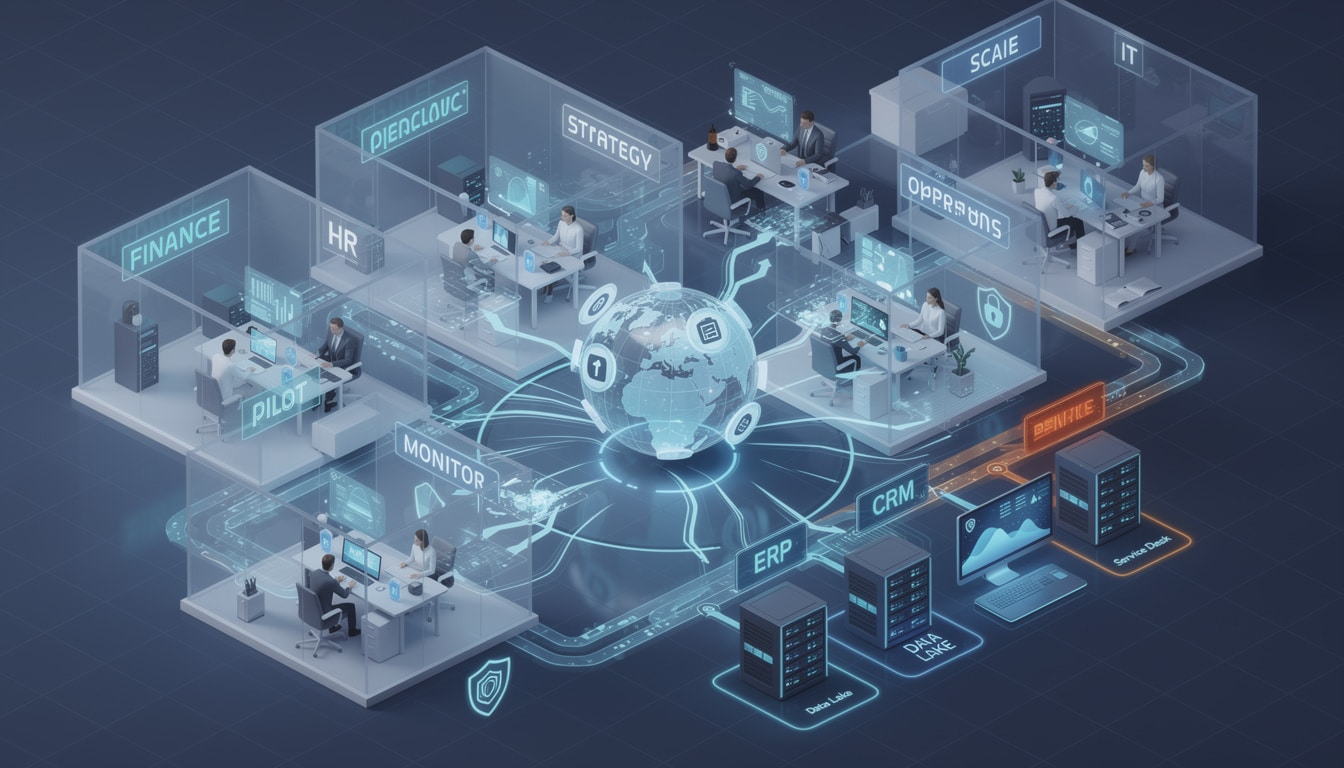
📊 How Autonomous Agents Are Redefining the Cost-Benefit Equation
The financial math is stark. An autonomous support agent costs between €200 and €500 a month as a packaged solution, while a level 1 human agent costs €25,000 annually (salary, benefits, training). But the real gain isn't just substitution: it's the ability to handle more volume without increasing resources.
Take a small business of 50 employees with 200 support tickets a month. Deploying an agent costs €300/month. By eliminating 60% of the volume (120 tickets), you free up 3 human-days per month. Over a year, that's 36 days of freed-up capacity, or about €7,000 in recovered productivity. ROI is reached in less than 2 months.
In a large corporation, the equation becomes exponential. A company with 5,000 employees, 50,000 tickets a month, and an 80-person support team can cut its headcount by 30 people by deploying intelligent agents. At €45,000 per person (total cost), that's €1.35 million saved annually. The ROI on a €150,000 implementation is reached in 1.5 months.
Of course, these figures depend on the quality of your data, integration with your existing systems, and your ability to properly supervise the agents. That's why a clear integration strategy is non-negotiable.
🎯 Structuring the Deployment of an Autonomous Agent in a Complex Environment
Large corporations face a complexity that startups don't: legacy technology, multiple business lines, distributed governance, and above all, millions of data points just waiting to be leveraged (or updated). Integrating an agent into this ecosystem requires a methodical approach.
The first mistake I've seen in my practice: starting with the technology. “We'll buy tool X and see what we can automate.” Wrong. The right starting point is the business objective and operational constraints. A support agent doesn't have the same requirements as a sales prospecting agent or a document analysis agent.
Here's the sequence that works for high-performing organizations:
🔍 Step 1: Map Your Processes and Identify Friction Points
Before thinking about agents, you need to understand your current reality. Which processes consume the most time, resources, or budget? Where do you have redundancies? Where are employees waiting on manual responses or approvals?
A practical exercise: ask each department (support, sales, HR, finance) to track repetitive manual tasks for 2 weeks. You'll discover that 30 to 40% of a support agent's day consists of extracting information from a ticket, looking up the answer in the knowledge base, formatting it, and sending it. That's exactly what an agent can automate.
This mapping phase takes 2 to 4 weeks. It costs little but it uncovers high-impact use cases. Without it, you risk deploying an agent on a process that's already efficient or too poorly structured to function autonomously.
⚙️ Step 2: Assess Your Technology Maturity and System Dependencies
An autonomous agent only exists if it can interact with your tools. Do you have APIs? What's the quality of your data? Are your major systems (CRM, ERP, SIRH—human resources information system) integrated or siloed? Is your cloud infrastructure complete or hybrid?
I worked with a large banking group that wanted to deploy a lead qualification agent. The problem: their CRM was an Access database, not accessible via API, and updated manually once a week. The agent would have processed outdated data. The solution: modernize the system first, then add the agent. Six months of preliminary work instead of three weeks for the agent alone.
This assessment also reveals your interoperability constraints. Will you need to build connectors? What will your architecture look like: centralized agents or agents distributed by department? Will you need multi-agent orchestration?
For large organizations, I recommend a technical audit conducted by an independent partner. This initial cost (€5,000 to €10,000) saves ten times more by avoiding bad integrations.
💡 Step 3: Define Your Success Criteria Before You Even Start
This is where most organizations get it wrong. They say “We'll see if it works” without clear KPIs. The result: after 3 months, nobody knows whether the project is worth the investment.
Before writing a single line of code, set measurable metrics that are ambitious yet realistic. For a support agent, here's what matters:
🎯 Autonomous resolution rate: what percentage of tickets does the agent handle on its own, without escalation? Realistic target: 50 to 65% in production.
🎯 Response time: reduction in the delay between ticket creation and the first response. Benchmark: going from 4 hours to 2 minutes for level 1 requests.
🎯 Customer satisfaction rate: not to be overlooked. An agent that's faster but less relevant will hurt your NPS. Target: maintain your current satisfaction rate or improve it.
🎯 Realized savings: cost per ticket processed (direct calculation) and freed-up human productivity (indirect calculation).
These KPIs must be established before the POC and tracked weekly once deployment begins. It's the only way to justify or adjust your strategy.
🤝 Step 4: Choose Between Building, Buying, or Orchestrating
You have three possible paths, each with different implications.
Option A: Buy a Packaged Solution (Agent as a Service)
You delegate to a vendor (Node6, Limova, Dust) that delivers a turnkey agent for your business. Advantages: fast time-to-value (2 to 4 weeks), no dev team required, predictable pricing. Drawbacks: less flexibility, vendor dependency, risk that the solution only covers 70% of your needs.
Ideal for: small businesses, large corporations that want to start simple, or departments where automation is standard (support, sales).
Option B: Develop In-House with Frameworks
You use LangChain, CrewAI, or LangGraph to build custom agents. Advantages: total flexibility, complete control over code and data, no recurring licensing costs. Drawbacks: requires data science/ML talent, ongoing maintenance, longer development cycles (2 to 3 months for a POC).
To dig deeper into the available frameworks, check out our CrewAI vs. LangChain comparison, which details the strengths and weaknesses of each approach.
Ideal for: large corporations with a solid tech team, highly specific use cases, or when you need a complex multi-agent architecture.
Option C: Orchestrate with Low-Code Tools (n8n, Make)
You connect your systems and public LLMs through a visual platform. Advantages: less code to write, a gentle learning curve, fast deployment. Drawbacks: less powerful for complex logic, can turn into visual spaghetti if the workflow grows heavy.
Ideal for: technical small businesses, straightforward use cases, or a first iteration before real development.
My advice: only choose after clarifying your steps 1 and 2. A large corporation won't have the same answer as a mid-sized company.
🔐 Managing Autonomy Without Losing Control: Governance in Practice
An autonomous agent is an agent that makes decisions. But in a large organization, every decision has consequences (reputational, legal, financial). That's why governance isn't a luxury—it's a requirement.
Three pillars underpin good agent governance:
📋 Traceability and Auditability: Every Action Must Be Explainable
When an agent makes a decision, the system must be able to answer these questions: Why did the agent reject this applicant? Which language model was used? What data influenced this conclusion?
This is especially critical in regulated industries (finance, healthcare, insurance). If your agent denies a customer's loan, the law requires you to be able to explain that decision in a non-discriminatory way. A “black box” agent is a legal liability.
To do this, implement systematic logging. Every request, every API call, every step of the reasoning process should be recorded. Use frameworks like LangSmith or proprietary solutions that offer this traceability by default.
Learn how large organizations structure this traceability in our guide on multi-agent system architecture, which also covers monitoring and audit patterns.
🛡️ Access Control and Data Minimization: The Principle of Least Privilege
An agent doesn't need access to all your data. Rigorously limit its permissions. If your support agent needs to answer customer questions, it doesn't need access to your HR department's payroll data.
This is a basic security principle applied to agents. In my practice, I've seen organizations grant their agents “admin” access for convenience. That's a costly mistake: a bug in the agent or a malicious prompt injection could compromise your critical systems.
Implement granular permissions. A marketing agent can access your CRM (prospects, leads, interactions) but not your sales contracts or financial data. An HR agent can process applications but not disciplinary files.
🔄 The Human-Agent Loop: When and How to Step In
Autonomy doesn't exist without intelligent oversight. You need to define checkpoints where a human validates or corrects the agent. These checkpoints shouldn't be systematic (otherwise you don't have automation)—they should be strategic.
Example: a prospecting agent can send follow-up emails without supervision, but any pricing change request must be approved by a manager before being sent to the client. A support agent can answer 80% of questions on its own, but any customer escalation or refund request must go to a human.
This “human-in-the-loop” approach is configured at the workflow level. It also needs to be clearly documented so teams understand when they should step in and why.
For a large organization with multiple teams, this oversight becomes a real job: agent supervisor. These people no longer handle tickets directly; instead, they monitor the proper functioning of the agents and step in at critical points. It's a role transformation, not a job elimination.
💼 Scaling Up Deployment: Change Management and Capacity Building
Too many automation projects fail not for technological reasons, but because teams refuse to work with the new tool. This is a change management challenge that's often underestimated in large corporations.
When you deploy an agent that handles 50% of support tickets, what happens to the 30 agents who used to handle them? Some retire or move to a different role. But many need to shift toward more complex tasks: handling escalations, managing agents, innovating in customer service.
It's a cultural shift, not just a technological one.
🎓 Training and Upskilling
Your teams need to understand how the agent works, when to trust it, and when to step in. A basic 2- to 3-day training is enough for end users (support, sales). For administrators or architects, plan on a more in-depth training (5 days) with hands-on workshops.
More important than initial training: ongoing support. An agent in production will “drift” (its performance will degrade) if no one actively monitors it. Assign a small team (1 to 2 FTEs) to oversee, improve, and maintain the agents.
📈 A Gradual Ramp-Up Strategy
Don't deploy your agent to 100% of volume all at once. Start with 20% of traffic running in parallel with your current processes. Measure performance, adjust, then scale up to 40%, 60%, and so on, up to 100%. This progression (continuous A/B testing) takes 6 to 12 weeks.
During this phase, keep your old processes running in parallel. If the agent's performance tanks, you won't paralyze your operations.
This gradual approach costs a bit more in infrastructure and operational management, but it drastically reduces risk. In the large corporations I've worked with, this method has prevented disasters (agents that “hallucinated” and sent nonsensical responses, or that froze up on an unexpected type of request).
🚀 Accelerating After the First Success
Once your first agent is in production and proving its value, adoption accelerates naturally. Your teams gain confidence, other departments start asking “Why not us too?”, and the investment quickly becomes profitable.
This is when a multi-agent strategy starts to make sense. You can orchestrate several agents (support, sales, HR) through a shared platform, share data between them, and create synergy. For example, the sales agent can alert the support agent that a customer just signed a major contract, and the support agent then raises that customer's priority level.
Check out our article on the cost of deploying multi-agent systems to plan ahead for the next step.
💰 Realistic Budgeting: From POC to Production in a Large Corporation
How much does an agent really cost in a large corporation? The answer varies enormously depending on your strategy, but here's a realistic breakdown.
🔬 POC Cost (Proof of Concept)
A POC tests an agent on a limited use case, with a reduced volume (100 to 1,000 transactions). Duration: 6 to 8 weeks. Budget: €10,000 to €25,000, depending on whether you go with a packaged solution (cheaper) or a custom build (more expensive).
This cost covers: the initial audit, tool selection, basic integration, testing, and reporting.
🏗️ Initial Deployment Cost (First Agent in Production)
Once the POC is validated, you're ready for production. This deployment takes 3 to 4 months and costs €30,000 to €80,000 if you use a packaged solution, or €50,000 to €150,000 for custom development.
This cost includes: full integration with all your systems, fine-tuned configuration, load testing, setting up governance and monitoring, and team training.
For packaged solutions, add a monthly subscription cost (€300 to €2,000/month depending on the solution and volume).
📊 Hidden Costs Not to Overlook
🔹 Infrastructure: APIs, servers, vector databases (Pinecone, Weaviate) if you use sophisticated RAG. Annual budget: €5,000 to €20,000.
🔹 Data cleaning and structuring: before an agent can leverage your data, it needs to be clean and well-structured. This often accounts for 30% of the effort. Budget: €10,000 to €30,000 for a first agent.
🔹 Ongoing maintenance and improvements: an agent in production naturally drifts over time. You'll need to retrain the models, adjust prompts, and fix bugs. Budget: 15 to 20% of the initial cost per year.
🔹 Governance and compliance: GDPR compliance audit, setting up secure logging, documentation for auditors. Budget: €5,000 to €15,000 (often done in parallel with the implementation).
💵 Realistic Scenario for a Mid-Sized Company (200 to 500 Employees)
A mid-sized company piloting 3 departments (support, sales, administrative). Each agent handles about 1,000 transactions per month.
Year 1:
🔹 Audit and strategy: €5,000
🔹 POC (1 agent): €15,000
🔹 Deployment of the 3 agents into production: €100,000 (3 × €30,000 for packaged solutions, a bit cheaper than full custom)
🔹 Subscriptions and infrastructure: €12,000 (€1,000/month × 12 months)
🔹 Training and change management: €8,000
Total for Year 1: €140,000
Year 1 gain: The 3 agents handle 25,000 transactions autonomously. Estimating a savings of €15 per transaction (avoided human cost), you gain €375,000. Gross ROI: 268% in the first year.
Following years: No deployment cost. Just maintenance (€20,000/year) + subscriptions (€12,000/year) = €32,000. Constant gains (€375,000 if you maintain the volume). ROI: 1,071%.
These figures vary significantly depending on your context, but the order of magnitude is consistent with what I observe among my clients. ROI is generally achieved after 3 to 4 months in production.
🌍 The Ecosystem and Trends Redefining Agent Integration in 2026
The landscape of autonomous agents is evolving very quickly. Three trends are reshaping what's possible for large corporations.
🔗 Emerging Interoperability Between Agent Platforms
Historically, an agent deployed on CrewAI couldn't interoperate with an agent on LangChain. You had silos. In 2026, standards are emerging: Open Agent Architecture, common languages for describing tools (OpenAPI), and unified orchestration frameworks.
This means a large corporation can deploy heterogeneous agents (purchased from a vendor, built in-house, rented via SaaS) and get them to work together without a major re-integration effort. This is a game-changer for technological innovation: you're no longer locked into your initial tool choice.
To stay up to date on these developments, check out Agentlink's resources on AI economy architecture, which cover emerging standards.
🧠 Lighter but Smarter Models: The End of the Giant LLM Monopoly
OpenAI, Anthropic, and Google dominate with their massive models. But in 2026, smaller, specialized, and efficient models are gaining ground. They're less “hallucination-prone,” faster, cheaper, and sometimes even more effective for specific business tasks.
For a large corporation, this means you can deploy highly effective agents without being fully dependent on external APIs. Your support agent can run on a Mistral model fine-tuned on your data, faster and more reliable than a GPT-4 call. This improves your technological sovereignty and reduces your token costs.
🔮 Predictive and Prescriptive Agents: Beyond Automation
The first generation of agents automates (it does things in place of humans). The second generation anticipates (it predicts and alerts before a problem occurs). The third generation prescribes (it proactively recommends the optimal action).
Tomorrow's support agent won't just process tickets. It will predict which customer is likely to churn based on their interaction patterns, and prompt the account management team to reach out before they leave. An HR agent will predict who might be ready for promotion and recommend the right training.
It's a shift toward pure business value, beyond simple operational efficiency.
⚖️ Ethics and Transparency: Governance Challenges Sharpen
The more autonomous decisions your agents make, the more critical the issue of ethics and transparency becomes. An agent that denies a loan, rejects a résumé, or allocates a budget—all of these decisions have human impact.
Large organizations are beginning to set up AI Ethics Boards to validate agents before deployment. These committees check for: absence of bias, legality of decisions, respect for privacy, and the ability to explain each decision.
This is an additional cost (1 to 2 FTEs, or €50,000 to €100,000/year for a large corporation), but it has become a legal requirement in certain sectors (finance, healthcare, employment).
Author Profile
Latest entries
 Finance20 November 2026Consumer Credit: Mini-Loans, Split Payments, and Overdrafts Face Tighter Rules
 Planet15 November 2026CO2 Emissions: Why Transportation Remains France's Climate Blind Spot
 Artificial Intelligence12 November 2026Imagine Enterprise: IBM and Microsoft Team Up on AI Agents for Large Businesses
 Economy11 November 2026Livret A Rate: Understanding How It's Calculated and Its Limits
This article was written with the help of artificial intelligence. Editorial policy