In brief: No-code and low-code platforms are radically transforming AI agent deployment, shifting from a task requiring teams of engineers to something accessible to everyone. In 2025, 70% of new enterprise applications now rely on these technologies, up from 25% in 2020. The best solutions offer intuitive visual interfaces, native integrations, persistent memory, and sophisticated tool orchestration, letting business teams build and deploy autonomous agents in just a few days. Platforms like Konverso, Copilot Studio, and n8n dominate the market in 2026, offering flexibility, security, and scalability for organizations of all sizes.
Overview: Launching an AI chatbot or conversational agent used to require a massive investment in technical talent and engineering budgets. Today, that reality has flipped. No-code and low-code tools put the power of intelligent agents within reach of non-technical teams, transforming how businesses automate operations, strengthen customer service, and speed up decision-making. This article explores the best no-code AI agent-building solutions, their real-world capabilities, their limitations, and how to choose the right platform for your specific business needs.
🚀 Why No-Code Tools Are Revolutionizing AI Agent Deployment
Contents
The rise of no-code tools for AI agents marks a major turning point in making artificial intelligence accessible. Where companies once had to assemble multidisciplinary teams and invest considerable resources, they can now design sophisticated autonomous systems in a matter of hours. This democratization isn't just marketing talk: it reflects a simple economic reality.
Between 2020 and 2025, the share of new applications using low-code or no-code technologies jumped from 25% to 70%, according to Gartner data. This explosive growth reflects organizations' urgency to modernize their processes quickly without being held back by hiring delays or traditional development timelines.
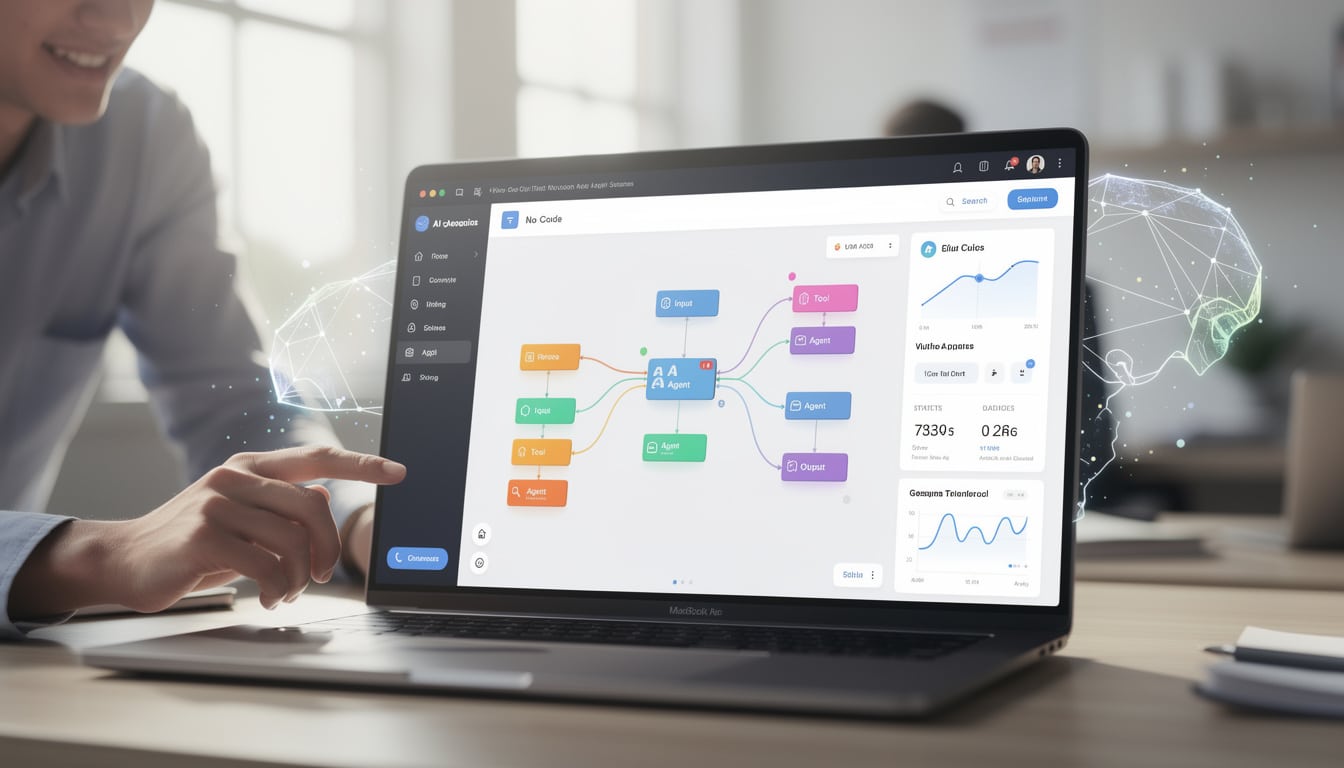
But beyond the numbers, the very nature of automation is changing. Modern AI agents no longer simply execute predefined scripts. They reason, adapt their actions in real time, access external data sources, and interact naturally with users. And they do all of this without a single line of code being written.
💡 From Costly Engineering to Universal Accessibility
Picture a customer support team that wants to automate 40% of its tickets. In the past, that would have required hiring developers, a long and expensive design phase, and then months of iterations. With a modern no-code platform, that same team can assemble an agent in just a few days, test it immediately, and fine-tune its behavior based on real-world feedback.
This speed provides a tangible competitive advantage. Organizations that quickly adopt no-code platforms not only cut their operating costs, they also become more responsive to competitive pressure. An AI agent deployed within a week creates immediate value, while traditional projects remain stuck at the specification stage.
🎯 The Crucial Differences Between No-Code and Low-Code
Before choosing a platform, it's important to clarify a fundamental distinction that directly affects your flexibility and your ability to extend functionality. No-code and low-code are not two synonyms, but two radically different development philosophies.
No-Code: Maximum Speed, Limited Flexibility
No-code tools completely hide the underlying logic. You assemble your agent using visual blocks, predefined templates, and graphical workflows. The immediate upside: anyone can build quickly, with no prior technical skills required. The downside: as soon as you step outside the predefined use cases, you hit a wall.
Take the example of a FAQ bot. A no-code tool excels at this kind of simple deployment. But if you need to call a proprietary API, handle complex conditional logic, or inspect why your agent made a particular decision, you're stuck. No-code tools trade transparency and customization for simplicity.
Low-Code: Flexibility and Control, with a Learning Curve
Low-code platforms, on the other hand, expose the underlying logic. You still work within visual environments, but you can inspect the workflows, write code when needed, and customize your agents' behavior. This approach requires some technical know-how, but it offers vastly greater power.
With low-code, you don't sacrifice the ability to build quickly: you simply gain the ability to go further. A developer can enhance an agent built by a business team, add custom tools, integrate complex data sources, and deploy production-ready systems without starting from scratch.
🛠️ The Key Capabilities That Set the Best AI Agent Platforms Apart
Not all platforms are created equal. The ones dominating the market in 2026 share a set of capabilities that make them genuinely useful for real production deployments.
🔗 Advanced Orchestration and Tool Management
An AI agent is only useful if it can interact with your existing systems. The best platforms offer not just native integrations (Salesforce, ServiceNow, Microsoft 365), but also the ability to add custom tools via APIs. This tool orchestration needs to be seamless: the agent must be able to decide when to call which service, with what parameters, and how to process the results.
Platforms like Konverso come with more than 30 built-in tools and support MCP (Model Context Protocol) configurations that let you extend the agent's capabilities in a modular way. This approach avoids vendor lock-in and offers genuine flexibility.
💾 Persistent Memory and Long-Term Context
A chatbot without memory isn't very useful. Truly autonomous agents need to retain the context of previous conversations, learn from past interactions, and adapt their behavior over time. Without this, your agent behaves like a simple FAQ bot, asking redundant questions and lacking relevance.
Modern platforms integrate vector databases and multi-level memory systems: short-term session memory, long-term user memory, and sometimes even enterprise knowledge via RAG (retrieval-augmented generation). This contextual richness transforms the user experience and dramatically increases the agent's usefulness.
🔍 Real-Time Observability and Debugging
How do you know why your agent made a particular decision? For critical projects, this kind of transparency isn't a luxury, it's a necessity. The best platforms include built-in debuggers that trace every step, showing which LLMs were called, which parameters were used, and what results were returned.
Botpress, for instance, offers a detailed debugger that literally explains every decision the agent makes. This speeds up troubleshooting and strengthens stakeholder confidence in the system, which is especially important in regulated environments.
🏆 The Best No-Code and Low-Code AI Agent Platforms in 2026
The market is flooded with tools, but a handful of platforms stand out for their maturity, reliability, and real-world production capabilities. Here are the ones that genuinely dominate the landscape.
Konverso: The Leading European Platform
Konverso has established itself as a pioneering solution for businesses looking for a secure French and European platform. Unlike many competitors, it guarantees data residency in Europe, SOC 2 Type II certification, and strict GDPR compliance.
What truly sets Konverso apart is its integration ecosystem. The platform connects natively to Microsoft 365 (Outlook, Teams, SharePoint), Confluence, ServiceNow, HubSpot, and Salesforce. Its agents can access corporate knowledge bases, orchestrate complex workflows, and execute tasks via MCP. One support team reported a 30% reduction in ticket volume thanks to intelligent automation powered by Konverso.
To see how the best no-code AI agent platforms in 2026 compare, Konverso's detailed analysis offers a rich perspective on the capabilities required for production use.
Botpress: Production-Ready Conversational Agents
Botpress excels at sophisticated conversational orchestration. More than a million users have built agents on this platform, which speaks to its maturity. The visual flow-building interface is intuitive, but it hides considerable power underneath: native API calls, multichannel integrations (Telegram, WhatsApp, Discord, Messenger), and built-in persistent memory.
What makes Botpress particularly appealing is its transparent pricing model. Unlike many competitors, Botpress adds no markup on LLM API costs: you pay OpenAI, Claude, or Mistral at list price. This transparency builds trust, especially for organizations wary of hidden fees.
n8n: When the Agent Lives Inside an Automation Chain
n8n tackles the problem differently. This open-source workflow automation platform treats AI as a single step, not as the decision-making layer. You orchestrate the flow: first call this service, then if the result equals X, do this, then transform the data and send it to the LLM, and finally execute this action.
For organizations with hundreds of integrations that think “workflows first, AI second,” n8n is irresistible. With more than 400 native integrations and the ability to add custom nodes in JavaScript, n8n offers unmatched flexibility. Self-hosting is free, which suits companies concerned about technological sovereignty.
Dify: The Swiss Army Knife of AI Platforms
Dify centralizes three layers usually handled by separate tools: visual workflows, knowledge base management (RAG), and an application interface. This complete integration makes it ideal for quickly deploying proofs of concept.
Dify's unified approach creates a smooth experience: you design your workflow, connect your PDF documents, and immediately get a web interface, an API, and a chat widget. But this completeness comes at a price: the learning curve is steeper, and self-hosting requires operational expertise (application server, database, vector database).
Microsoft Copilot Studio: Native Microsoft Integration
For organizations invested in the Microsoft 365 ecosystem, Copilot Studio is a natural choice. Deep integration with Teams, Power Automate, Azure, and native connectors delivers a seamless experience. Agents deployed in Teams automatically sync with your corporate directory and inherit Microsoft permissions.
The trade-off: Copilot Studio is optimized for internal, enterprise-facing use cases. If you need a public-facing agent on a website, this platform isn't the best option. In addition, Microsoft's pricing model can become opaque: counting on $0.01 per message is simple in theory, but actual fees depend on how complex your orchestrations are.
📊 How to Choose the Right Platform for Your Organization
Every platform excels in certain contexts and falls short in others. The right choice depends on a clear-eyed analysis of your needs, your existing infrastructure, and your tolerance for technical complexity.
Assess Your Real Use Cases
Start by listing precisely what you want to automate. A simple FAQ bot? Go with pure no-code. A complex business process automation with conditional logic and multiple integrations? You need low-code. A deterministic workflow orchestration involving many services? n8n is your answer.
To learn more about selection criteria, check out how to build an AI agent without code and pinpoint your exact needs before committing.
Check Compatibility with Your Existing Stack
An AI agent platform doesn't exist in isolation. It needs to connect to your data. If your data lives in Salesforce, ServiceNow, and Microsoft 365, Konverso or Copilot Studio offer native integrations that save weeks of configuration. If your stack is more of a patchwork, n8n with its 400+ integrations or Langflow with its LangChain flexibility may be a better fit.
Evaluate Your Security and Compliance Requirements
For regulated industries (finance, healthcare, insurance), security isn't negotiable. IBM Watsonx.ai (Agent Lab) and Konverso were built from the ground up for strictly compliant environments. If you operate in Europe and GDPR is non-negotiable, Konverso offers guarantees that American solutions can't provide.
For less constrained organizations, a self-hosted open-source tool like n8n or Dify can offer the best value for money, provided you have the in-house talent to manage the infrastructure.
💪 Real-World Cases: How Companies Deploy AI Agents in Production
The theory is appealing, but how does this actually play out? Here's how real organizations have transformed their operations.
Automating Customer Support with Conversational Agents
A mid-sized SaaS company had 15% of its support tickets tied to recurring questions about billing, password resets, and order status. By deploying a Konverso agent connected to its knowledge base (Confluence) and its user management API, it cut that volume by 30% within three weeks.
The impact: every human agent can now focus on complex issues requiring genuine empathy and creativity. The average response time dropped from 6 hours to 2 minutes for simple cases. The platform paid for itself in less than two months.
Speeding Up Responses to Requests for Quotes (RFQs)
A B2B company received hundreds of requests for quotes every month. Responding to each one required digging through internal databases, consulting account managers, and drafting standardized replies. An AI agent trained on historical responses and connected to CRM and ERP systems cut that response time by a factor of 7.
Now, the agent drafts a response in 30 seconds, a human approves it in 5 minutes, and it's sent. This speedup allowed the team to handle 3x more requests for quotes with the same headcount.
Automating HR and Internal Workflows
A large organization deployed an AI agent on Teams to answer employees' common questions about leave, benefits, and processes. Connected to the HR knowledge base and company policies via RAG, this agent reduced requests sent to the HR team by 42%, freeing up time for more complex cases.
The key takeaway here: intelligent automation doesn't eliminate jobs, it reallocates human time toward the work that creates real value.
🔐 Security, Compliance, and Governance: The Non-Negotiables in Production
Deploying a free AI agent in a few hours is appealing. Putting it into production at a company subject to strict rules requires serious thought about security and governance.
Sovereignty and Data Residency
Where does your data go? For companies operating in Europe, the answer is crucial. A platform hosted on American servers doesn't guarantee absolute GDPR compliance, even if it claims to. Konverso and other European solutions offer a guarantee of geographic data residency, an essential point for demanding B2B contracts.
Certifications and Independent Audits
The best platforms obtain SOC 2 Type II certifications, confirming that their security processes have been audited by independent third parties. This certification isn't marketing decoration: it means the platform has been rigorously inspected and its security controls have withstood scrutiny. Konverso and Botpress hold these certifications; some free tools do not.
Handling Personal Data and Confidentiality
Your customer conversations, emails, and proprietary documents should never be used to train the vendor's models. Konverso explicitly guarantees that customer messages never feed into its models. Other platforms remain vague or, worse, quietly use your data to improve their own offerings. This difference isn't academic: it directly affects your intellectual property.
Cost Visibility and Traceability
An AI agent can rack up expensive API calls if nobody's watching. The best platforms include detailed cost dashboards, alerts for unusual spending, and the ability to set budgets. Botpress, for example, offers transparent billing with no markups, letting you precisely control your LLM spending.
🚀 The Trends Shaping AI Agents in 2026
The AI agent market is moving fast. Understanding current trends helps you choose a platform that won't be obsolete in 18 months.
The Rise of Multi-Agent Systems
A single agent has its limits. The most sophisticated systems deploy several specialized agents that work together. A classification agent routes customer requests to a sales specialist agent, which can delegate to a compliance verification agent, and so on. Platforms that natively support this kind of multi-agent orchestration (like Konverso with its MCP configurations) have a structural advantage.
RAG Integration as a Standard
Generic agents handle generic FAQ questions well. But to truly master your specific business domain, your agents need access to your proprietary data. RAG (Retrieval-Augmented Generation) is no longer an optional feature; it's now standard. Platforms that natively integrate vector databases and chunking pipelines eliminate months of manual configuration.
Governance and Responsible AI
As AI agents automate critical decisions (approvals, pricing, resource allocation), the ability to audit and explain those decisions is becoming legally important. Platforms offering full observability and decision traceability will have a competitive edge in regulated industries.
Interoperability and Avoiding Vendor Lock-In
Organizations are learning that locking themselves into a single proprietary SaaS platform is risky. Tools offering comparisons of no-code AI agent tools with a focus on interoperability and workflow export are gaining traction. Open-source platforms or those that support self-hosting offer strategic flexibility.
⚡ Maximizing Your ROI: Effective Deployment Strategies
Having a good platform is only half the battle. Success lies in disciplined implementation.
Start with a Targeted MVP, Not a Full-Scale Automation
Don't try to automate your entire customer support operation at once. Pick a well-defined ticket category (e.g., password resets), fully automate it, measure the results, then iterate. This rapid MVP cycle generates concrete feedback that guides subsequent rollouts.
Involve Business Teams from the Start
AI agents aren't a toy for technicians. Involve support managers, sales reps, and HR leads from the design phase onward. They'll quickly understand why certain automations make their jobs easier or harder. This involvement turns AI agents from an IT project into a business initiative.
Track the Right Metrics
Don't just count “messages processed.” Measure the time saved per hour of human work, customer satisfaction rates, cost per interaction handled, and time to resolution. These KPIs help justify further investment and identify where to optimize.
Plan for Governance and Regular Updates
An AI agent that's deployed and never updated will gradually become less effective as your business context evolves. Set up a monthly review cadence: what types of conversations does the agent handle poorly? What tools or integrations need to be added? Who on the team is responsible for these updates?
The best tool on the market will be useless without clear governance and engaged owners.
Author Profile
Latest entries
 General27 November 2026Telethon: How Content Creators Are Reinventing Fundraising
 Food & Drink21 November 2026Beaujolais Nouveau: A Historically Low Harvest, Yet Sales Keep Climbing
 Finance20 November 2026Consumer Credit: Mini-Loans, Split Payments, and Overdrafts Face Tighter Rules
 Planet15 November 2026CO2 Emissions: Why Transportation Remains France's Climate Blind Spot
This article was written with the help of artificial intelligence. Editorial policy