Summary: In 2026, the market for open source AI agent orchestrators is exploding. With frameworks multiplying rapidly, how do you choose the best one for your needs? Discover how solutions like LangChain, CrewAI, and AutoGen are transforming AI agent management and which criteria should guide your decision.
Key takeaways: 🎯 Open source orchestrators cut time to production by 40% / 🔗 LangChain dominates with 106k GitHub stars and maximum flexibility / 🤖 CrewAI excels at linear multi-agent workflows / 🏢 AutoGen and Semantic Kernel stand out in enterprise environments / 📊 Scalability, integration, and security remain the three pillars of the decision / ⚡ Developers gain autonomy while business teams speed up coordination / 🌐 System interoperability becomes a major competitive advantage.
🚀 Why AI Agent Orchestration Is Redefining Automation in 2026
Contents
Deploying autonomous AI agents was long reserved for tech giants with unlimited resources. But the emergence of open source orchestrators has changed the game. These frameworks let smaller teams build sophisticated systems without massive investment in proprietary infrastructure.
Agent orchestration isn't just a technical question — it's an organizational problem. When a company deploys multiple AI agents, how do they ensure effective communication? How do you maintain consistency in decision-making? How do you supervise and debug complex workflows involving autonomous agents? Orchestrators address these challenges by providing abstraction layers that hide the complexity.
According to a 2024 McKinsey study, 65% of companies in France now use generative AI on a regular basis, but many get stuck during the transition to production. 🔴 Teams that build their infrastructure manually take 5 months or more to deploy. Orchestrators solve this problem by standardizing tedious tasks: prompt management, API calls, logic chains, and memory persistence.
🎭 The Difference Between an Autonomous AI Agent and a Simple Chatbot
Many people confuse AI agents with chatbots. A chatbot answers questions based on predefined scripts or decision trees. An AI agent, on the other hand, perceives its environment, reasons about information, and acts autonomously to achieve goals. It's the difference between a train ticket vending machine and a travel agent who negotiates, books, and automatically rebooks.
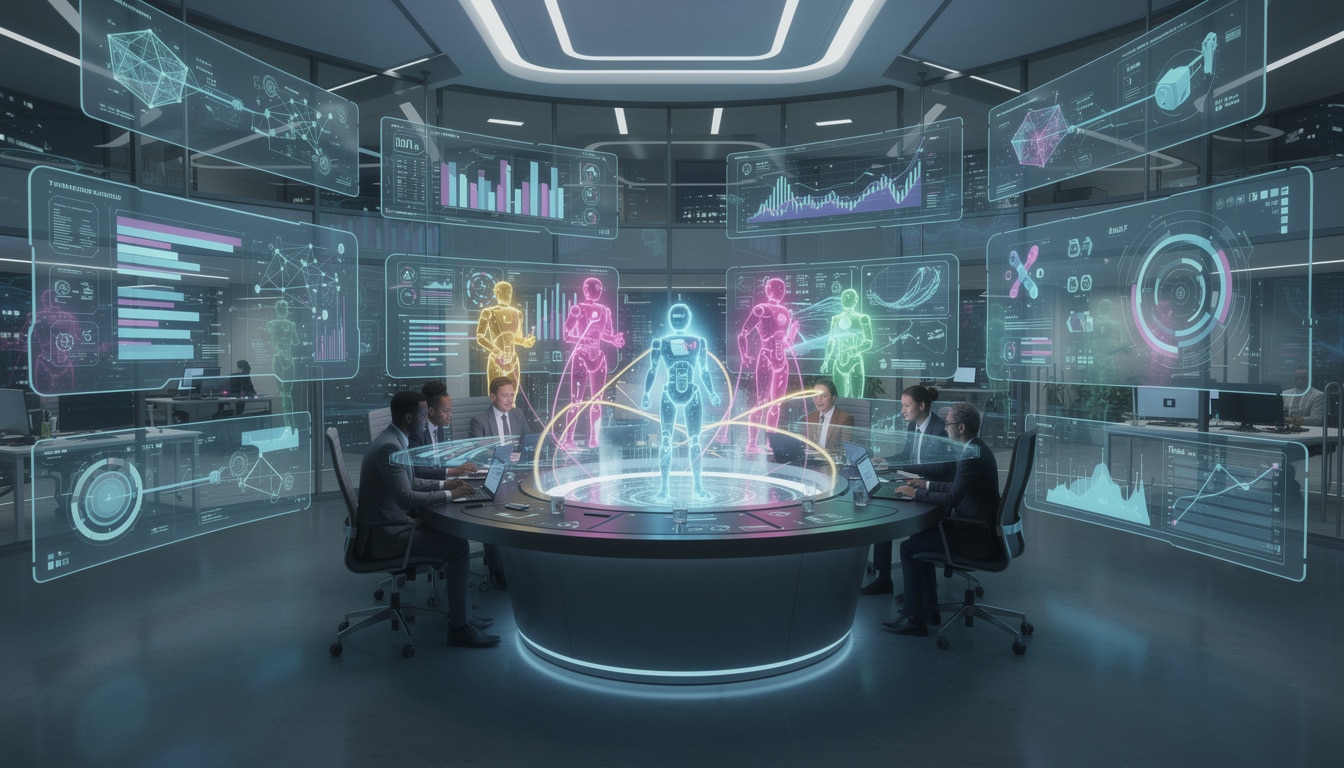
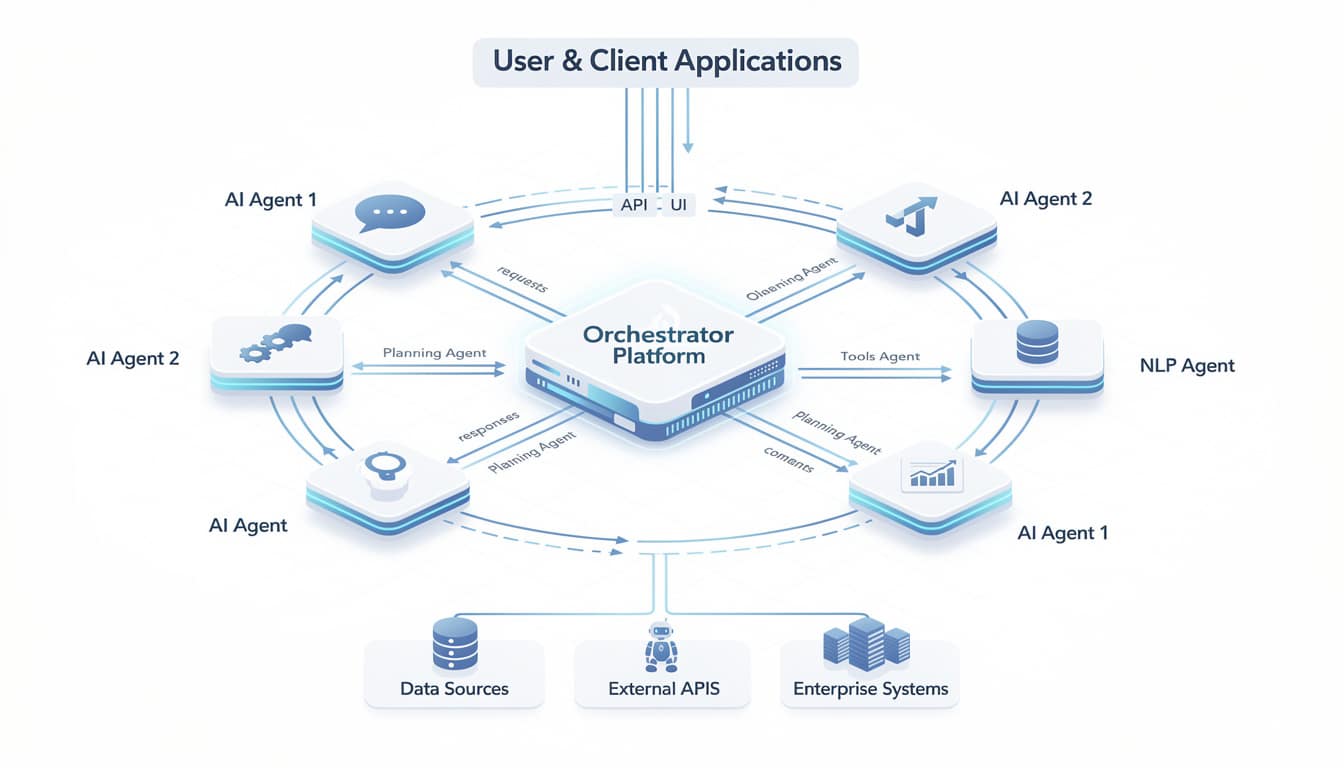
Orchestration becomes critical when multiple agents need to collaborate. Imagine an AI team made up of a research agent, an analysis agent, and a synthesis agent. Without orchestration, these three agents work in silos. With a good orchestrator, they pass context to each other, adapt to one another's responses, and solve complex problems that none of them could handle alone.
⚙️ The Essential Components of a High-Performing AI Agent Orchestrator
To evaluate an orchestrator, you need to understand how it works internally. All good orchestrators share a basic architecture, even if they differ in the details. Here are the non-negotiable elements.
The agent architecture defines the core of the reasoning process. Some orchestrators adopt planning logic (the agent breaks a goal down into steps), others use conversational logic (the agent exchanges messages with other agents). This choice directly impacts the system's flexibility. 🧠 A planning architecture is better suited to strictly sequential workflows, while conversational logic shines in collaborative and adaptive scenarios.
Task management drives workflow execution. It assigns tasks to agents, sequences them, and adapts them as things evolve. Good task management supports conditional branches (“if agent A fails, switch to agent B”), parallelization (“run tasks 1 and 2 simultaneously”), and automatic retries in case of a blockage.
Memory systems let the agent retain context. Without memory, an agent forgets what happened five messages earlier. Three types dominate: short-term memory (context from the current session), vector memory (key facts stored in a vector database), and persistent memory (a database). 📌 The best orchestrators offer a combination of all three for rich, nuanced context.
🔗 Tool Integration: The Bridge Between Agents and Reality
An agent without tools is harmless but useless. Most orchestrators let agents call external tools: HTTP APIs, function calls, SQL queries, cloud service calls. The quality of tool integration defines the agent's real value.
A robust orchestrator includes an extensive library of ready-to-use integrations (CRM, email, databases, cloud services), as well as the flexibility to build custom integrations. Some, like Botpress, offer native connectors for WhatsApp, Slack, and popular CRMs. Others, like LangChain, let developers build their own integrations via plugins.
Monitoring and debugging round out the picture. 🔍 How do you know what an agent is doing at each step? How do you identify why a task failed? Professional orchestrators come with visualization dashboards, detailed logs, and tracing tools. That's the difference between deploying an agent to production blind and having full visibility into its behavior.
💡 The Five Criteria That Should Guide Your Orchestrator Choice
Choosing an orchestrator from among the dozens available can seem overwhelming. Yet a few targeted questions are enough to refine your decision. Here's the framework that experienced practitioners apply.
📈 Scalability and Performance Under Load
An orchestrator can run smoothly with 10 calls a day but collapse at 10,000. Scalability isn't optional in 2026. A customer support prototype that goes from 200 to 20,000 daily visitors needs to absorb the increased load without exponential cost increases.
Some orchestrators are built on a distributed architecture (like AutoGen), while others rely on a single server (some versions of Rasa). Cloud-native orchestrators, especially hosted variants of LangChain and CrewAI, offer automatic elasticity. 🚀 Self-hosted solutions require more planning but offer better cost control at scale.
Orchestrators that excel in this area allow for gradual scaling: start small, then scale horizontally (adding servers) or vertically (increasing resources) without rewriting code.
🎨 Ease of Use and Learning Curve
A powerful but unintelligible orchestrator is useless. Ease of use depends heavily on your team's profile. 🧑💻 An experienced Python developer will prefer LangChain or CrewAI. A business team with no coding skills will prefer a visual interface like Botpress or Flowise.
Low-code and no-code options have become essential. They let business teams iterate quickly, test hypotheses without depending on a developer, and document business logic visually. However, they often involve trade-offs in terms of customization.
The best orchestrators offer a continuum: a visual interface for rapid prototyping, but the ability to drop down into code for advanced customization. This is the hybrid approach that Langflow popularized.
🔐 Security and Regulatory Compliance
As soon as you handle sensitive data (names, emails, payment information, health data), security becomes critical. 🔒 An orchestrator should offer: encryption of data in transit and at rest, GDPR compliance, SOC 2 or HIPAA compliance depending on your industry, granular access rights management, and complete audit trails.
Open source orchestrators hosted on your own infrastructure (Rasa, self-hosted LangChain) offer maximum control over privacy. SaaS versions (like Botpress Pro or CrewAI Cloud) shift this responsibility to the provider. Check their certifications and request access to their security reports.
🧩 Integrations and Extensibility
No agent works in isolation. The orchestrator needs to connect to your existing technology ecosystem: CRM, ERP, databases, business APIs, cloud services. Leading orchestrators like LangChain and AutoGen shine here with their thriving ecosystem of plugins and community integrations.
Ask yourself these questions: Does the framework integrate natively with my databases? Can I easily connect a custom API? Is there an integrations marketplace? Can I develop my own extensions? ✅ If the answers are yes, you have a solid candidate.
💰 Pricing Model and Total Costs
A “free” orchestrator can become extremely expensive at scale if LLM token or infrastructure costs explode. Compare the total cost of ownership (TCO), not just the entry price.
Self-hosted open source orchestrators (LangChain, Rasa, AutoGen) require infrastructure but no licensing fees. SaaS solutions (Botpress, CrewAI Cloud) offer seamless scaling but predictable bills. 💵 Freemium offerings (Langflow, Flowise) are excellent for prototyping, but anticipate the limits: capped number of runs, no support, advanced features behind a paywall.
🏆 The Dominant Orchestrators in 2026: A Detailed Overview
The market has consolidated around a few major players. Here are the orchestrators redefining the industry and why they deserve your attention.
🔗 LangChain: The Universal Orchestrator for Developers
LangChain has revolutionized the approach to agent orchestration. With 106,000+ GitHub stars, it represents the de facto reference for Python developers. Its strength? Extreme modularity. You can swap out any component (LLM, memory, tool) without refactoring your entire application.
LangChain draws its power from LangGraph, a low-level framework for building controllable, stateful agent workflows. 🎯 Unlike high-level abstractions that limit your flexibility, LangGraph lets you explicitly define every step, every transition, every condition. It's like going from a full-stack web framework to assembly programming: more control, but also more responsibility.
Use cases where LangChain excels: sophisticated RAG systems (Retrieval-Augmented Generation), multi-step agents with complex conditional logic, personalized search, and research. Teams building multi-agent LLM workflows quickly discover that LangChain offers unmatched flexibility.
The price? LangChain Core is open source and free. LangSmith (the monitoring and evaluation platform) starts at €39/month per user. LangChain Plus ($) offers team capabilities and higher tracing limits. For enterprise-level deployments, custom pricing applies.
🤖 CrewAI: Simplicity for Multi-Agent Workflows
CrewAI follows a different philosophy: giving each team of agents a clear role and a shared goal. It's the ideal orchestrator for teams rapidly prototyping multi-agent behaviors without getting lost in technical details.
Imagine a workflow: you need a researcher agent, an analyst agent, and a writer agent. CrewAI lets you define them in just a few lines, without manually managing inter-agent communication. 🎪 The agents collaborate automatically, exchange results, and deliver a coherent final output.
Its limitations? CrewAI shines with linear, well-structured workflows. As soon as you need complex conditional branches or dynamic adjustments mid-task, you'll need to switch to a more flexible solution. For simple tasks, it's a huge time saver. For ultra-complex systems, that time-saving advantage flattens out.
Pricing: free version (50 runs/month, 1 team), Basic (€99/month, 100 runs), Standard (€500/month, 1,000 runs), Pro (€2,000/month, unlimited teams).
🏢 AutoGen: The Rigor of an Enterprise Architecture
AutoGen, backed by Microsoft, targets technical teams in enterprise environments. Its strength? A flexible layered architecture and explicit message management that provides complete visibility into agent behavior.
With AutoGen, you script the conversation between agents. A planner exchanges messages with a researcher, who consults an executor, who reports results back to the planner. Every message is traceable, every decision can be explained. 📋 This is ideal for processes with human intervention (human-in-the-loop workflows), for complicated debugging, or for highly regulated workflows where traceability is mandatory.
With 43,000+ GitHub stars and Microsoft's backing, it's a safe choice for large organizations. AutoGen Studio, its graphical interface, even lets non-developers prototype multi-agent workflows without code.
AutoGen's complexity? It requires careful upfront design. You have to explicitly define the roles, capabilities, and transition conditions for each agent, which can slow down initial prototyping.
📊 Semantic Kernel: The Choice for the Microsoft Ecosystem
Semantic Kernel, also from Microsoft, fits into the logic of enterprise .NET and Python applications. Its approach is based on the concept of “skills”: modular units (native functions, LLM prompts, tools) that you compose into semantic plans.
If your organization is heavily invested in the Microsoft ecosystem (Azure, Office 365, Dynamics), Semantic Kernel offers native integration and support guarantees. 🔧 Built-in memory management and goal planning make it a solid choice for complex workflows within an existing application.
Unlike LangChain or CrewAI, Semantic Kernel is aimed less at pure AI developers than at application developers who want to add an AI layer to their existing systems.
🌐 Botpress: The Visual Interface for Non-Developers
Botpress pushes the boundaries of no-code. Its drag-and-drop visual editor lets you build agents connected to tools, with LLM-driven steps, without touching a line of code. 🎨
You build workflows like flowcharts: each node represents an action (LLM call, tool integration, condition). Users can add custom logic in Python if needed, but it's not mandatory. Botpress natively supports integration with WhatsApp, Slack, CRMs, and databases.
AI orchestration software like Botpress transforms team dynamics: business users can prototype independently, and developers only step in for complex logic. It's a massive productivity gain for agile organizations.
Pricing offers a free plan with one bot, a Plus plan at €89/month, and Enterprise options. The platform excels in customer support, onboarding, and long-term persistence.
🔍 How to Evaluate the Best Orchestrator for Your Specific Context
There's no “best” orchestrator in an absolute sense. Each solution excels in a particular context. Here's how to identify the right fit for you.
🎯 Mapping Out Your Use Case
Ask yourself these questions: How many agents will you have? What will your daily query volume be? Are your workflows linear or highly adaptive? Do you need a visual interface, or are your teams 100% developers? 🗺️
A prototype with 2-3 agents handling 100 requests a day doesn't have the same requirements as a critical system processing 100,000 requests a day. A LangChain prototype may suffice. At scale, you'll need a cloud-native solution like AutoGen or Botpress Cloud.
A customer support workflow with complex branching and human interventions? Opt for AutoGen. A well-defined, linear multi-agent workflow? CrewAI shines. An enterprise application requiring deep integration? Semantic Kernel or LangChain.
🧪 Building a PoC (Proof of Concept)
Don't rely on documentation alone. Build a small prototype with your 2-3 finalist candidates. Measure how long it takes you to: deploy a simple agent, add an integration, debug unexpected behavior, scale to 10x more requests. 🧪
An orchestrator that takes 3 days to set up but 2 hours to scale can be better than one that takes 4 hours to get started but 3 days to scale. The TCO (Total Cost of Ownership) includes not just the price, but also the cost of learning and maintenance.
👥 Involving Stakeholders
Developers, product managers, and operations teams don't have the same priorities. 👨💼 A developer prioritizes flexibility and elegant abstractions. A product manager wants to get to market quickly. An ops team is looking for stability and observability.
A collaborative discussion often reveals essential criteria that would otherwise go unnoticed. “Do our agents need to query a legacy SQL Server database?” “Do we need data to never leave our servers?” These requirements can eliminate 80% of candidates right off the bat.
🔗 Evaluating the Ecosystem and Community
An orchestrator without an active community is a risk. GitHub stars, active discussions, community plugins, Stack Overflow questions: these signals indicate a healthy project. 💪
LangChain has thousands of contributors and integrations for nearly every service imaginable. CrewAI‘s community is growing explosively. AutoGen benefits from Microsoft's weight behind it. Younger projects (PydanticAI, Letta) are attracting more and more adventurous developers.
A thriving ecosystem means you'll never get stuck. If you have a problem, someone else has probably already solved it. If you have a custom need, there's a good chance a plugin already exists, or that a community of developers can implement it quickly.
On the other hand, an abandoned orchestrator with zero stars in the past 18 months is a red flag. 🚩 You risk getting stuck with no support and no migration path to an alternative.
⚡ The Trends Shaping Tomorrow's Orchestrators
The field is evolving at a dizzying pace. Today's orchestrators incorporate capabilities that didn't exist 18 months ago. Here's what will shape decisions in 2026 and beyond.
🧠 The Rise of Vector Memory and RAG Systems
Today's agents no longer reason solely on logical rules. They intelligently retrieve external data (RAG: Retrieval-Augmented Generation) to enrich their context. Leading orchestrators natively integrate vector databases like Pinecone, Weaviate, or Chroma.
The implication? A modern orchestrator should offer seamless access to vector databases, support embeddings (converting text into numerical representations), and let agents flexibly mix lexical and semantic queries. 📚 The ideal AI agent orchestration framework manages this complexity without overloading the developer.
🎬 Integrating Web Scraping and Browser Automation
Autonomous agents need to perceive the web in real time. Orchestrators are gradually integrating web scraping tools (Playwright, Selenium) and controlled browsing. This lets agents interact with sites that have no API, fill out forms, and click buttons. 🌐
AutoGen natively supports Playwright for web navigation. Some orchestrators even integrate tools like Crawl4AI for advanced data extraction. This convergence between AI agents and RPA (Robotic Process Automation) is creating a new class of hybrid automations.
🛡️ Security and Compliance as a Central Criterion
As agents handle more sensitive data, security becomes non-negotiable. 🔒 Orchestrators are investing heavily in: end-to-end encryption, strict input validation, isolated execution environments, and compliance audit trails.
Frameworks that require a cloud-native architecture or support zero-knowledge approaches (where user data never leaves their infrastructure) gain a major competitive advantage, particularly in regulated industries (finance, healthcare).
⚙️ The Emergence of “Agentic OS” Orchestrators
Orchestrators are no longer simple frameworks. They're becoming “operating systems for agents”: platforms that manage resource allocation, scaling, supervision, and coordination between agents. 🖥️
Imagine a future where you deploy your agents on an “agentic cluster” that automatically handles load distribution, auto-scaling, and resilience. Projects like Temporal (workflow orchestration) combined with agent orchestrators are creating this layer.
🌍 System Interoperability
No single orchestrator dominates the market entirely. Major organizations use combinations: LangChain for rapid prototyping, AutoGen for critical workflows, Botpress for the customer interface. The orchestrators that will excel are the ones that integrate seamlessly with one another.
Open source AI agent frameworks are increasingly adopting open standards (OpenAPI, inter-agent communication standards) to enable this interoperability. It's a major advantage: you're never locked into a single solution.
Your choice today shouldn't lock you in irrevocably for the next five years. A good orchestrator lets you pivot, expand, and combine it with other tools.
🎯 Making the Right Choice: Recommended Frameworks by Area of Expertise
Navigating the market becomes simpler if you think in terms of use-case domains. Here are recommendations honed by real-world experience.
🤝 For Customer Support and Conversation Management
If you're deploying agents to handle support tickets, dynamic FAQs, or conversational interactions: Botpress or Rasa. Botpress offers an intuitive visual interface and native integrations with Slack, email, and WhatsApp. Rasa excels at multi-language natural language understanding and managing complex contextual dialogues.
For 360° support, combine Botpress (conversational flow management) with a vector database for intelligent documentation search. 💬
📊 For Data Analysis and Report Generation
LangChain with LlamaIndex. LangChain offers the flexibility to orchestrate multiple analysis steps, while LlamaIndex excels at building RAG agents that can intelligently retrieve data from your knowledge base, documents, or APIs.
Example: an agent that receives a query like “What's our revenue by region in Q3?”, queries the sales database, synthesizes the data, and generates a visual report. This is a perfect multi-step workflow for LangChain. 📈
🏭 For Business Process Automation (BPM)
AutoGen or Semantic Kernel. These orchestrators shine in structured, highly controlled, and traceable workflows. They enable inter-agent collaboration, human intervention at key steps, and complete observability.
For a process like “approve a request > extract documents > validate compliance > create a ticket > track through to completion,” these frameworks offer the rigor and traceability required. 🔐
🔬 For Research and Rapid Prototyping
CrewAI or Langflow. These frameworks minimize boilerplate and let you jump straight into experimentation. Langflow adds a visual interface, ideal for data scientists who don't want to write infrastructure code.
You're testing a hypothesis: “Can we build an agent that analyzes news articles and identifies trends?” Thirty minutes with Langflow, and you have a working prototype. 🚀
🌐 For Complex Collaborative Multi-Agent Systems
LangChain with LangGraph. LangGraph gives you low-level control over topology and transitions between agents. You explicitly define how A communicates with B, how C retrieves the results of A and B, and so on.
It's the solution for emergent workflows where agents need to adapt in real time, negotiate, and make collective decisions. 🤝
Author Profile
Latest entries
 Food & Drink21 November 2026Beaujolais Nouveau: A Historically Low Harvest, Yet Sales Keep Climbing
 Finance20 November 2026Consumer Credit: Mini-Loans, Split Payments, and Overdrafts Face Tighter Rules
 Planet15 November 2026CO2 Emissions: Why Transportation Remains France's Climate Blind Spot
 Artificial Intelligence12 November 2026Imagine Enterprise: IBM and Microsoft Team Up on AI Agents for Large Businesses
This article was written with the help of artificial intelligence. Editorial policy