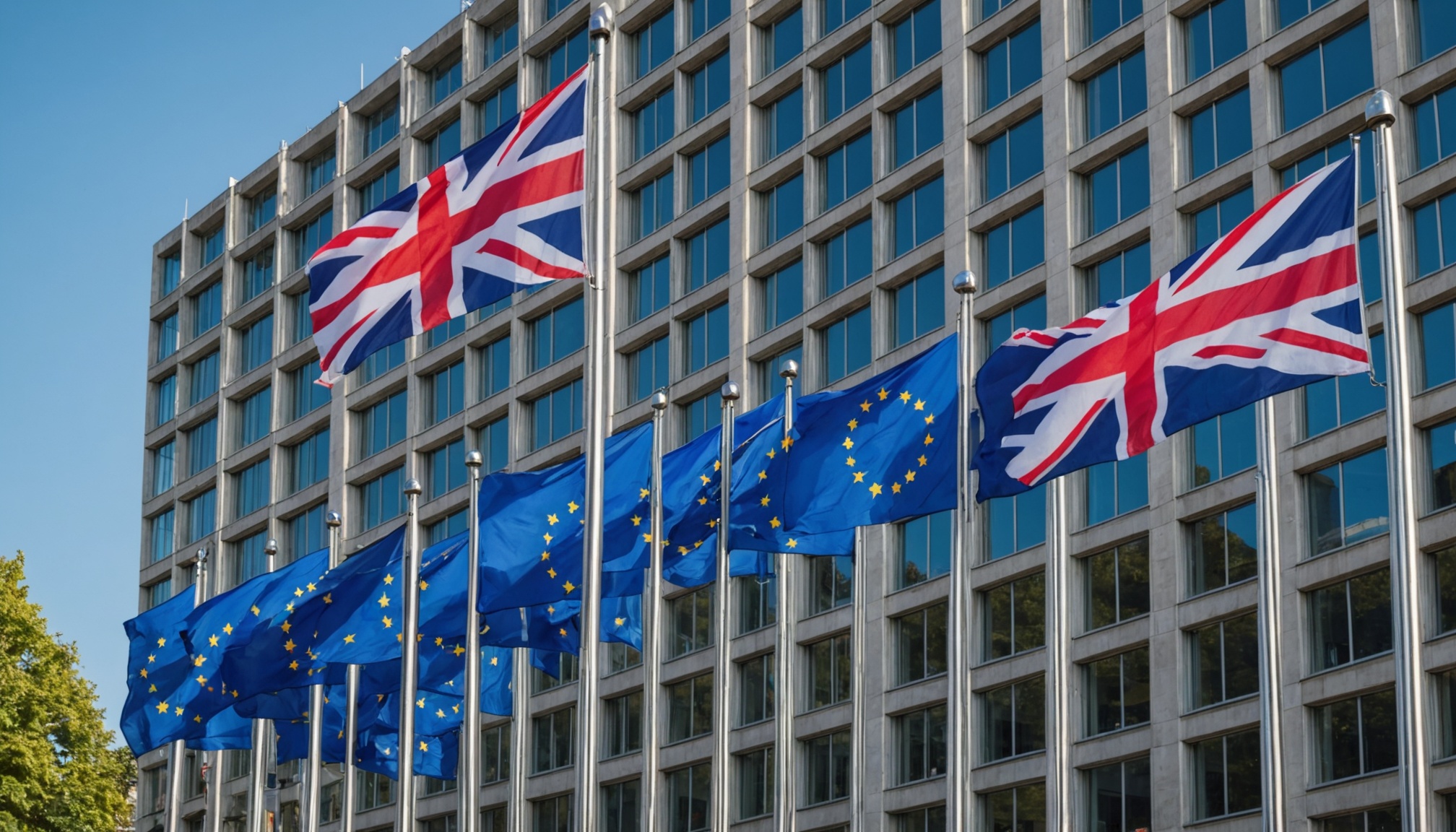
One year after their first post-Brexit summit, the European Union and the United Kingdom signed, on July 22, 2026 in Brussels, a new series of agreements that reshapes their relationship. Meeting around British Prime Minister Keir Starmer and European leaders, negotiators approved a package covering fishing, energy, food products, youth mobility, and, above all, the linking of the European and British carbon markets.
Carbon, the Centerpiece of the Deal
Contents
The most structural point concerns the link between the European Emissions Trading System (ETS) and its British equivalent. In practical terms, carbon allowances issued under either system become mutually recognized: a British or European industrial company can now buy and trade pollution allowances on either market interchangeably. Energy sector analysts are pointing to a narrowing of the price gap between European allowances (EUA) and British allowances (UKA), which should limit competitive distortions between industrial companies on both sides of the English Channel, particularly in steelmaking, chemicals, and electricity production.
What Changes for Young People and Travelers
The summit also laid the groundwork for a future youth mobility program, open to work, study, au pair placements, and volunteering. The precise terms — visa duration, annual quotas — still need to be negotiated, but the principle of a regulated, capped scheme has now been agreed on both sides. Another tangible step forward for the general public: British travelers will once again be able to use eGates at European airports, cutting border wait times, and pet passports are being reinstated, removing the requirement for costly health certificates every time someone travels with a dog or a cat.
Fishing, Food, and Energy Are Also Affected
The negotiated package also includes provisions on shared fishing quotas, a sanitary and phytosanitary (SPS) agreement designed to ease trade in food products and beverages between the UK and the continent, as well as strengthened energy cooperation. For exporting companies, these measures should reduce certain customs checks that emerged after Brexit, an issue closely watched by both British and European agricultural and food industries.
A Relationship Still Being Built
This July 2026 summit marks the second step in a process launched in May 2025. The most sensitive points — the final status of youth mobility, the precise timeline for implementing the carbon link — still need to be finalized in the coming months. It nonetheless illustrates a broader trend: rather than rolling back Brexit, London and Brussels are pragmatically adjusting their cooperation wherever the shared economic interest is clearest, from trade to energy to the everyday lives of consumers.
For exporting companies, these agreements are worth watching closely: their concrete implementation, rolled out over several months, will determine how significant the announced simplifications actually turn out to be.
Frequently Asked Questions
What does the link between the European and British carbon markets actually change?
It allows companies subject to carbon emission allowances to buy and sell their allowances interchangeably on the European (EUA) or British (UKA) market, which should bring the prices of the two systems closer together and reduce competitive distortions between industrial companies.
Is youth mobility between the UK and the EU already in effect?
No, the principle of a regulated program (work, study, internships, volunteering) was agreed at the July 22, 2026 summit, but the precise terms — visa duration and quotas — still need to be negotiated in the coming months.
Are travelers with pets affected by these agreements?
Yes, the reinstatement of pet passports removes the requirement for paid health certificates every time someone crosses the English Channel with a dog or a cat.
Sources
Author Profile
Latest entries
 Food & Drink21 November 2026Beaujolais Nouveau: A Historically Low Harvest, Yet Sales Keep Climbing
 Finance20 November 2026Consumer Credit: Mini-Loans, Split Payments, and Overdrafts Face Tighter Rules
 Planet15 November 2026CO2 Emissions: Why Transportation Remains France's Climate Blind Spot
 Artificial Intelligence12 November 2026Imagine Enterprise: IBM and Microsoft Team Up on AI Agents for Large Businesses
This article was written with the help of artificial intelligence. Editorial policy