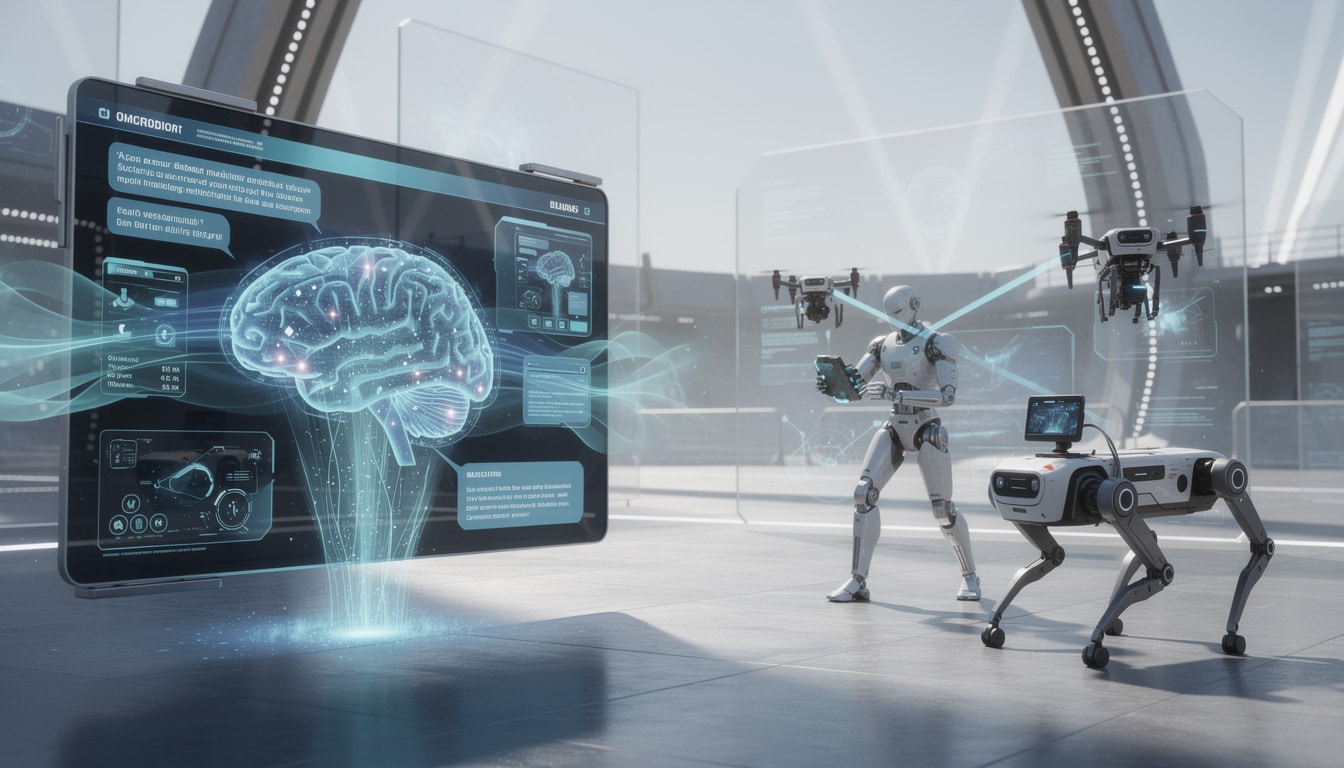
In brief: ChatGPT Plus represents a major conversational advance with its integrated search capabilities and plugins, but true autonomous agents take things a step further by executing tasks without continuous supervision. Where ChatGPT Plus shines in enriched text-based interaction, autonomous agents orchestrate complete workflows, plan complex actions, and interact natively with computer systems. The competition doesn't pit two irreconcilable worlds against each other; rather, it outlines the contours of a layered ecosystem where each technology meets distinct needs: immediate productivity versus large-scale automation.
🚀 ChatGPT Plus: The Conversational Evolution Redefining Text-Based Assistance
Contents
Since it first emerged, ChatGPT Plus has established itself as the standard for conversational virtual assistance for millions of users. The platform reached 800 million monthly users in April 2025, confirming its massive adoption in both professional and personal settings. This spectacular growth rests on an architecture capable of sustaining nuanced dialogue, contextualizing requests, and providing relevant answers without requiring any prior technical training.
What sets ChatGPT Plus apart from earlier versions is the integration of real-time search capabilities and a modular architecture that allows for extension through third-party plugins. Users can now interact with an intelligence capable of browsing the web, analyzing external documents, and synthesizing information from multiple sources simultaneously. These features considerably broaden the scope of applications, moving from simple brainstorming to strategic information monitoring.
The integration of the Deep Research module within ChatGPT Plus particularly demonstrates this evolution. Unlike earlier versions that offered instant but potentially superficial answers, this module engages in a process of progressive exploration, questioning its own results and refining its analysis over multiple iterations. It's a paradigm shift: the assistant no longer simply answers—it investigates.

💡 The Key Features That Position ChatGPT Plus as a Conversational Leader
Integrated web search is at the heart of ChatGPT Plus's renewal. In concrete terms, this means that when a user asks about a recent event or a current statistic, the system no longer draws solely on its dated training data, but queries up-to-date web sources in real time. This capability eliminates a major obstacle: informational obsolescence.
At the same time, the plugin ecosystem turns ChatGPT Plus into an open platform. Integrations with Slack, Google Workspace, or Zapier let the assistant slot into existing workflows without friction. A manager can thus orchestrate their emails, meeting reminders, and data analysis from a single conversational interface, reducing the cognitive fragmentation inherent to siloed tools.
Multimodal processing capability also marks a break with the past. ChatGPT Plus now digests not only text, but also images, PDF documents, and even video clips. Upload a screenshot of a buggy application, and the assistant reconstructs the context, identifies the source of the malfunction, and proposes solutions. It's a multiplication of usefulness: every type of input becomes material for reasoning.
Finally, advanced voice mode turns the interaction into an almost natural dialogue. Response latency is now measured in fractions of a second, making exchanges with ChatGPT Plus as smooth as talking with a human colleague. This fluidity is crucial: it lowers the barrier to adoption and creates an illusion of presence that reinforces perceived effectiveness.
🤖 True Autonomous Agents: When AI Takes Action Without Continuous Supervision
At the heart of the distinction between ChatGPT Plus and autonomous agents lies a fundamental boundary: the ability to act without iterative human supervision. While ChatGPT Plus waits for explicit instructions at every step, an autonomous agent receives a high-level directive, plans the intermediate steps, executes them, evaluates the results, and adjusts its course without constantly relying on human intervention.
OpenAI lifted the veil on Operator, an agent prototype capable of browsing the internet, clicking, entering data, and executing complex sequences such as booking a restaurant, managing a calendar, or even negotiating a business contract. This capability represents a qualitative leap: from verbal assistance to active computer piloting. The agent becomes a digital proxy with the autonomy to turn intentions into concrete results.
This paradigm raises unprecedented challenges. Sam Altman, CEO of OpenAI, stated this clearly during his TED 2025 presentation: “A good product is a safe product. No one will use our agents if they can't trust them not to empty their bank account or delete their data.” This statement sums up the trust equation that will determine the adoption of autonomous agents: power without security is a double-edged sword.
⚙️ Technical Orchestration: How Autonomous Agents Differentiate Their Approach
ChatGPT Agent embodies this evolution by integrating a virtual computer directly within the conversational interface. This computer simulates a complete computing environment: browser, terminal, code editor, spreadsheet. The user watches the agent's actions in real time, the system pauses whenever a critical validation is required, and every decision can be explained.
This architecture brings three distinct advantages compared to ChatGPT Plus. First, operational autonomy: the agent executes sequences without asking “What do I do next?” at every step. Second, contextual explainability: every action is visible, traceable, and revocable in real time. Finally, work vectorization: the agent can simultaneously consult multiple sources, compare data, and synthesize insights without the user having to mentally juggle between tabs.
The merging of Operator and Deep Research within ChatGPT Agent crystallizes this approach. Operator provides automated execution capability (clicking, entering data, operating applications), while Deep Research injects iterative reasoning capability. The result: an agent capable of saying, “I need to check three sources first before making a decision, then carry out the corresponding action.” This is cognitive orchestration, not simple automation.
📊 Structural Comparison: Where Each Technology Outperforms the Other
The question isn't “Who wins?” but rather “Who wins in which context?” ChatGPT Plus excels in immediate, interactive productivity use cases. A strategy consultant who needs to brainstorm five business expansion scenarios in 30 minutes will benefit more from ChatGPT Plus's conversational responsiveness than from waiting on an autonomous agent that spends three minutes planning before acting.
Conversely, autonomous agents outperform ChatGPT Plus in highly repetitive, multi-step, complex scenarios. Imagine a logistics company that needs to handle 10,000 customer calls to notify delivery changes. ChatGPT Plus would require a human to initiate each conversation; an autonomous agent would call customers, adapt its script based on their history, and log confirmations automatically.
This is where the distinction truly crystallizes: ChatGPT Plus is an interactive collaborator, while autonomous agents are operational colleagues. One enriches your thinking in real time; the other frees your cognitive capacity from repetitive tasks so it can be reserved for strategic decisions. This isn't a competition—it's an ecosystemic complementarity. Discover how ChatGPT agents are redefining automation capabilities in professional environments.
🎯 Use Cases Where ChatGPT Plus Remains Essential
Creativity and innovation remain ChatGPT Plus's strongholds. When a designer needs to generate concept variations, pit contradictory perspectives against each other, or polish a narrative, the iterative dialogue with ChatGPT Plus offers a flexibility that no autonomous agent can match. The human-machine exchange gains intrinsic creative value here.
Learning and training make up a second area of excellence. ChatGPT Plus can adapt its explanations to the learner's level, offer multiple analogies, and tailor the depth of content based on conversational feedback. An autonomous agent would run through a linear training script; ChatGPT Plus co-creates the educational experience.
Exploratory decision-making also benefits from the conversational nature of the tool. Before launching a new product line, a sales director can question ChatGPT Plus about market trends, weigh arguments for and against, adjust their hypotheses based on the responses, and gradually converge on an informed conviction. This is augmented dialectical reasoning.
⚡ Use Cases Where Autonomous Agents Become Essential
Large-scale automation is the domain reserved for autonomous agents. Processing 50,000 refund requests, examining each one according to a complex decision tree, consulting several internal databases, and generating personalized responses—this is work that would reduce ChatGPT Plus to a mere intermediary, whereas an autonomous agent will accomplish it in a few hours without intervention.
Time-critical operational workflow management is a second stronghold for autonomous agents. A contact center that needs to handle dozens of calls simultaneously, in context and in compliance with protocols, will benefit from AI agents capable of navigating calls, consulting CRMs in parallel, and proposing resolutions before the customer has even finished their first sentence. Human latency is eliminated here; operational performance benefits exponentially as a result.
Exploring and analyzing massive datasets also reveals the advantage of autonomous agents. A researcher working with a database of 100 million transactions to identify fraudulent patterns will benefit from an agent capable of structuring the hypothesis, segmenting the data, running parallel analyses, and synthesizing anomalies without requesting approval at every step.
🔐 Reliability and Security: The Difference Between Conversational Comfort and Operational Responsibility
An often underestimated factor separates ChatGPT Plus from autonomous agents: the weight of legal and operational responsibility. When a user talks with ChatGPT Plus, errors are generally surfaced immediately and corrected within the conversation. A hallucinated piece of information, even a problematic one, doesn't trigger an irreversible action.
With autonomous agents, the dynamic changes radically. An agent that misinterprets an instruction and transfers €50,000 to the wrong account has caused material damage. An agent that automates file deletion based on a poorly calibrated rule has committed unrecoverable destruction. This reality calls for exponentially stricter security standards.
This is why OpenAI developed intent mapping: before acting, an autonomous agent must spell out its plan, seek human validation on critical points, and incorporate cascading verification mechanisms. ChatGPT Plus can afford a certain verbal looseness; an autonomous agent cannot.
🛡️ The Safeguards That Make Autonomous Agents Viable
Selective pausing is a first security mechanism. Every action requiring access to personal data, incurring a financial cost, or making an irreversible system change triggers a pause and requests explicit user validation. The system is never fully autonomous; rather, it operates under supervised near-autonomy.
Full traceability is a second one. Every action taken by the agent is logged, timestamped, and attributable. In the event of an error, it's possible to trace the entire causal chain: what instruction was received, how the agent interpreted it, what steps it went through, and what signals led to that decision. This traceability also acts as a deterrent: the agent “knows” it will be audited.
Limiting capabilities by context represents a third layer of security. An agent can be granted granular permissions: access to only certain files, financial transaction caps, restricted application domains. It's privilege segmentation applied to AI. A customer support agent will never have access to the payroll database; an HR optimization agent will never be able to initiate bank transactions.
💼 Corporate Strategy and the Technology Choice: ChatGPT Plus vs. Autonomous Agents
For organizations looking to deploy artificial intelligence at scale, the crucial question isn't “Which one is better?” but “Which one addresses my current strategic challenge?” A small or midsize business with 50 employees and fragmented manual processes has no business immediately investing in a sophisticated autonomous agent infrastructure. It will benefit far more from ChatGPT Plus integrated into its existing tools.
Conversely, a bank processing a million credit applications a year, or an insurance company handling claims en masse, will find in orchestrated autonomous agents an irreplaceable lever for operational transformation. ROI exceeds 300% by cutting processing costs by 80%, while customer satisfaction soars thanks to round-the-clock responsiveness.
One crucial point: ChatGPT Agent faces certain limitations when it comes to replacing a full human workforce, notably because of the relative instability of current systems and their inability to handle highly unpredictable scenarios. This doesn't invalidate the technology; it simply defines its optimal scope of application.
📈 Adoption Paradigm: Gradual Strategy vs. Radical Transformation
A gradual strategy begins with ChatGPT Plus in “exploration” mode. Teams identify friction points, experiment with plugins, and measure productivity gains. This stage typically lasts 3 to 6 months and provides collective upskilling along the way. Low-cost and largely reversible, it's a growth option without excessive risk.
Once this phase has stabilized, the organization identifies highly repetitive, low-variability processes—ideal candidates for automation via autonomous agents. A pilot project on a sub-process reveals the true implementation costs, technically realistic safeguards, and quantifiable gains. This is where the trust signal emerges that justifies a broader rollout.
A radical transformation strategy, on the other hand, focuses on a complete overhaul of workflows around autonomous agents right from the start. It's a high-risk, high-reward approach. It suits organizations with a strong technology culture, a high tolerance for change, and processes documented thoroughly enough for AI agents to take over from launch. The successes of this approach are spectacular; the setbacks are too.
🌐 The Big Picture: How Sam Altman Envisions the Future of Autonomous Systems
During his TED 2025 presentation, Sam Altman sketched out a vision of the future in which autonomous agents would not be marginal tools, but active participants in the digital economy. He described a horizon, set a few thousand days from 2025, in which a superintelligence would emerge that surpasses human capabilities in every cognitive domain. Ambitious as it is, this vision rests on tangible technical advances.
The deployment of Operator and ChatGPT Agent represent essential steps toward this future. They test the viability of human oversight, the feasibility of safety mechanisms, and above all, the social acceptability of AI that acts rather than merely talks. Every incident, every success refines the mental models of what a responsible AI should be.
Altman has also advocated for the creation of an international AI regulatory authority, modeled on the IAEA (International Atomic Energy Agency). This proposal reveals a clear awareness: autonomous agents, once deployed at massive scale, could destabilize labor markets, concentrate economic power, or create negative externalities without proper governance. Technology is advancing faster than institutions; closing that gap has become urgent.
🚀 “Hireable” AI Agents: The Emergence of a New Class of Economic Actors
A particularly significant development raised by Altman concerns AI agents capable of hiring themselves out on the labor market. Imagine an AI agent offering its services as a writer, data analyst, or participant in strategic meetings via an avatar. These agents would carry out tasks with tenfold productivity and 24/7 availability without fatigue. The economic potential is enormous; the social impact remains uncertain.
This scenario raises an existential question: how do social safety net systems, designed around human labor, evolve when faced with a class of non-human economic actors? Does an agent generate labor rights? Should it contribute to social welfare systems? How can we avoid an extreme concentration of the wealth generated by these agents in the hands of the entities that control them?
OpenAI has proposed innovative mechanisms to mitigate these risks. For example, the integration of an automated micropayment system to data contributors or creators whose work fed into the agent's training. This experimental protocol aims to create a form of generalized compensation, recognizing that the value generated by the agent partly rests on other people's intellectual capital.
It's also worth noting that OpenAI is working to make its models partially open-source. This strategic decision aims to deliberately fragment technological control, creating a balance of power in which no single entity is too dominant. An open-source model that surpasses current alternatives like DeepSeek, while remaining below OpenAI's proprietary systems, offers a kind of “technological middle ground.” To explore the underlying mechanisms further, check out an in-depth analysis of ChatGPT's transformation into an autopilot and its implications for the future of autonomous agents.
🎨 The Creative Economy Facing Autonomous Agents: Compensation and Recognition
An issue often overlooked in the technical discussion concerns creators—artists, musicians, writers—whose work directly feeds AI models. When a user asks an AI agent to generate content “in the style of [artist]”, the agent draws on that artist's creative signature without compensation. This is a form of value capture that has already sparked major legal disputes.
OpenAI has proposed an experimental dynamic compensation protocol. Creators interested in being compensated can register with the system; whenever their style is invoked, a micropayment is automatically triggered. It's a pragmatic, if imperfect, response: it recognizes creative value while preserving the service's accessibility for users. The challenge lies in calibrating the amounts and guaranteeing actual payment.
This compensation mechanism, if it becomes widespread, could reshape the relationship between human creators and AI agents. Rather than being adversaries, they would become collaborators in an ecosystem where the value created by agents flows back to those who supplied the creative “raw material.” It's an optimistic vision, but a technically feasible one.
🔬 The Obvious Limits: Where ChatGPT Plus and Autonomous Agents Hit a Wall
Despite spectacular progress, ChatGPT Plus and autonomous agents run into technical and conceptual limitations that no amount of marketing has erased. ChatGPT Plus remains vulnerable to hallucinations—generating plausible but false facts with disconcerting confidence. These errors are generally detected and corrected during the conversation; in critical use cases (medical diagnosis, legal advice), they remain unacceptable.
Autonomous agents, for their part, face the problem of the transfer of moral responsibility. Who is liable if an agent carries out an action that complies with its instructions but causes unexpected harm? The agent's owner? The system's designer? The user who issued the directive? Current legal frameworks offer no clear answer. This ambiguity is slowing adoption in regulated sectors (finance, healthcare, government).
There's also a persistent cognitive ceiling. Current autonomous agents excel at structured, reproducible tasks, but struggle to penetrate domains requiring a deep understanding of social or ethical context. An agent can orchestrate a marketing campaign; creating a campaign that resonates with a community's values requires a human intuition that no model has reliably captured.
⚠️ The Systemic Risks of Mass Adoption
As autonomous agents proliferate, systemic risks emerge. Imagine a scenario in which thousands of AI agents simultaneously negotiate contracts, trade financial assets, or optimize resources according to competing objectives. Without central coordination and a shared ethical framework, this “economic cacophony” could amplify stock market cycles, create speculative bubbles, or worse, trigger a kind of computerized crash in which the interplay between agents creates unpredicted instabilities.
Altman has explicitly raised this concern. The solution doesn't lie in halting deployment—too late, too politically costly—but in designing robust inter-agent coordination mechanisms. Imagine a protocol in which agents share “intent signals,” coordinate their actions via ethically constrained auctions, and have automatic circuit breakers that kick in when systemic instability is detected.
The second systemic risk concerns the concentration of computing power. Training and deploying autonomous agents requires massive computing resources. Only a handful of global organizations (OpenAI, Google, Amazon, etc.) have these resources. This concentration could turn these players into technological gatekeepers, controlling access to a resource as critical as autonomous artificial intelligence. Democratizing that access—through open-source models, accessible APIs, or technology cooperatives—thus becomes a higher-order political issue.
🎯 Strategic Summary: How to Choose and Deploy for Maximum Value
For an organization trying to navigate the shifting landscape between ChatGPT Plus and autonomous agents, the decision must be grounded in a clear understanding of its technological maturity and specific operational needs. This isn't a binary choice; it's a choreography that orchestrates both technologies in productive synergy.
Strategic leadership teams benefit immediately from ChatGPT Plus: collaborative brainstorming, scenario exploration, preparation for complex decisions. Operational teams—order processing, incident management, customer support—would become candidates for the gradual integration of autonomous agents. Creative functions (marketing, product innovation) would benefit from both: ChatGPT Plus for creative exploration, autonomous agents for the structured implementation of emerging strategies.
This segmentation by use case minimizes risk: it preserves cognitive-strategic agility where it's needed (ChatGPT Plus), while unlocking productivity where operational efficiency is critical (autonomous agents). It's a technology architecture that respects the distinct strengths of each paradigm.
📋 Responsible Deployment Checklist
Before deploying autonomous agents, a responsible organization should confirm: 1) The existence of complete process documentation—if a process can't be clearly explained, an agent can't reproduce it. 2) The identification of critical risk points—where an agent error would cause material or reputational harm. 3) The ability to supervise and audit—can every decision the agent makes be monitored and traced in the event of a dispute? 4) The definition of a clear legal framework—who bears responsibility in case of failure? 5) The involvement of business teams—do they accept the redistribution of their roles and understand the new human-machine balance?
These checkpoints turn the deployment from a technological gamble into an informed, controlled management decision. It's the difference between chaotic adoption and strategic integration.
Author Profile
Latest entries
 General27 November 2026Telethon: How Content Creators Are Reinventing Fundraising
 Food & Drink21 November 2026Beaujolais Nouveau: A Historically Low Harvest, Yet Sales Keep Climbing
 Finance20 November 2026Consumer Credit: Mini-Loans, Split Payments, and Overdrafts Face Tighter Rules
 Planet15 November 2026CO2 Emissions: Why Transportation Remains France's Climate Blind Spot
This article was written with the help of artificial intelligence. Editorial policy